
Speaking a Woman’s Spring Lament
Tang dynasty・Liu Fangping

Tang dynasty・Liu Fangping
In the morning sun, the last orioles join my weeping; I lift the curtain and see only grass growing thick.
At times the east wind enters the courtyard; all thousand willow strands bend west.
The animation remains in its original Chinese.
The animation is ready.

The morning sun rises, and the lingering oriole calls of late spring seem to weep with me. Lifting the curtain, I see only lush green grass. The east wind blows into the courtyard from time to time, sweeping a thousand willow strands westward.
代: speaking on behalf of a character. 残莺: orioles in late spring, also suggesting that spring is nearing its end. 妾: a woman’s self-reference, spoken in the voice of the poem’s character.
萋萋: lush vegetation. 东风: the spring wind blowing from the east. “尽向西” (“all toward the west”) describes the willow branches following the wind’s direction, while leaving room to imagine longing for someone far away.
The poem does not explicitly state where the distant person is; there is no need to insist that “西” (west) means a particular city.
Introduction: Liu Fangping writes of spring sorrow in the voice of a woman in her private chamber. The poem offers only orioles’ calls, the opening of a curtain, and wind stirring the willows; the person she is parted from and the reason for their separation remain unstated. Her sorrow emerges chiefly through the scenery and her responses.
The first line pairs birdsong with weeping, while “只见” (“see only”) in the second shows that opening the curtain has not revealed the hoped-for person. The more luxuriant the vegetation before the eyes, the emptier the person feels.
In the final line, all the willow strands stream westward, an accurate image of wind that also seems to give direction to feelings with nowhere to settle. The poem adds no further account of human emotion, allowing the scenery to carry its lingering feeling away.
Let words find a melody
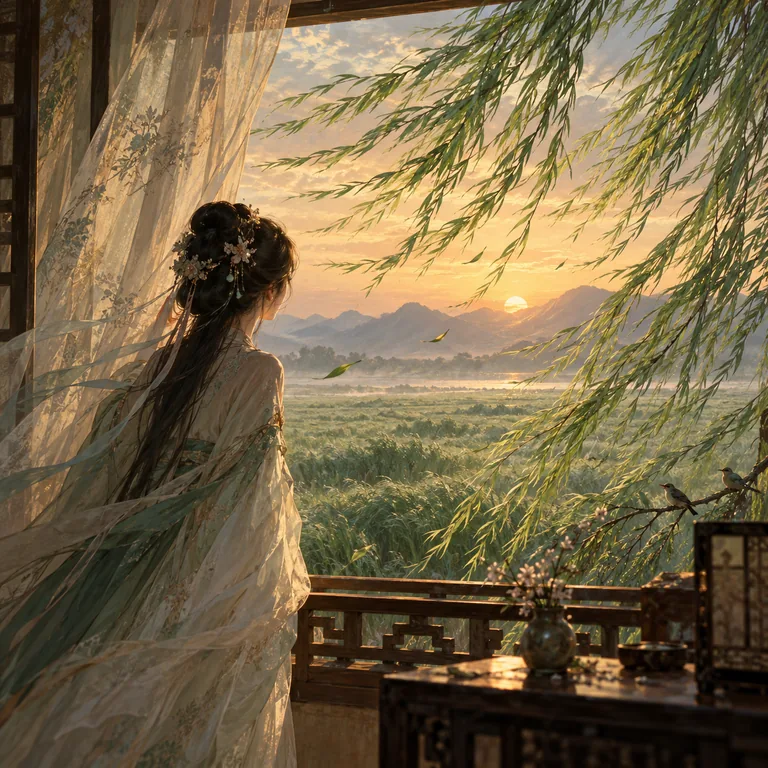

From a poem into a story
Cheng Xiang returns with twenty taels of silver, hoping to buy back their old house in the south of the city and give his wife a secure home. Xu Heng first tells him to move his luggage: beneath it lie the willow saplings she has grown into a livelihood during five years without word from him. Her husband thinks a few branches can simply be sold off, but she has a contract to deliver three hundred saplings. Before they have even agreed where to live, the spring floods arrive early.
Start readingAI-assisted writing · Fictional characters and events
