
Immortal at the Magpie Bridge
Song dynasty・Qin Guan

Song dynasty・Qin Guan
Fine clouds weave their skill, flying stars carry longing, across the distant Silver River they pass unseen. One meeting in golden wind and jade dew surpasses countless meetings in the mortal world.
Tenderness like water, a cherished meeting like a dream—how can they bear to look back along the Magpie Bridge? If two hearts love enduringly, must they be together every morning and every night?
The animation remains in its original Chinese.
The animation is ready.
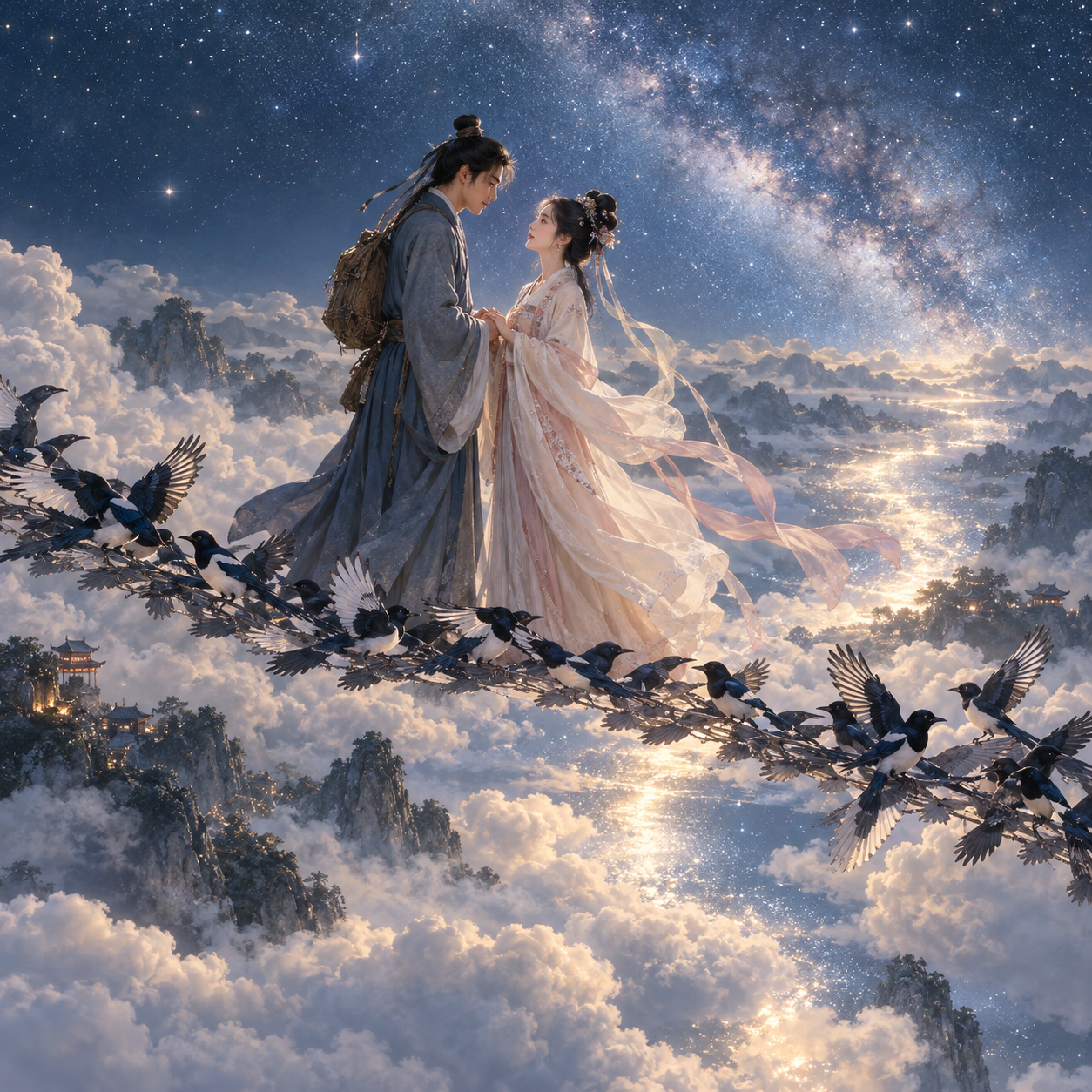
Thin clouds shift endlessly across the sky; shooting stars convey the sorrow of longing, and tonight I quietly cross the boundless, distant Milky Way. This meeting on the Seventh Night, amid autumn wind and white dew, surpasses those earthly couples who stay together but are united only in appearance, their hearts far apart.
They share their longing, their tenderness flowing like water; their brief reunion is as fleeting as a dream. At parting, they cannot bear to look at the road across the Magpie Bridge. If their love remains faithful unto death, why crave the sweet intimacies of every morning and evening?
纤云: light, delicate clouds.
弄巧: the clouds transform in the sky into all manner of intricate patterns.
飞星: shooting stars. Another interpretation identifies them as the stars of the Cowherd and the Weaver Girl.
银汉: the Milky Way.
迢迢: far away or distant.
暗度: to cross quietly or unnoticed.
金风玉露: autumn wind and white dew. Li Yishan’s “Double Seventh in the Xinwei Year”: “恐是仙家好别离,故教迢递作佳期。由来碧落银河畔,可要金风玉露时。” (“Perhaps the immortals cherish parting, and so appoint their tryst far apart. There beside the Milky Way in the blue heavens, must they await autumn wind and shining dew?”)
忍顾: how could one bear to look back.
朝朝暮暮: Being together morning and evening. The expression comes from Song Yu's “高唐赋” (Rhapsody on Gaotang).
This lyric is a hymn to love. Its first stanza describes the reunion of the Cowherd and Weaver Girl, and its second their parting. Grief and joy intertwine throughout, blending lyric feeling with reflection and uniting heaven with the human world. Beautiful imagery and profound emotion combine in a rising and falling celebration of love. Its reflections unfold freely and fluently, remaining accessible while also graceful, restrained, and rich in lingering resonance. The final two lines, in particular, lift its vision to an entirely new height.
Using the story of the Cowherd and Weaver Girl to express mortal joys, sorrows, partings, and reunions through a realm beyond humanity has a long history. Examples include Far, Far Away, the Cowherd Star from the Nineteen Old Poems, Cao Pi's Song of Yan, and Li Yishan's Seventh Night in the Xinwei Year. Song writers including Ouyang Wenzhong, Zhang Ziye, Liu Qiqing, and Su Dongpo also treated this subject. Though their phrasing differed, all followed the traditional theme “欢娱苦短” (joy is painfully brief), with plaintive, sorrowful tones. By comparison, this lyric by Qin Guan can be called strikingly original and lofty in conception.
This is a seasonal lyric celebrating the Qixi Festival. Its opening establishes the festival's distinctive emotional atmosphere, while “巧” (“skill”) and “恨” (“sorrow”) identify both the human custom of praying for needlework skills and the tragic character of the Cowherd and Weaver Girl story, with accomplished, poignant beauty. Through their joys, sorrows, reunions, and partings, it celebrates steadfast and sincere love. The closing lines, “两情若是久长时,又岂在朝朝暮暮” (“If love between two people endures, why must they be together every morning and evening?”), offer its most elevated vision. They describe the particular nature of the celestial lovers' relationship while expressing the author's own view of love, becoming a highly condensed and memorable saying. The lyric thus possesses aesthetic value and artistic distinction across eras and national boundaries. It blends scenery, emotion, and reflection, recounting the myth of the two stars, the Cowherd and Weaver Girl, and giving these immortal lovers a rich humanity. It celebrates love that is sincere, delicate, pure, and steadfast. Openly it describes two stars in heaven; implicitly it portrays lovers on earth. Its emotional expression uses joyful scenes to convey grief and sorrowful scenes to convey joy, intensifying both and leaving the reader profoundly moved.
The lyric begins with “纤云弄巧” (“Delicate clouds display their skill”): soft clouds of many forms create beautiful, intricate patterns, showing the Weaver Girl's incomparable craftsmanship. Yet this lovely being cannot share a happy life with the one she loves. “飞星传恨” (“Flying stars convey sorrow”) makes the glittering stars seem to carry the lovers' grief at separation as they race across the sky.
Of the Milky Way, the Nineteen Old Poems says: 「河汉清且浅,相去复几许?盈盈一水间,脉脉不得语。」 (The River of Heaven is clear and shallow; how far apart can they be? A gleaming stretch of water lies between them; gazing tenderly, they cannot speak.) With 「盈盈一水间」 (a gleaming stretch of water between them), they seem so close that even the other's expression and manner of speaking appear vividly before the eyes. Here, however, Qin Guan writes: 「银汉迢迢暗度」 (Secretly they cross the far-stretching Milky Way), using 「迢迢」 (far-stretching) to describe its vastness and the great distance between the Cowherd and the Weaver Girl. This change deepens the emotion and emphasizes the pain of longing. The far-reaching waters of the Milky Way divide two lovers: how difficult it is for them to meet! 「暗度」 (crossing secretly in the dark) both identifies the occasion of 「七夕」 (the Seventh Night) and closely echoes 「恨」 (sorrow): they travel alone through the night, coming from far away to meet.
The poet then broadens his treatment, exclaiming in an emotionally charged reflection: 「金风玉露一相逢,便胜却人间无数!」—“One meeting amid autumn winds and jade-like dew surpasses countless meetings in the mortal world!” A long-separated pair of lovers reunites beside the Milky Way beneath the heavens on such a night, and this beautiful moment equals thousands upon thousands of earthly meetings. The poet passionately celebrates an ideal love that is sacred and eternal. 「金风玉露」, “autumn winds and jade-like dew,” adapts a line from Li Shangyin’s “Seventh Night in the Xinwei Year” to describe the season and scenery of the lovers’ meeting on the Seventh Night. It also carries a deeper meaning: against this pure, pristine setting, their precious reunion reveals a love noble, untainted, and beyond the ordinary world.
“柔情似水” (“tenderness like water”): the affection shared by the reunited lovers is as gentle and lingering as a quiet, flowing stream. In “柔情似水,” “似水” (“like water”) echoes “银汉迢迢” (“the distant River of Stars”), creating a wholly natural metaphor from the scene. Their one night of reunion vanishes suddenly like a dream; scarcely have they met when they must part again—how could this fail to break the heart! “佳期如梦” (“the happy meeting is like a dream”) conveys both the brevity of their time together and the complex feelings of lovers reunited. “忍顾鹊桥归路” (“how can they bear to look at the return road across the Magpie Bridge?”) turns to their separation: the bridge that just enabled their meeting becomes, in an instant, the road that takes them away from each other. Rather than saying they cannot bear to leave, the poet asks how they can bear to look at that homeward road. This indirect phrasing holds boundless reluctance to part and endless bitter tears. Looking back on their secret meeting, they wonder whether it was real or unreal, dream or illusion; by the time they bid farewell at the Magpie Bridge, their attachment has reached its utmost intensity. Here the lyric suddenly pivots as if in midair and bursts into a ringing declaration: “两情若是久长时,又岂在朝朝暮暮!” (“If love between two hearts endures, why must they be together every morning and evening!”) These two lines by Shaoyou reveal the true essence of love: it must withstand the test of prolonged separation. So long as two people sincerely love each other, even living far apart all year is far more precious than the commonplace pleasures of constant companionship. This emotionally charged reflection has become an enduring masterpiece among songs in praise of love. It echoes the reflection in the first stanza, giving both stanzas the same structure, with narrative and commentary alternating to form a continuous rise and fall of feeling. This sound understanding of love and this noble spiritual outlook far surpass similar works from antiquity and are exceptionally precious.
The reflections in this lyric flow freely and naturally, remaining accessible while also subtle and restrained, with an enduring resonance. The author combines incisive commentary and prose-like syntax with beautiful imagery and profound feeling, celebrating the beauty of human love through shifting emotional movements and achieving a remarkable artistic effect.
Let words find a melody
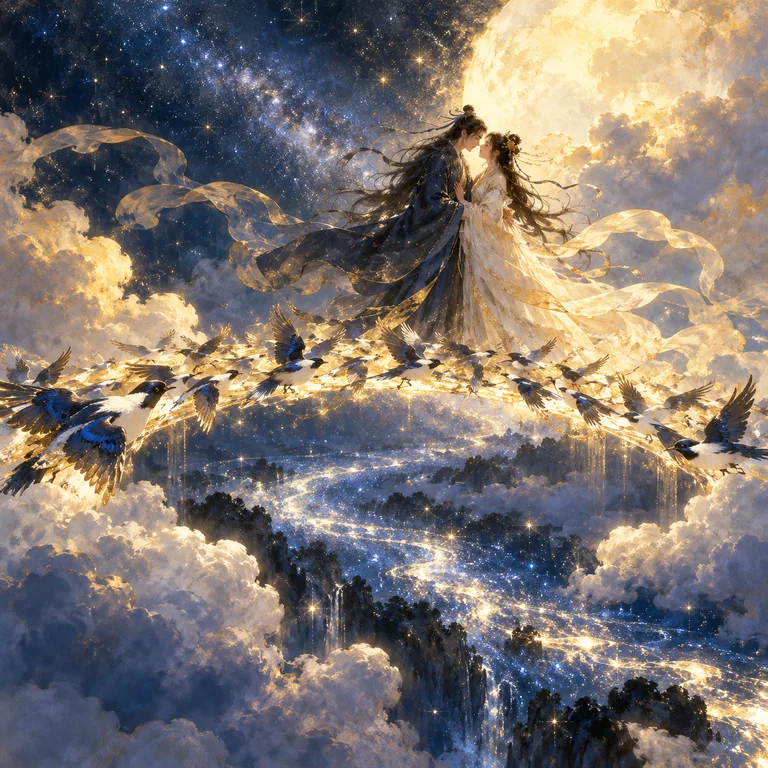
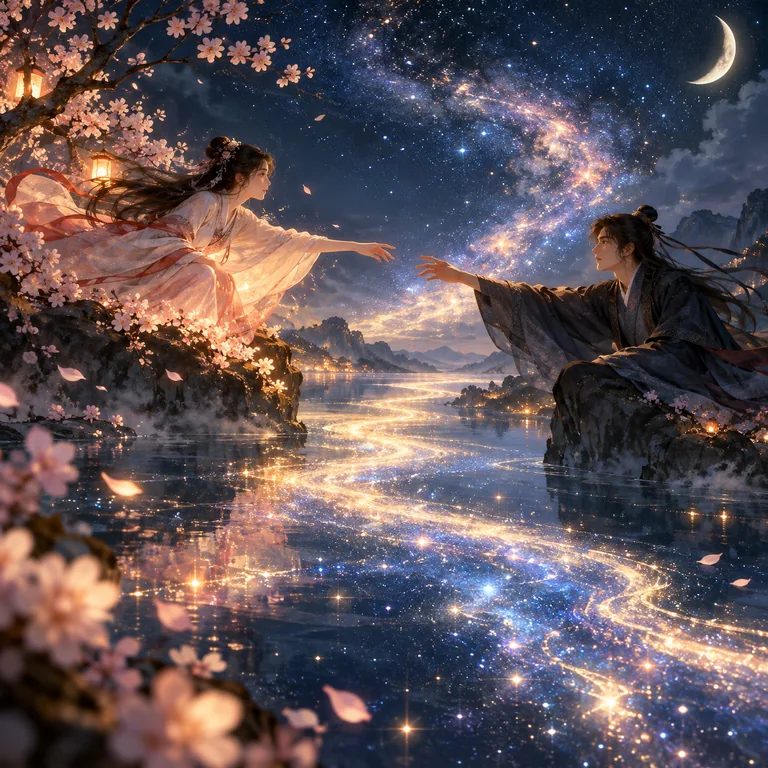
From a poem into a story
A-Xiang and Lin Yue each keep watch on opposite banks of the River of Dreams. Only on the Qixi Festival can they weave a bridge from the dream threads they have gathered over the year and meet for a single night; after waking, they remember nothing of each other. As their tenth meeting approaches, a wet shoe flecked with wheat chaff lands on the unfinished bridge, bearing, impossibly, the weight of the mortal world. Across the river, the red lantern still urges her to come, yet the final three passes of the shuttle in A-Xiang’s hand remain unmade.
Start readingAI-assisted writing · Fictional characters and events
