
Viewing the Vast Sea
Western and Eastern Han・Cao Cao

Western and Eastern Han・Cao Cao
Eastward I climb Jieshi,to gaze upon the vast sea。
水何澹澹,山岛竦峙。— How vast and rippling the waters; mountainous islands tower high.
Trees grow in dense clusters; a hundred grasses flourish.
The autumn wind sighs and rustles,great waves surge up。
The sun and moon in their courses seem to rise from within it.
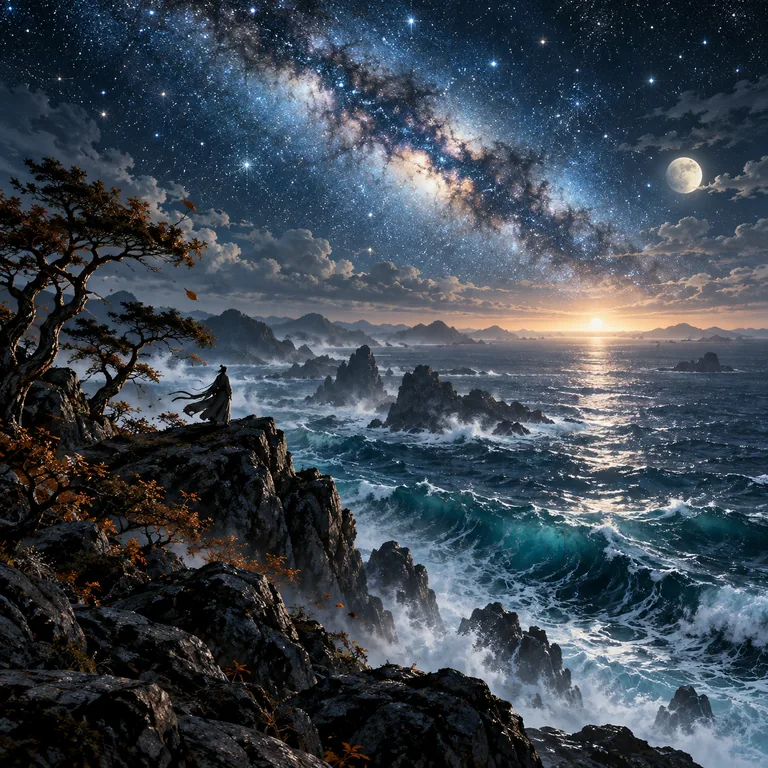
The Milky Way glitters, as though emerging from within it.
What supreme good fortune! I sing to give voice to my aspirations.
The animation remains in its original Chinese.
The animation is ready.
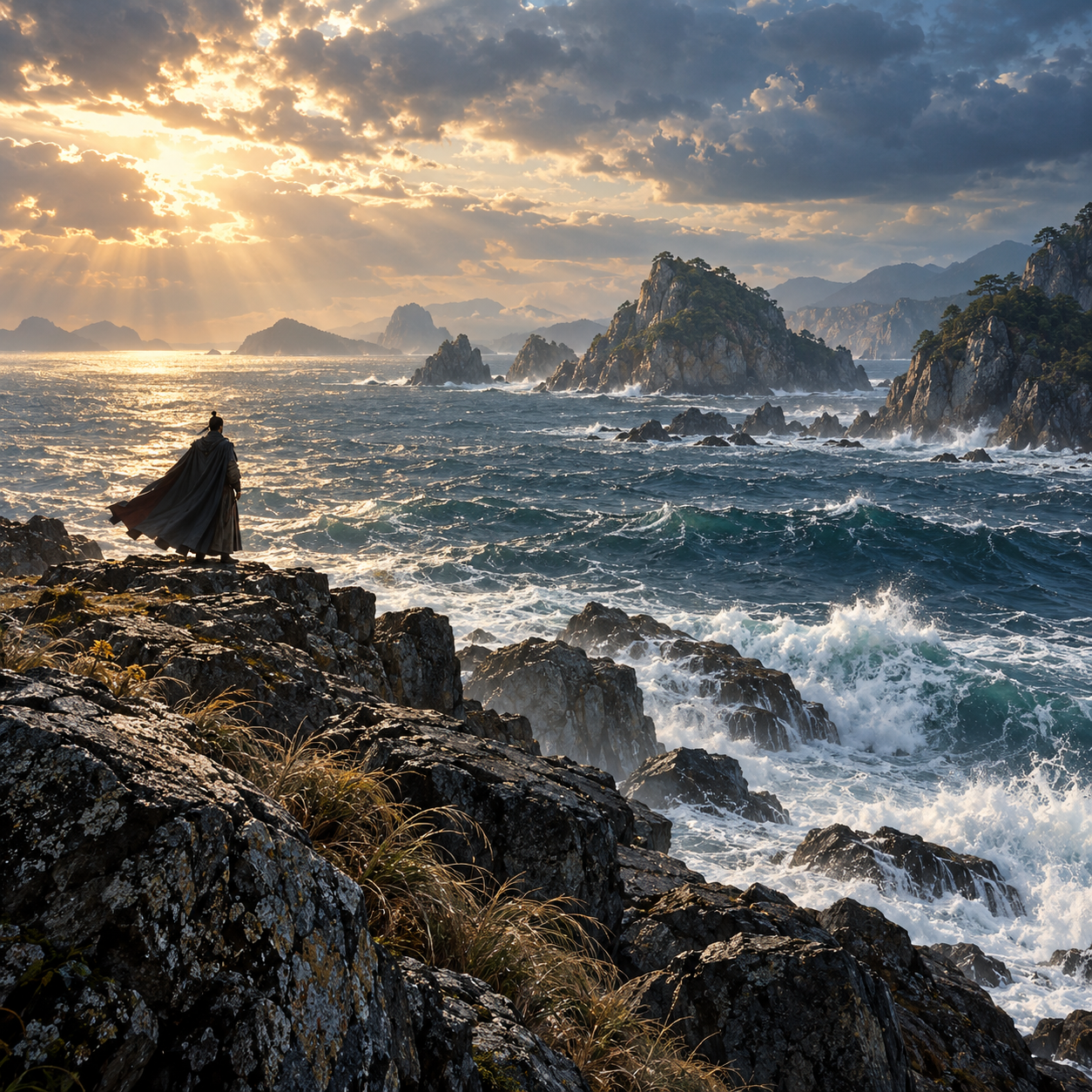
I climb Jieshi to the east to gaze upon the vast sea. How boundless its waters, how lofty its mountainous islands; trees cluster thickly, grasses and plants flourish. The autumn wind blows with a desolate rustling, and immense waves surge without cease.
The sun and moon in their courses seem to rise from the sea and return to it; the brilliant Milky Way, too, seems to emerge from this vast ocean. How fortunate indeed; let this song express the aspirations in my heart.
临: To ascend and look out. 碣石: The name of an ancient mountain, whose precise location remains subject to differing scholarly findings. 沧海: The vast sea. 澹澹 (dàn dàn): The rippling movement of water. 竦峙 (sǒng zhì): To tower high.
萧瑟: the sound of wind blowing through plants and trees. 洪波: great waves. 星汉: the Milky Way. 若: as if, indicating that the descriptions of the sun, moon, and Milky Way are imaginative. “幸甚至哉,歌以咏志” (What supreme good fortune; I sing to express my aspirations) is a conventional closing formula in Music Bureau lyrics. This poem is one section of the cycle Walking Out of Xiamen.
Introduction: This poem in four-character lines moves from ascending a height to view the sea to a vast vision of the sun, moon, stars, and Milky Way. The sea, mountain islands, vegetation, wind, and waves form a tangible landscape, while the grandeur of a sea embracing the heavens carries the poem beyond an ordinary record of scenery.
The opening announces the ascent and the act of viewing. It then depicts the sea and mountain islands, followed by vegetation, wind, and waves, shifting the gaze from still objects to surging movement. The autumn wind does not bring unrelieved decline; the islands' plants and trees remain full of life.
“若出其中” (as though emerging from within it) and “若出其里” (as though arising inside it) gather the sun, moon, and Milky Way into the sea's embrace; the two instances of “若” (as though) preserve the imagination's openness. The work uses an immense sense of space to carry breadth of spirit and aspiration; each landscape detail need not be rigidly matched to a particular political event.
Let words find a melody
From a poem into a story
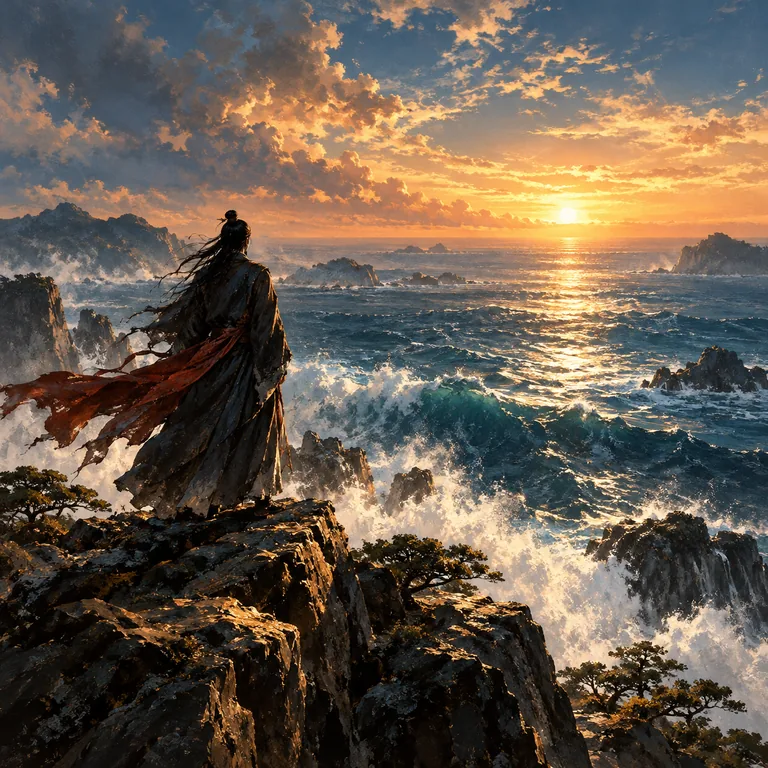
On his first voyage, Meng Zhao plants a flag on a new island and names it Chang’an Islet, hoping to trade a harbor chart for a share in a ship. But Wen Pu, the pilot traveling with him, refuses to rush into surveying the land: the island has no spring, and the origins of its vegetation seem wrong. After nightfall, the two reefs at the bay’s entrance have shifted behind them. The sampan where they are spending the night is still secured by two ropes, and the knots he tied himself that day are slowly pulling taut.
Start readingAI-assisted writing · Fictional characters and events
