
To the Tune of Niannujiao · Remembering the Past at Red Cliffs
Song dynasty・Su Shi

Song dynasty・Su Shi
The great river flows east; its waves wash away the illustrious figures of a thousand ages.
West of the old ramparts lies what people call the Red Cliff of young General Zhou of the Three Kingdoms.
Jagged rocks pierce the sky,startling waves pound the shore,rolling up a thousand heaps of snow.
江山如画,一时多少豪杰。— Rivers and mountains are like a painting; how many heroes lived in that age.
I think back to Gongjin in those days: Xiao Qiao newly wed to him, his bearing heroic, his spirit radiant.
With feather fan and silk headscarf, amid laughter and conversation, enemy ships turned to flying ash and vanishing smoke.
My spirit wanders through that ancient realm; surely you would laugh at my sentiment, my hair already turning white.
Life is like a dream; once more I pour a cup in offering to the river moon.
The animation remains in its original Chinese.
The animation is ready.
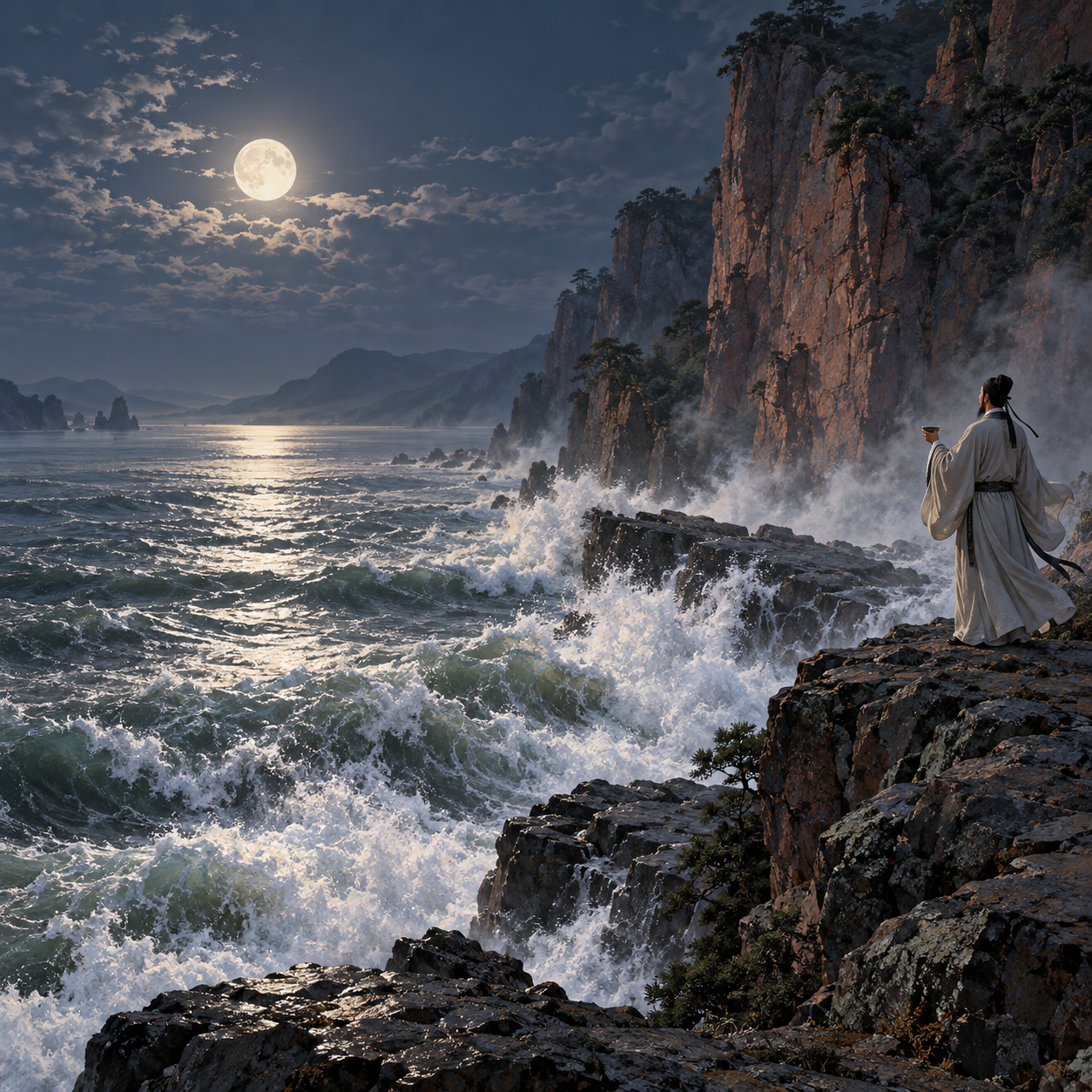
The Yangtze surges east, its waves seeming to wash away the heroes of all ages. West of the old ramparts, people say, lies Red Cliff, where Zhou Yu defeated the enemy in the Three Kingdoms era. Steep rocks tower above, huge waves pound the banks, and spray rolls up like a thousand heaps of white snow. With rivers and mountains so picturesque, how many great heroes that age brought forth!
I think of Gongjin in his youth, when Xiao Qiao had just become his bride, his bearing splendid and his spirit high. With a feather fan in hand and a silk headscarf, he reduced the enemy warships to smoke and ashes amid laughter and conversation. As my mind wanders through this ancient place, I ought to laugh at my own deep sentiment, which has turned my hair gray so soon. Life is like a dream; let me pour a cup of wine in offering to the bright moon over the river.
念奴娇: a ci tune pattern. 风流人物: outstanding figures. 故垒: old military ramparts. 周郎、公瑾: both refer to Zhou Yu; Gongjin was his courtesy name. “人道是” (people say this is) preserves the tone of local tradition; Red Cliff at Huangzhou should not be definitively identified as the ancient Three Kingdoms battlefield.
千堆雪: “a thousand heaps of snow,” a metaphor for breaking waves, not snowfall. 小乔初嫁: “Xiao Qiao newly wed,” an image emphasizing Zhou Yu’s youth and success, rather than a strict chronology of his marriage as of the Battle of Red Cliffs.
纶(guān)巾: a silk headscarf. 羽扇纶巾: a feather fan and silk headscarf, depicting Zhou Yu's bearing as a cultivated general in this lyric, rather than introducing Zhuge Liang. 樯橹: masts and oars, standing for warships; another version reads “强虏” (mighty enemy).
故国: the ancient battlefield or old site. 华发: graying hair. 尊: a wine vessel, interchangeable with “樽.” 酹 (lèi): to pour wine onto the ground or beside water as a libation. Another version has “人间” (“the human world”) in place of “人生” (“human life”).
Reading guide: Su Shi wrote this lyric in the fifth year of Yuanfeng (1082), while living in exile in Huangzhou. From a vantage point on the riverbank, he imagines Zhou Yu, then returns to his own feelings about his prematurely graying hair. Recalling the past does not mean retelling a battle; it opens a dialogue between historical achievement and personal circumstances.
The great river opens the poem, making time itself seem an unceasing eastward current. Jagged rocks, crashing waves, and snowy spray build powerful momentum for the hero's entrance, yet Zhou Yu wins with unhurried “谈笑,” conversation and laughter; complexity and simplicity illuminate each other.
Moving from “遥想” (imagining the distant past) to “笑我” (laughing at me), the gaze that admires an ancient figure suddenly turns back upon the self. The ending's sense that life is a dream carries disappointment, yet the gesture of raising wine to the moon remains; the emotion does not disappear but finds a place within the wider river and sky.
Let words find a melody

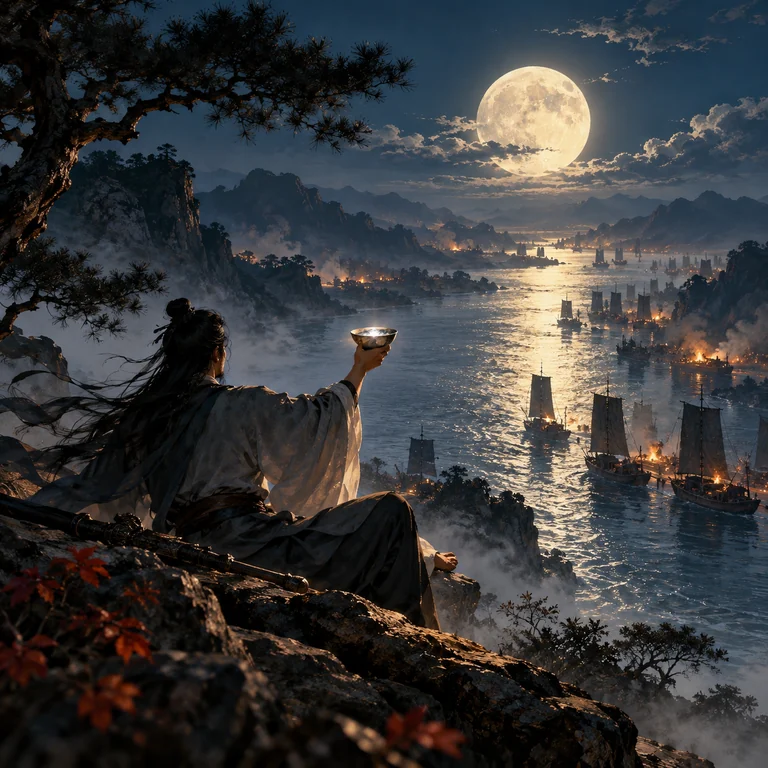
From a poem into a story
A Deng has supplied the stage’s east wind eighty-seven times, and the applause has never been for him. For the burning-warships play at Chishi Ferry, the theater owner promises to let him take the stage in armor for the final scene and sing two lines announcing victory. He knows the passenger boats are moored too close, but cannot bear to lose this chance. When the performance begins, the moon shines bright over the river, and everyone along the bank waits for the hero to flourish his fan. On the water, however, the wind quietly changes direction.
Start readingAI-assisted writing · Fictional characters and events
