
Autumn Thoughts
Jin dynasty・Yuan Haowen

Jin dynasty・Yuan Haowen
Cool leaves rustle with the scattered sound of rain; cold whispers fill the empty hall, veiled in frostlike clarity.
Yellow chrysanthemums keep their own appointment with the west wind; white hair first appears upon the traveler far from home.
My chanting, like autumn insects, grows more anguished; my dreams, like cold-night magpies, are repeatedly startled.
When, on the mountain road through Shiling Pass, will a glimpse of my home hills briefly brighten my eyes?
The animation remains in its original Chinese.
The animation is ready.
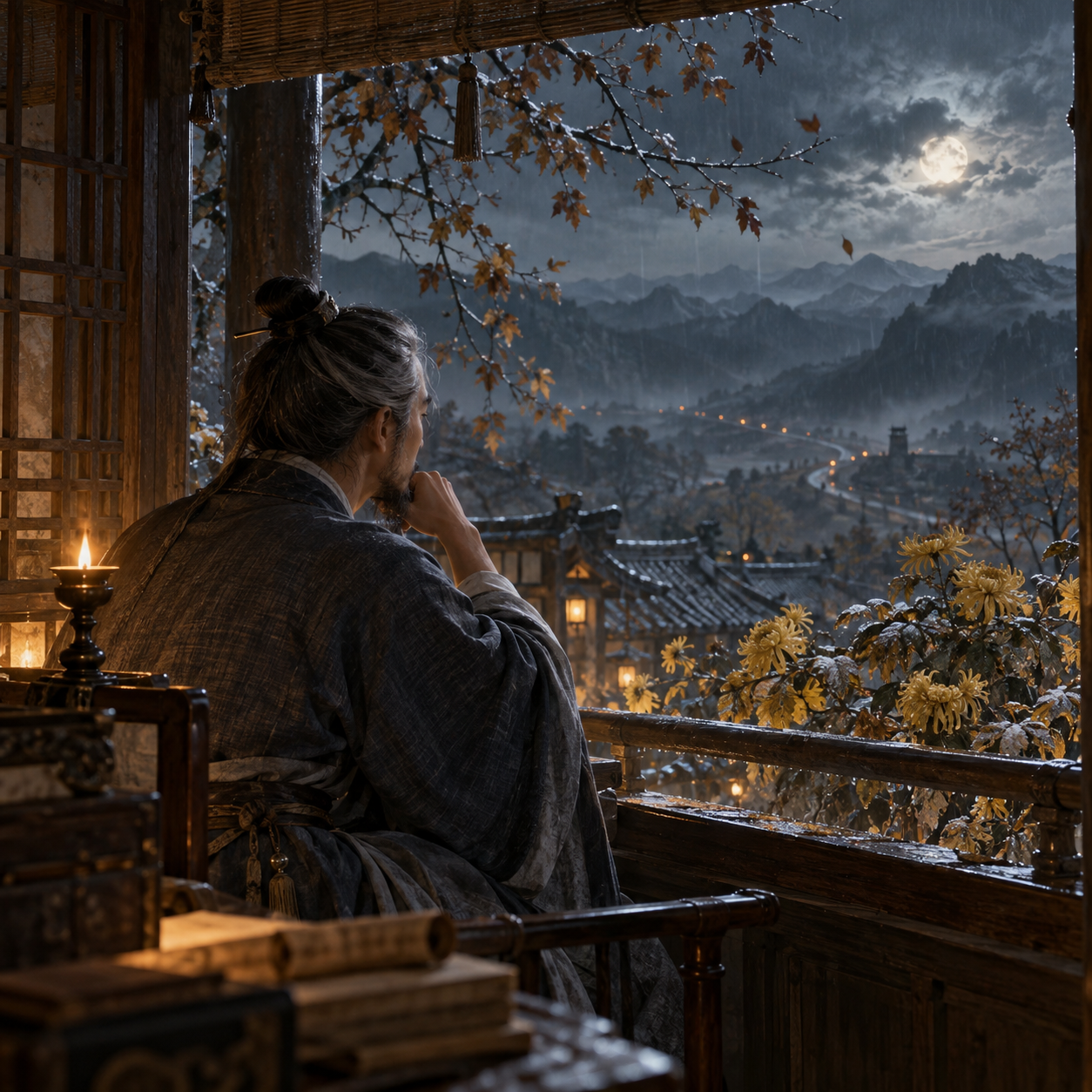
Leaves in the cool autumn rustle like scattered rain; cold sounds whisper through the empty hall, as though it were shrouded in clear frost. Yellow chrysanthemums will greet the west wind as promised, yet the wandering traveler has already grown white hair. My verse sounds like autumn insects, more plaintive as autumn deepens; my sleep resembles that of a cold magpie, repeatedly startled awake at night. When can I take the mountain road through Shiling Pass and see my homeland's mountains and rivers at a glance, briefly brightening my dim eyes?
虚堂: an empty, silent hall. 淅淅: the faint, scattered sounds of wind, rain, falling leaves, and the like. 黄华: chrysanthemums; 华 is used for “花” (“flower”). 远客: a person wandering far from home, referring to the author himself.
候虫: insects whose calls mark the seasons, such as crickets. 寒鹊: magpies on a cold night, often taking flight when startled. 石岭关: Shiling Pass, in present-day Shanxi, a pass on the poet’s route home.
家山: one’s native place. 眼暂明: the sight of home briefly lifts the spirits, emphasizing the comfort of returning.
Reading guide: This seven-character regulated poem by Yuan Haowen expresses homesickness on an autumn night away from home. Fallen leaves, yellow chrysanthemums, autumn insects, and cold magpies appear in sequence, but the poem does more than list autumn things: it moves from bodily aging and troubled sleep toward a desire to return home.
The second couplet sets the chrysanthemum against the distant traveler: flowers keep their seasonal appointment, while a wandering person grows old before his time. The word “先,” meaning “before,” distinguishes nature’s cycles from the wearing away of a human life.
Chanting like insects and dreams startled like magpies carry the desolation of sound into the inner world. At the end, recognizable roads through mountain passes suddenly appear, giving sorrow a direction; “暂” (“briefly”) also shows that this clarity remains only a moment hoped for.
Let words find a melody


From a poem into a story
Gu Xing returns to Shiling Pass with thirty-seven displaced people and finally recognizes his wife, from whom he has been separated for three years, atop the gate tower. Holding a crossbow, Liang Su does not ask where he has been all these years; first she asks whether anyone in the crowd has a fever. Inside the pass, food is scarce; outside, the cold is coming. The gateway home he promised all along the journey has not opened. A brazier is lit beside a yellow boulder, and the people behind him are still waiting for him to speak.
Start readingAI-assisted writing · Fictional characters and events
