
Rhapsody on the Goddess of the Luo
Three Kingdoms・Cao Zhi

Three Kingdoms・Cao Zhi
In the third year of Huangchu, I attended court in the capital and crossed the Luo on my return. The ancients said that the goddess of this river was named Fufei. Moved by Song Yu’s account to the King of Chu concerning a goddess, I composed this fu. Its words are these:
I left the capital to return to my eastern fief, leaving Yique behind, crossing Huanyuan, passing through Tonggu, and ascending Mount Jing. The sun was sinking westward; the carriage was worn and the horses weary. We unharnessed on banks fragrant with wild ginger and fed the four horses in fields of sacred herbs. I wandered through sunlit woods, casting my gaze over the Luo. Then my spirit stirred in wonder, and suddenly my thoughts scattered. Looking down, I had noticed nothing; raising my eyes, I beheld a strange sight: a beautiful woman beside the cliffs. Taking hold of my charioteer, I said: “Do you see that person over there? Who is she, so extraordinarily beautiful!” The charioteer replied: “I have heard that the goddess of the He and Luo rivers is named Fufei. Could she be the one Your Highness has seen? What does she look like? I should like to hear.”
I told him: Her form flutters like a startled wild goose, graceful as a roaming dragon, radiant as autumn chrysanthemums, luxuriant as spring pines. She shimmers like light clouds veiling the moon, drifts like snow whirled by the wind. Seen from afar, she shines like the sun rising through morning clouds; viewed close at hand, she glows like a lotus emerging from clear waves. Neither too full nor too slender, neither too tall nor too short, with shoulders as if sculpted and a waist like gathered white silk. Her graceful neck extends, revealing fair skin; she wears neither fragrant ointment nor powder. Her cloudlike coiffure rises high, her long brows curve delicately; red lips glow without, white teeth gleam within. Her bright eyes glance enchantingly, dimples nestle beneath her cheekbones. Her beauty is extraordinary, her bearing composed and refined; her feelings tender, her manner graceful, her speech charming. Her wondrous dress is unmatched in the world, her figure worthy of a painting. She wears brilliant gauze robes and ornaments of beautiful jade. Gold and kingfisher-green jewels adorn her head, and bright pearls illuminate her body. She wears patterned Yuanyou shoes and trails a light hem of mistlike silk. Faintly fragrant as secluded orchids, she wanders by the mountain. Suddenly she moves freely, roaming and playing. A colored-feather standard stands at her left, a cassia banner shades her right. She extends her white wrists on the sacred bank to gather dark sacred herbs beside the rapids.
I delighted in her gracious beauty, my heart stirred and ill at ease. With no good matchmaker to bring us together, I entrusted my words to the ripples. Hoping my sincere devotion might reach her first, I unfastened my jade pendant to invite her. Ah, the lady was truly lovely, versed in ritual and poetry. She raised fine jade in response and pointed to the deep waters to appoint our meeting. Holding to my devoted sincerity, I feared this spirit might deceive me. Recalling the broken promise to Jiaofu, I grew sorrowful, hesitant, and doubtful. I composed my expression and quieted my mind, holding myself within the bounds of propriety.
Then the spirit of the Luo was moved; she paced and lingered. Her divine radiance gathered and dispersed, now shadowed, now bright. She raised her light body like a standing crane, as though about to fly, yet not taking wing. She trod pepper-scented paths and passed through wild-ginger thickets, spreading fragrance. Lifting her voice in a long lament of enduring longing, she sang with sorrowful intensity, the sound stretching on. Then spirits gathered in multitudes, calling friends and summoning companions. Some played in clear streams, some soared over sacred islets; some gathered bright pearls, some collected kingfisher feathers. With the two consorts of the southern Xiang beside her, she took the wandering goddess of the Han by the hand. She sighed for the companionless Gourd Star and sang of the Oxherd’s solitude. Her light robe fluttered; she shaded herself with long sleeves and stood gazing. Swift as a flying duck, elusive as a spirit, she stepped lightly on the waves, her gauze stockings raising spray like dust. Her movements followed no fixed pattern, now precarious, now at ease; her advances and pauses could not be foretold, as though departing, as though returning. Her shifting glances streamed with radiance, her jade-like face glowed. Words rested unspoken on her lips, her breath fragrant as secluded orchids. Her beauty and graceful form made me forget to eat.
Then Pingyi gathered in the wind, and Chuanhou stilled the waves. Fengyi sounded the drums, and Nüwa sang a clear song. Patterned fish flew up to guard the carriage; jade bells rang as all departed together. Six dragons aligned their heads, drawing the cloud carriage in stately motion. Whales leaped beside its wheels, and waterbirds soared as guards. Crossing the northern islet and passing the southern ridge, she turned her white neck and looked back with radiant eyes. Her red lips moved as she spoke slowly, explaining the essential terms of our relationship. She lamented that mortals and divinities follow different paths, grieved that our prime years could find no fulfillment. Raising a gauze sleeve to hide her tears, she wept until they streamed over her lapels. She mourned that our happy meeting must end forever, grieved that one departure would leave us in separate lands. With no small tenderness sufficient to express her love, she offered bright pearl earrings from south of the river. Though she dwelt deep in the shadowy waters, her heart would always remain with Your Highness. Suddenly I could not tell where she had gone; sorrowfully I watched the spirits vanish and their radiance fade.
Then I left the low ground and climbed high; my feet moved on, but my spirit remained. Lingering affection conjured her image; looking back, I harbored sorrow. Hoping her divine form would appear again, I took a light boat upstream. Drifting along the long river, I forgot to return; endless thoughts deepened my longing. All night I lay restless and sleepless, drenched in thick frost until dawn. I ordered my servant to ready the carriage: I would return along the eastern road. Grasping the horses’ reins, I raised the whip, yet lingered sorrowfully, unable to leave.
The animation remains in its original Chinese.
The animation is ready.
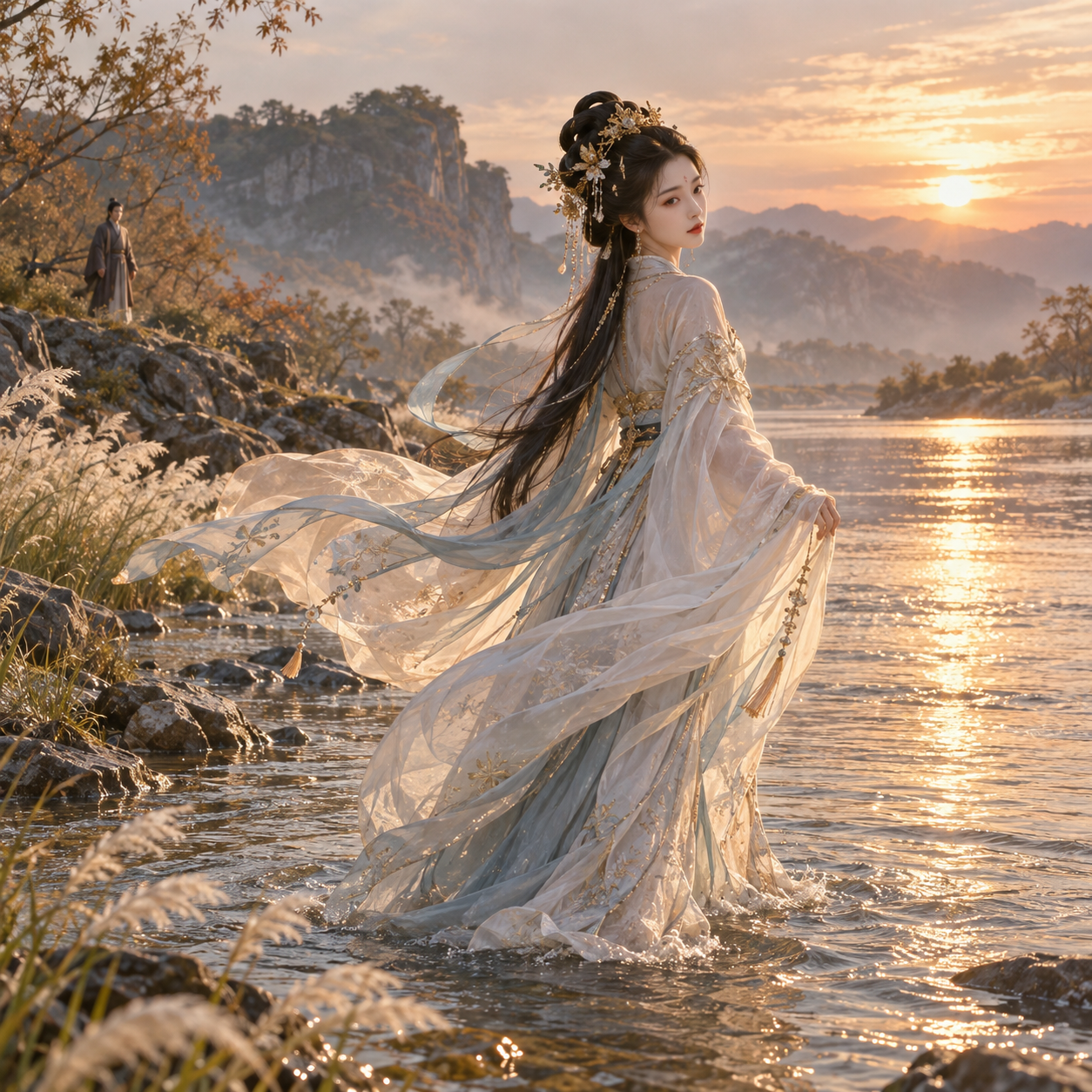
In the third year of Huangchu, I came to the capital to attend court and crossed the Luo on my return. The ancients said the goddess of this river was named Fufei. Moved by the story of the goddess that Song Yu told the King of Chu, I composed this fu. It reads:
I set out from Luoyang, the capital, to return east to my fief at Juancheng, leaving Yique behind, crossing Huanyuan, passing through Tonggu, and ascending Mount Jing. By then the sun was sinking westward, the carriage worn and the horses weary. We unharnessed on banks thick with wild ginger and fed the horses in fields of sacred herbs. I wandered through sunlit woods, gazing over the vast waters of the Luo. Without realizing it, I grew dazed and my thoughts scattered. Looking down, I had noticed nothing, but raising my head I discovered an extraordinary sight: a woman of exquisite beauty stood beside the cliffs. I instinctively grasped the charioteer beside me and said: 「你看见那个人了吗?那是什么人,竟如此艳丽!」—Have you seen that person? Who is she, so extraordinarily beautiful! The charioteer replied: 「臣听说河洛之神的名字叫宓妃,然而君王所看见的,莫非就是她!她的形状怎样,臣倒很想听听。」—I have heard that the goddess of the He and Luo rivers is named Fufei. Could she be the one Your Highness has seen! What does she look like? I should very much like to hear.
I told him: Her figure flutters like a startled wild goose and curves gracefully like a swimming dragon. Her face shines like chrysanthemums beneath the autumn sun, her form flourishes like green pines in the spring breeze. She appears and fades like light clouds veiling the moon, floating like snow whirled by a circling wind. Seen from afar, she is bright and pure as the rising sun amid morning clouds; close at hand, fresh and lovely as a new lotus opening among clear waves. Her figure is balanced, her height just right; her narrow shoulders seem sculpted, her slender waist gathered tight. Her graceful neck reveals fair skin. She wears neither ointment nor powder; her coiffure rises like clouds, her long brows curve delicately, her red lips are fresh, her teeth white. Her sparkling eyes glance enchantingly, with two sweet dimples beneath her cheekbones. Her posture is elegant and alluring, her manner gentle and composed, her expression tender and agreeable, her words gracious and pleasing. Her wondrous dress is unmatched, her bearing and form like those in a painting. She wears brilliant gauze robes and exquisite jade ornaments. Gold, silver, and kingfisher-green jewels adorn her head, while bright pearls sparkle all over her. Wearing patterned Yuanyou shoes and trailing a mistlike skirt, she gives off a faint orchid fragrance as she wanders by the mountain. Suddenly she rises lightly, walking and playing, with a colored-feather standard at her left and a cassia banner shading her right. On the riverbank she extends her white hands to gather black sacred herbs beside the stream.
Enamored of her gracious beauty, I felt my heart flutter in restless agitation. With no suitable matchmaker to plead my case, I could only send my words upon the ripples. Hoping that my sincere feelings might reach her before anyone else’s, I unfastened my jade pendant to invite her. How truly lovely she was, versed in propriety and eloquent in speech. She raised fine jade in response and pointed to the deep waters to appoint our meeting. Holding to my devoted sincerity, I nevertheless feared this goddess might deceive me. Remembering how the goddess Zheng Jiaofu encountered had broken her promise, I felt sorrow, hesitation, and doubt. I therefore composed my expression, steadied my mind, and restrained myself with propriety.
Deeply moved, the Luo goddess lingered and paced, her divine radiance gathering and dispersing, now bright, now dim. She raised her light body like a standing crane, as though about to fly but not yet taking wing. She trod a path rich with the fragrance of pepper and passed through wild-ginger thickets, stirring their scent. Suddenly she gave a long, melancholy cry to express her deep longing, its sorrowful sound lingering. Spirits came crowding together, calling friends and companions. Some played in clear streams, some flew over wondrous islets, some gathered bright pearls, and some bent to collect kingfisher feathers. Ehuang and Nüying, the two consorts of the southern Xiang, followed beside her, and she held the arm of the Han River goddess. She sighed for the companionless Gourd Star and sang sorrowfully of the solitary Oxherd. At times she lifted her windblown robe and shaded her eyes with long sleeves, gazing into the distance and standing long; at others she moved as lightly and swiftly as a flying duck, drifting unpredictably. She walked upon the waves, her gauze stockings scattering spray like dust. Her movements followed no pattern, seeming at once precarious and at ease; her advances and retreats were unpredictable, as though leaving and returning. Her eyes sparkled as they turned, her face shone with a moist radiance. Before she spoke, her breath was already fragrant as orchids. Her graceful beauty made me forget food and drink.
At that moment Pingyi, the wind god, restrained the evening breeze, and Chuanhou, the water god, stilled the waves. Fengyi sounded the divine drums, and Nüwa sang in clear, cool tones. Flying patterned fish guarded the Luo goddess’s carriage, and the deities departed together to the ringing of jade carriage bells. Six dragons advanced abreast, drawing the cloud carriage serenely onward. Whales leaped on either side, while waterbirds circled in protection. The carriage passed the northern sandbank and crossed the southern ridge. The goddess turned her white neck and looked back with her lovely brows and eyes. Parting her red lips slightly, she slowly explained the essential terms of their relationship. She lamented only that mortals and divinities were different, so that even in the prime of their lives their wishes could not be fulfilled. As she spoke, she raised a gauze sleeve to hide her weeping face, her flowing tears soaking her lapels. She mourned that their joyful meeting must end forever, that this departure would leave them in separate lands. With no small tender gesture sufficient to express her love, she could only give him bright pearl earrings as a lasting remembrance. Though she dwelt deep in the shadowy waters, her thoughts would always remain with His Highness. When she finished, she suddenly vanished to an unknown place. I felt profound sorrow as the spirits disappeared and their radiance faded.
I left the low ground and climbed higher. Though my feet moved, my spirit remained where it was. Lingering affection kept me imagining our meeting and the goddess’s face; each backward glance brought more sorrow. Hoping with all my heart that she might reappear, I recklessly took a light boat upstream. Drifting along the long Luo, I forgot to return, while unbroken longing only grew stronger. All night my restless heart kept me awake, and thick frost covered me until dawn. At last I had to order my servant to prepare the horses and carriage for the journey east. Yet as I grasped the reins and raised the whip, a sense of loss overcame me, and I lingered in attachment, unable to leave.
The third year of Huangchu: the third year of the Huangchu reign era of Cao Pi, Emperor Wen of Wei, corresponding to 222 CE. The opening account explains why the author crossed the Luo on his return to his fief.
东藩: the author’s eastern fief. 伊阙、轘辕、通谷、景山: Yique, Huanyuan, Tonggu, and Mount Jing, names of passes, valleys, and other places around Luoyang marking his return route.
宓妃: Fufei, the legendary goddess of the Luo River. 宋玉神女之事: the story of the King of Chu and a goddess in Song Yu’s fu, a literary tradition that informed this work’s conception.
税驾: halt the carriage to rest. 蘅皋: raised riverside ground covered in fragrant herbs. 秣驷: feed the four carriage horses. 容与: move slowly and leisurely. 流眄: turn one’s gaze to look. 觌(dí): see.
惊鸿、游龙: a startled wild goose and a roaming dragon, metaphors respectively for lightness of bearing and a gracefully curving figure. 芙蕖: lotus. 渌: clear. 秾纤得衷: perfectly balanced between fullness and slenderness. 修短: height. 约素: gathered white silk, used to describe the waist.
铅华: cosmetic powder. 修眉联娟: long, slender, curving brows. 靥辅: dimples on the cheeks. 权: cheekbones. 瓌 is a variant of “瑰,” meaning beautiful. 闲: refined and composed.
珥: wear earrings. 瑶碧、华琚: fine jade and jade ornaments. 远游: Yuanyou, a type of shoe. 雾绡: silk as light and sheer as mist. 芳蔼: fragrance. 踟蹰: walk slowly and linger.
采旄、桂旗: ceremonial standards decorated with colored feathers and cassia branches. 攘皓腕: raise or extend white wrists. 浒: a riverbank. 湍濑: rapids. 玄芝: a mythical sacred fungus.
诚素: sincere, pure feelings. 要(yāo): invite or arrange a meeting. 信修: truly beautiful. 琼珶: fine jade. 款实: sincere affection.
交甫: Zheng Jiaofu, who, according to legend, met goddesses by the Han River and received jade pendants, only for both the goddesses and pendants to vanish. The author invokes this to express his fear and doubt about whether a meeting between mortal and goddess can endure. 礼防: the restraints of ritual propriety.
洛灵: the deity of the Luo River. 徙倚: pace or linger. 椒涂、蘅薄: fragrant paths and thickets of aromatic herbs. 杂遝: gather in great numbers. 俦、侣: companions.
南湘之二妃: the legendary Ehuang and Nüying. 汉滨之游女: goddesses of the Han River. 匏瓜、牵牛: the Gourd and Oxherd stars, whose solitude here expresses the sorrow of separation.
轻袿(guī): a light, soft woman’s robe. 翳: cover or shade. 延伫: stand for a long time. 飞凫: a flying wild duck. 凌波: tread upon waves. 尘: dust, here a metaphor for fine spray, describing the goddess’s steps.
屏翳: Pingyi, a mythical deity, here governing the wind. 川后: a water deity. 冯夷: Fengyi, a river god. 女娲: Nüwa, a mythical goddess. 文鱼: patterned fish. 玉鸾: jade-decorated bells on a carriage.
毂: the hub of a wheel, here standing for the carriage. 沚: a small islet. 纡素领: turn a pure white neck. 清阳: the radiance of the brows and eyes. 袂: a sleeve. 浪浪: the flowing of tears.
明珰: bright pearl earrings. 太阴: the deep, shadowy underwater abode. 神宵: the spirits swiftly vanish; this line describes the goddess’s uncertain destination and fading radiance.
背下陵高: leave low ground and ascend higher ground. 上溯: travel upstream. 耿耿: restless and unable to sleep. 騑辔(fēi pèi): the reins of carriage horses. 抗策: raise the whip. 盘桓: linger without moving onward.
Reading note: the love between mortal and goddess is an artistic invention of the fu; identifying the Luo goddess directly with a particular real woman cannot be substantiated from this work alone.
The Rhapsody on the Goddess of the Luo is a celebrated fu by Cao Zhi, a writer of Cao Wei during China’s Three Kingdoms period. Drawing on Song Yu of the Warring States kingdom of Chu and his depiction of the Goddess of Mount Wu in Rhapsody on the Goddess, Cao Zhi recounts an encounter with the Luo goddess, borrowing extensively from Song’s plot and characterization. The work imagines the author’s chance meeting with the goddess and their mutual longing and love. She is incomparably beautiful, and their love is elusive and dreamlike. Yet mortal and goddess follow different paths and cannot be united, leading finally to boundless grief and melancholy. The work can be divided broadly into six sections: the first describes the author seeing the 「丽人」—beautiful woman—Fufei standing on a cliff as he returns from Luoyang to his fief; the second depicts her beautiful appearance, bearing, and dress; the third describes his profound love for this goddess, versed in propriety and eloquent in speech, and his fear of deception even after expressing his true feelings, offering a token, and arranging a meeting; the fourth depicts her response to the sincerity of the 「君王」—prince; the fifth contains the work’s central underlying meaning; and the sixth describes his longing after their separation. Throughout, splendid language, delicate description, rich imagination, and lingering affection suggest a deeper significance.
Cao Zhi achieved distinction in both poetry and fu rhapsodies. His fu inherited the tradition of short lyrical rhapsodies established during the two Han dynasties while absorbing the romantic spirit of the Songs of Chu, opening new possibilities for the genre. The Rhapsody on the Goddess of the Luo is among his outstanding works. Through a dreamlike realm and a romantic approach, the author depicts sincere love between a mortal and a goddess, who ultimately part in sorrow because 「人神殊道」—mortals and divinities follow different paths—and cannot be united.
The work begins by recounting the journey away from the capital, 「背伊阙,越轘辕,经通谷,陵景山」—leaving Yique behind, crossing Huanyuan, passing through Tonggu, and ascending Mount Jing—and describing the author and his attendants arriving at the Luo. By then, 「日既西倾,车殆马烦」—the sun was sinking westward, the carriage worn and the horses weary. They unharnessed on fragrant banks, fed the horses in fields of sacred herbs, wandered through sunlit woods, and gazed over the Luo. Amid the stillness, the author’s thoughts drift as he looks far across the shimmering river. The instant he happens to raise his head, a marvel appears: a goddess of extraordinary beauty stands on the opposite cliff. Astonished, he instinctively grasps the charioteer beside him and urgently asks: 「尔有觌于彼者乎?彼何人斯,若此之艳也!」—Do you see that person over there? Who is she, so extraordinarily beautiful! Here the lovely riverside and mountain scenery before sunset sets off the delighted surprise of this unexpected discovery, creating a captivating atmosphere. The charioteer’s response is equally ingenious. He avoids answering the first question—「尔有觌于彼者乎」, whether he sees the person—and solemnly introduces Fufei, the Luo goddess, in the speculative language of 「臣闻」 and 「无乃」, meaning “I have heard” and “could it be.” This deliberately prepares for the description to follow while adding mystery to an already strange encounter. According to legend, Fufei was a daughter of the ancient ruler Fuxi who drowned in the Luo and became its goddess. Qu Yuan mentions this legendary goddess in both Questions to Heaven and Encountering Sorrow. Later, Sima Xiangru and Zhang Heng described her in their fu: 「若夫青琴宓妃之徒,绝殊离俗,妖冶娴都,靓妆刻饰,便环绰约。……芬芳沤郁,酷烈淑郁;皓齿灿烂,宜笑的皪;长眉连娟,微睇绵藐」(《上林赋》)—Women such as Qingqin and Fufei surpass the ordinary world, alluring and refined, exquisitely adorned, graceful and delicate. Their fragrance is rich and intense; white teeth gleam in radiant smiles, long brows curve delicately, and subtle glances reach afar (Rhapsody on the Imperial Park); and 「载太华之玉女兮,召洛浦之宓妃。咸姣丽以蛊媚兮,增嫮眼而蛾眉。舒妙婧之纤腰兮,扬杂错之袿徽。离朱唇而微笑兮,颜的砾以遗光……」(《思玄赋》)—I carry the Jade Maiden of Mount Taihua and summon Fufei from the Luo’s banks. All are beautiful and bewitching, with lovely eyes and mothlike brows; they stretch their slender waists and flutter their patterned robes, parting red lips in slight smiles, their radiant faces shedding light (Rhapsody on Pondering the Mystery). Unlike these direct descriptions, this work first portrays the goddess’s appearance through a succession of vivid, extraordinary similes: 「其形也,翩若惊鸿,婉若游龙,荣曜秋菊,华茂春松。仿佛兮若轻云之蔽月,飘颻兮若流风之回雪。远而望之,皎若太阳升朝霞;迫而察之,灼若芙蓉出渌波。」—Her form flutters like a startled wild goose and curves like a roaming dragon, radiant as autumn chrysanthemums and luxuriant as spring pines. She shimmers like light clouds veiling the moon and drifts like snow whirled by the wind. From afar she shines like the sun rising through morning clouds; close at hand she glows like a lotus emerging from clear waves. The vivid images and brilliant colors offer more than the eye can take in. In particular, 「翩若惊鸿,婉若游龙」—fluttering like a startled wild goose, curving like a roaming dragon—captures the spirit and grace of her floating approach. Like the subsequent 「轻云之蔽月」 and 「流风之回雪」—light clouds veiling the moon and wind swirling snow—these images convey movement that is light, flowing, fluid, and graceful. Meanwhile, 「秋菊」, 「春松」, 「太阳升朝霞」, and 「芙蓉出渌波」—autumn chrysanthemums, spring pines, the sun rising through morning clouds, and a lotus emerging from clear waves—convey the bright, clear, splendid, and alluring colors of her appearance. Movement and color interweave and suffuse one another, forming a wondrous scene of flowing radiance that vividly reveals her incomparable beauty. Building on the powerful effect of these repeated similes, the author then uses traditional methods to describe her figure, features, dress, and bearing in detail. This daughter of Fuxi has a well-proportioned figure, sloping shoulders, and a slender waist; her beauty is natural and needs no cosmetics. Her cloudlike coiffure, long brows, fresh lips and teeth, bright eyes, and dimples make her face radiant. Brilliant gauze robes, deep-green jade ornaments, sparkling pearls, and a fluttering hem further enhance her 「瓌姿艳逸,仪静体闲」—extraordinary loveliness and composed, refined bearing. These descriptions recall the Book of Songs’ praise of Zhuang Jiang, wife of Duke Zhuang of Wei: 「手如柔荑,肤如凝脂,领如蝤蛴,齿如瓠犀,螓首娥眉,巧笑倩兮,美目盼兮」(《卫风·硕人》)—Hands like tender shoots, skin like congealed cream, a neck like a longhorn beetle’s larva, teeth like gourd seeds, a cicada’s forehead and mothlike brows; how charming her smile, how lively her beautiful eyes (Airs of Wei: The Stately Lady). They also recall Song Yu’s praise of the neighbor’s daughter: 「增之一分则太长,减之一分则太短,著粉则太白,施朱则太赤」(《登徒子好色赋》)—Add a fraction and she would be too tall; subtract a fraction and she would be too short; powder would make her too white, rouge too red (Rhapsody on Dengtuzi’s Love of Beauty). Their influence is evident, but Cao Zhi places greater emphasis on beauty in movement. He next concentrates on the goddess’s innocent, lively actions: 「践远游之文履,曳雾绡之轻裾。微幽兰之芳蔼兮,步踟蹰于山隅。于是忽焉纵体,以遨以嬉。左倚采旄,右荫桂旗。攘皓腕于神浒兮,采湍濑之玄芝。」—Wearing patterned Yuanyou shoes, she trails a light hem of mistlike silk. Faintly fragrant as secluded orchids, she wanders by the mountain. Suddenly she moves freely, roaming and playing, with a colored-feather standard at her left and a cassia banner shading her right. She extends her white wrists on the sacred bank to gather dark sacred herbs beside the rapids. By now her form and spirit are fully realized, almost ready to step from the page. 「余情悦其淑美兮,心振荡而不怡」—I delight in her gracious beauty, my heart stirred and ill at ease: the author is deeply moved by the beautiful goddess before him. At first he is distressed at having no way to convey his admiration; then he hopes 「愿诚素之先达」—that his sincere devotion may reach her first—and 「解玉佩以要之」—unfastens his jade pendant to invite her. After Fufei responds and he holds to 「执眷眷之款实」—his devoted sincerity—he remembers the legend of Zheng Jiaofu and the vanished pendants beside the Han, and doubts her gesture of 「指潜渊而为期」—pointing to the deep waters to appoint their meeting. These successive turns of feeling vividly reflect his subtle inner state. The goddess, in turn, is moved. Yet rather than describe her psychological changes directly, as it does his, the work reveals her ardent love and the profound sorrow of its impossibility through a finely observed sequence of actions. She 「徙倚彷徨。神光离合,乍阴乍阳」—paces and lingers, her divine radiance gathering and dispersing, now shadowed, now bright. At one moment she rises lightly like a crane about to fly; at another she passes through pepper-scented paths and wild-ginger thickets, stirring rich fragrance; then she gives a long, sorrowful cry, its sound echoing with enduring longing. When her lament summons the other deities, who carefree 「或戏清流,或翔神渚,或采明珠,或拾翠羽」—play in clear streams, soar over sacred islets, gather bright pearls, or collect kingfisher feathers—she remains lost in thought despite the company of the two Xiang consorts and the wandering goddess of the Han, 「叹匏瓜之无匹兮,咏牵牛之独处」—sighing for the companionless Gourd Star and lamenting the solitary Oxherd. Suddenly she drifts and circles over the vast misty waters like a swiftly flying waterbird, her movements elusive. Only her shifting, tender gaze and lips poised to speak seem to reveal her boundless attachment and sorrow. These depictions of her pacing, chanting, standing in longing, and drifting resemble a dance drama of intense emotion and graceful movement. Her changing, swaying steps reveal love, conflict, melancholy, and pain. In particular, 「体迅飞凫,飘忽若神。凌波微步,罗袜生尘。动无常则,若危若安。进止难期,若往若还」—Her body is swift as a flying duck, elusive as a spirit. She steps lightly on the waves, her gauze stockings raising spray like dust. Her movements follow no fixed pattern, now precarious, now at ease; her advances and pauses cannot be foretold, as though departing, as though returning—brings this dance drama to its climax, giving the fullest expression to her emotional turbulence and inner conflict. As the author and goddess face one another in silent affection, the moment of parting finally arrives. The scene is extraordinary in conception and alive with divine splendor: Pingyi gathers in the wind, Chuanhou stills the waves, and to Fengyi’s drums and Nüwa’s song, the cloud carriage drawn by six dragons carries Fufei away, guarded by whales beside its wheels and strange fish flanking its shafts. Seated in the receding carriage, the beautiful goddess repeatedly turns back to pour out her heart. 「悼良会之永绝兮,哀一逝而异乡」—I mourn that our happy meeting ends forever, grieve that one departure leaves us in separate lands: profound sorrow envelops this mythic scene. After explaining the 「交接之大纲」—essential terms of their relationship—through 「恨人神之道殊兮,怨盛年之莫当」—lamenting that mortals and divinities follow different paths and their prime years cannot find fulfillment—she solemnly promises: 「虽潜处于太阴,长寄心于君王。」—Though I dwell deep in the shadowy waters, my heart will always remain with Your Highness. Finally her radiant figure vanishes into the gathering dusk. The author still stands by the water, gazing forlornly in the direction she departed, overwhelmed by loss. He takes a light boat upstream, hoping to glimpse her lovely form again. But the misty waters and endless night only deepen his lingering affection and unbroken thoughts. At dawn he must 「归乎东路」—return along the eastern road—yet still 「揽騑辔以抗策,怅盘桓而不能去」—grasps the reins and raises the whip, lingering sorrowfully, unable to leave. This passage overflows with lyric feeling and possesses a spellbinding power, bringing the goddess’s image into still sharper, more perfect focus in the reader’s heart.
This fu has three principal features. First, a rich imagination. The author leaves Luoyang, the capital, to return east to his fief at Juancheng. On the way, he halts beside the Luo to water the horses, and while strolling through sunlit woods sees Fufei, the Luo goddess: this is an imagined encounter. Her swaying, elusive figure resembles a startled wild goose; her soft, curving form, a dragon swimming through water. Fresher and more splendid than autumn chrysanthemums and luxuriant pines, lovely as morning clouds and pure as a lotus, she possesses peerless beauty. He falls in love with her, entrusts his feelings to the ripples, and offers a jade pendant as a pledge. Yet her sacred purity prevents him from acting rashly. Finally moved by his sincerity, she meets him and pours out her feelings. But mortal and goddess follow different paths; with no hope of union, they reluctantly part. The imagination is brilliant, its romantic, poignant emotion remaining delicate yet undissolved, inspiring sighs and threads of melancholy. Yet the invention is not outlandish, since the work was inspired by Song Yu’s Rhapsody on the Goddess and Rhapsody on Gaotang.
Second, the diction is splendid without restlessness, suffused with a refreshing vitality. Carefully crafted parallelism, antithesis, and rhythm make the language orderly, concentrated, vivid, and beautiful. No Han fu surpasses it in material and conception. From the opening, it creates an atmosphere in which the extraordinary lies within the ordinary. Its unassuming introductory narrative resembles the opening voyage of the man from Wuling in Tao Yuanming’s Account of the Peach Blossom Spring: nothing foretells the wondrous realm to come. Yet in an instant the author witnesses an unforgettable sight: a lovely woman, the Luo goddess, appears. He then describes her radiant beauty and suffering with such intensity that he seems intent on rivaling Song Yu’s Goddess of Mount Wu. The subsequent departure of the goddess and her retinue achieves an effect akin to the sorrowful journey into the distance depicted in Qu Yuan’s Encountering Sorrow.
The third feature is the vivid characterization, combined with skillfully varied metaphor and contextual enhancement. Expansive without being wearisome, beautiful without overwhelming, it feels like viewing a superb painting whose figures have flesh and blood, rather than an air of unreality. Descriptions of the Luo goddess’s figure, features, and bearing convey beauty that could make fish sink and wild geese descend. At the same time, she possesses the fresh purity of 「清水出芙蓉,天然去雕饰」—a lotus emerging from clear water, naturally free of ornament. The depiction of her expressions during their encounter makes her seem to appear before the reader, graceful and enchanting. At their parting, 「屏翳收风,川后静波,冯来鸣鼓,女娲清歌。」—Pingyi gathers in the wind, the water god stills the waves, Feng Lai sounds the drums, and Nüwa sings a clear song. Their love is sincere and pure, everything so beautiful that after parting, though the person leaves, the heart remains, and longing continues. The goddess’s lovely silhouette and the scenes of meeting and mutual understanding remain vivid, romantic yet bitter, leaving him restless, lingering beside the Luo and unable to bear leaving.
Earlier critics praised this fu’s ideas and artistic achievements highly, most notably by repeatedly placing it alongside Qu Yuan’s Nine Songs and Song Yu’s Goddess rhapsodies. In fact, Cao Zhi’s work combines both traditions: it has the rich lyricism of The Lord of the Xiang and The Lady of the Xiang, as well as the exquisite portrayal of feminine beauty found in Song Yu’s fu. Its complete plot, varied techniques, and enduring formal charm also offer qualities earlier works had not achieved.
Let words find a melody
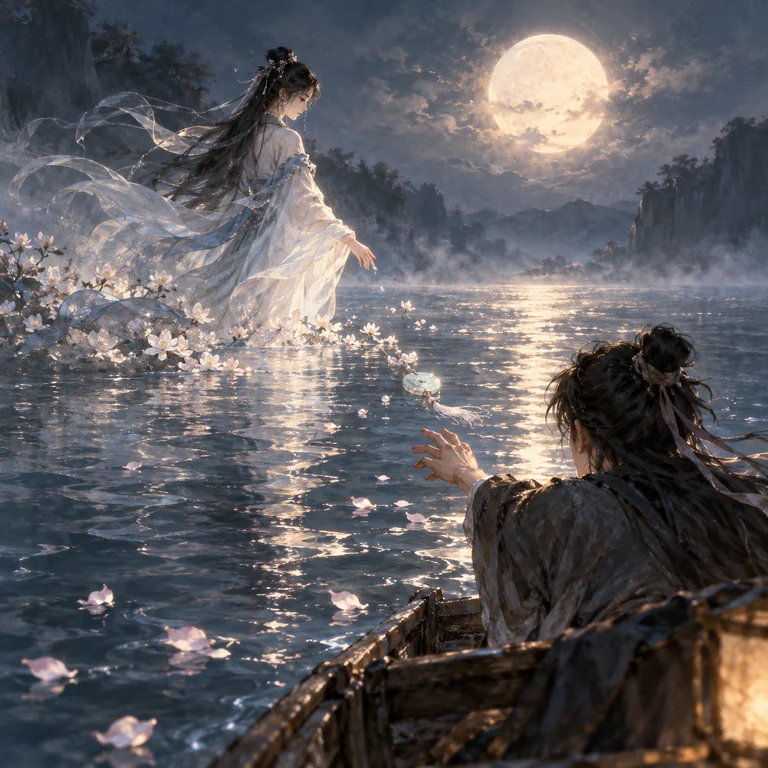
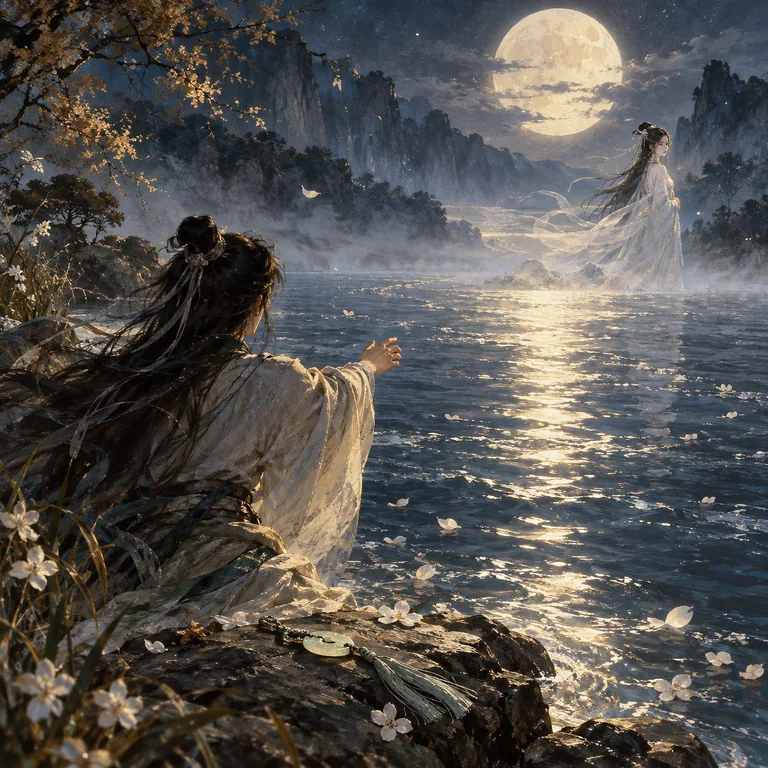
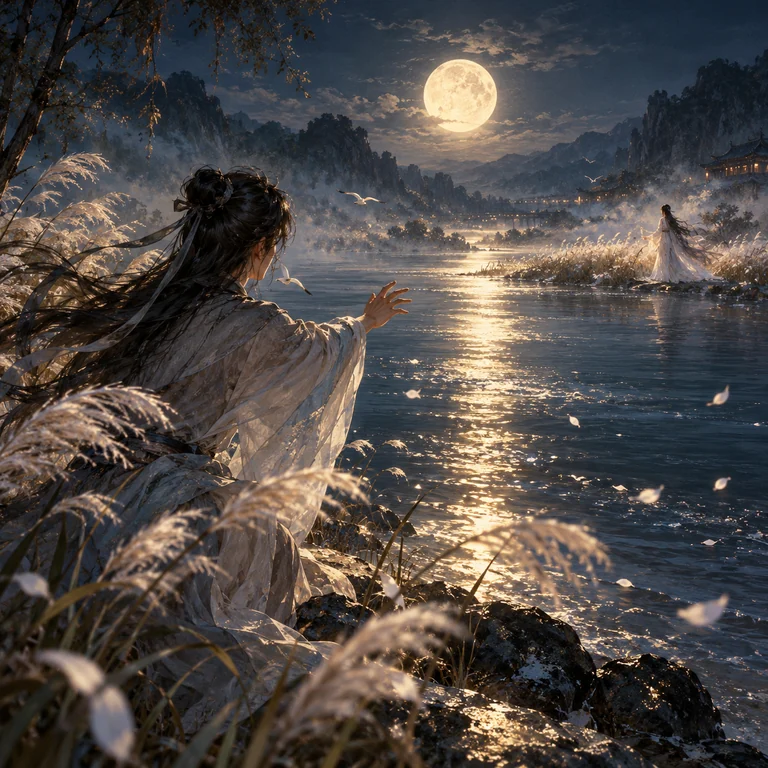
From a poem into a story
At dusk, on the stone steps by the Luo River, Shen Mi sees the red shoe his younger sister lost seventeen years ago. Its sole is still warm, yet the woman who brought it stands on the mudflat without a drop of water touching her hem. She offers him one double-hour in which to see his sister, if he will return to the old sluice house and finish saying what he left unsaid that year. Across the river, windows light up one by one, and an old affair buried beneath the water begins to find human voices.
Start readingAI-assisted writing · Fictional characters and events
