
Thoughts on the River in the Early Cold / Thoughts in the Early Cold
Tang dynasty・Meng Haoran

Tang dynasty・Meng Haoran
Leaves fall and geese cross southward; the north wind chills the river.
My home lies at a bend of the Xiang River,far away beyond the clouds of Chu.
My tears for home are spent in exile; I watch a lone sail at the edge of the sky.
Lost at the ford, I long to ask the way; the broad waters stretch endlessly into dusk.
The animation remains in its original Chinese.
The animation is ready.
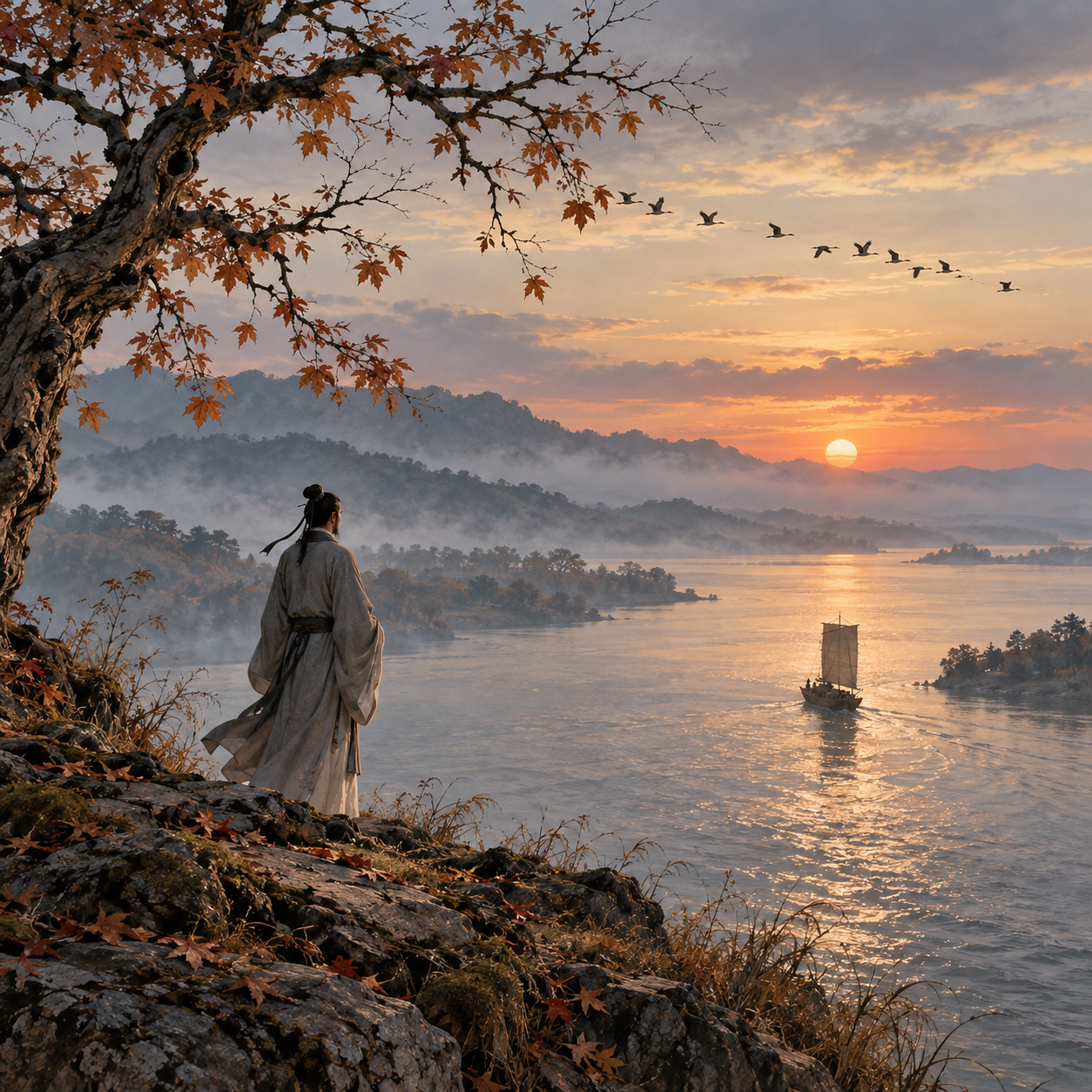
Leaves have fallen, geese pass southward, and the north wind chills the river. My home lies at a bend in the Xiang River, now far away beyond the clouds of Chu. On this journey, my homesick tears seem already spent; I can only watch a solitary sail at the horizon. Having lost the ferry crossing, I wish to ask someone the way, yet before me lies only the river, broad and level as the sea, in boundless dusk.
木落: leaves falling from trees. 南度: flying southward across the sky. 襄水: the waters around Xiangyang. 曲: a bend. 楚云端: the distant cloudy skies of Chu.
乡泪: tears of homesickness. 孤帆: “a solitary sail,” the wording used on this page; other versions have “归帆” (“a homeward sail”). 津: a ferry crossing. 迷津欲问: wishing to ask the way at an uncertain crossing; it also recalls the story of asking directions to a ford in the Analects, suggesting difficulty in choosing one’s path in life.
平海: a body of water broad as the sea; it need not mean the boat has entered the ocean. 漫漫: vast, distant, and indistinct.
Reading guide: Encountering an early chill on the river, Meng Haoran thinks of home through falling leaves and southbound geese. Asking for the crossing in the final couplet is both a traveler's search for directions and a source of hesitation about life's course, intertwining homesickness with feelings about his own circumstances.
The geese have a clear direction southward, while the traveler gazes toward home through Chu's clouds. Natural migration contrasts with human wandering, and the opening couplet's “寒” (cold) gradually moves from the weather into the state of mind.
No one appears to answer at the end; only the broad, level river remains in the evening light. The greater the space, the harder it is to find a direction, allowing the meaning of “迷津” (“losing one’s way at the crossing”) to linger beyond the poem’s close.
Let words find a melody
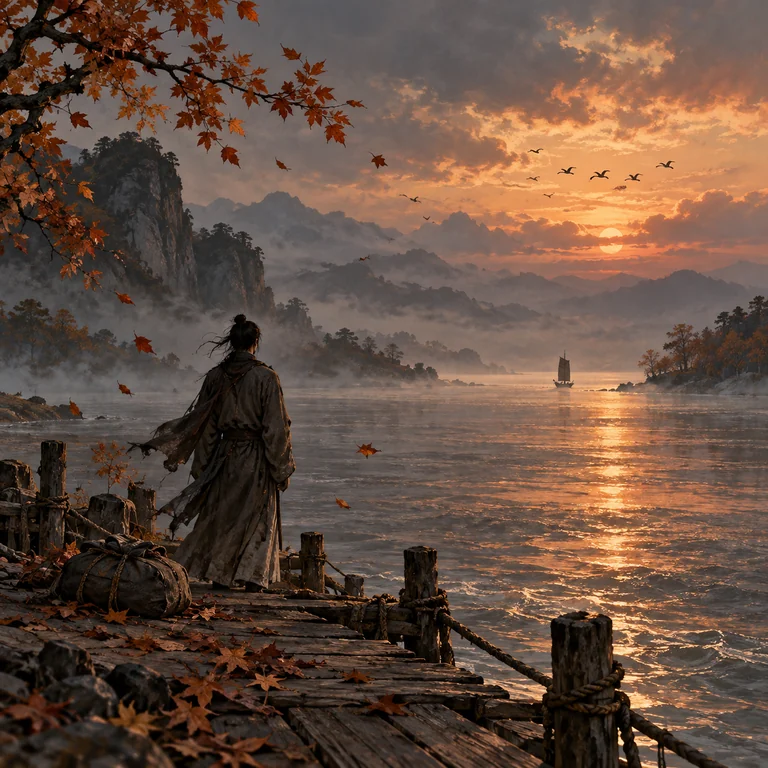

From a poem into a story
On the anniversary of his father’s death, Pei Du takes aboard an old man who cannot pay the full fare, simply because he hears a trace of his hometown in the man’s final syllables. Once the boat leaves shore, the old man speaks his father’s name and recognizes his habit of bracing the punting pole with his right foot. An old affair he has spent years asking about rises to the surface. A surge of cold water is coming downstream, the long, narrow bundle still lies across the old man’s knees, and this boat has little room for an easy turn back.
Start readingAI-assisted writing · Fictional characters and events
