
The Song of Everlasting Sorrow
Tang dynasty・Bai Juyi

Tang dynasty・Bai Juyi
The Han emperor prized beauty and longed for one who could topple a realm,through many years of rule, he sought her in vain。
A daughter of the Yang family had just come of age, raised deep in the women's quarters, unknown to the world.
Born with beauty she could scarcely leave neglected, one day she was chosen to stand beside the sovereign.
She turned her head and smiled, awakening a hundred charms,the powdered beauties of the six palaces lost all their color。
In spring’s chill, she was granted a bath in Huaqing Pool; its smooth hot-spring waters washed her creamy skin.
Attendants help her rise, lovely and languid: this was when she first received the emperor's favor.
Cloudlike hair, a flowerlike face, and a golden swaying hairpin; in warm lotus curtains, she passes the spring night.
春宵苦短日高起,从此君王不早朝。— Spring nights were painfully short; he rose when the sun was high, and from then on the emperor held no early court.
Serving his pleasure and attending his feasts, she had no idle moment; in spring she joined his outings, and night after night was his alone.
Three thousand beauties dwelt in the inner palace; the favor meant for all three thousand fell on her alone.
Adorned in the golden chamber, she tenderly attended him at night,the feast ended in the jade tower, she was drunk with wine and spring。
Her sisters and brothers all received lands—how splendid the glory that shone upon her family's gates.
Thus parents throughout the realm came to value daughters over sons.
Li Palace rises high into azure clouds; immortal music drifts on the wind, heard everywhere.
Gentle songs and slow dances blend with strings and flutes; all day the emperor cannot watch enough.
The war drums of Yuyang came shaking the earth, shattering the Melody of Rainbow Skirts and Feathered Robes.
Dust of war arose within the ninefold city gates; a thousand carriages and ten thousand horsemen headed southwest.
The kingfisher-feathered imperial banners sway, advancing and stopping again, more than a hundred li west of the capital’s gate.
The six armies would not advance; nothing could be done. The lovely, slender-browed woman died before the horses.
Floral ornaments lay abandoned on the ground, with no one to gather them,kingfisher-tail adornments, golden birds, and jade hairpins。
The emperor covered his face, unable to save her; looking back, his tears flowed mingled with blood.
黄埃散漫风萧索,云栈萦纡登剑阁。— Yellow dust spreads through the bleak wind; winding cloud-high plank roads ascend to Sword Gate.
Few travelers pass below Mount Emei; the banners lack luster, and the sunlight is pale.
蜀江水碧蜀山青,圣主朝朝暮暮情。— Shu's river waters are emerald, its mountains green; morning and evening, the sovereign's longing endures.
At the traveling palace, the sight of the moon wounds his heart,in the night rain, the sound of bells breaks it。
Heaven and sun turned, and the imperial carriage returned; reaching this place, he lingered, unable to leave.
In the earth below Mawei Slope, her jade-like face is nowhere seen, only the place where she died remains.
Sovereign and ministers look at one another, their robes soaked with tears; facing the capital's gates in the east, they let their horses carry them home.
On returning, the pools and gardens are unchanged: lotuses at Taiye, willows at Weiyang.
The lotuses resemble her face, the willows her brows; how could he face them without shedding tears?
春风桃李花开日,秋雨梧桐叶落时。— On days when peach and plum blossoms opened in spring winds; at times when parasol-tree leaves fell in autumn rain.
Autumn grass overruns the western palace and southern inner court; red fallen leaves cover the steps, unswept.
The Pear Garden performers have newly whitened hair; the palace chamber's attendants and young women have grown old.
Fireflies flit through the palace at dusk, his thoughts silently sorrowful; he trims the lone lamp’s wick to its end, yet still cannot sleep.
Slowly the bells and drums mark the beginning of the long night; bright shines the River of Stars as dawn draws near.
The paired-duck roof tiles are cold beneath heavy frost, the kingfisher quilt is chill, who is there to share it?
Long, long have life and death kept them apart through the years; her spirit has never come into his dreams.
A Daoist from Linqiong, a visitor to Hongdu, could summon spirits through the utmost sincerity.
为感君王辗转思,遂教方士殷勤觅。— Moved by the emperor's restless longing, he had the Daoist adept search diligently for her.
Cleaving the sky, riding the air, he sped like lightning, searching everywhere in heaven and beneath the earth.
Above, he searched the azure heavens; below, the Yellow Springs; in both boundless realms, she was nowhere to be seen.
Suddenly he heard of an immortal mountain out at sea, a mountain amid the misty void.
Exquisite towers rise amid five-colored clouds, and within them dwell many graceful immortal maidens.
Among them was one called Taizhen,her snowy skin and flowerlike face seemed much the same。
At the western chamber of the golden palace, he knocks on the jade door, then asks Xiaoyu to announce him to Shuangcheng.
Hearing that an envoy of the Han emperor had come, her dreaming soul stirred in alarm within the ornate curtains.
Gathering her clothes and pushing aside her pillow, she rises and paces; pearl curtains and silver screens open one after another.
Her cloudlike hair half askew, newly wakened from sleep, she descends from the hall with her flowered crown awry.
风吹仙袂飘飖举,犹似霓裳羽衣舞。— The wind lifts her immortal sleeves, fluttering, as though she still danced the Rainbow Skirt and Feathered Robe.
Her jade-like face was forlorn, tears streaming across it, a single pear blossom bearing spring rain.
含情凝睇谢君王,一别音容两渺茫。— With a lingering, tender gaze she thanks the emperor; since their parting, each other's voice and face have grown distant and dim.
In Zhaoyang Hall, love and favor have ended; in Penglai Palace, the days and months stretch long.
Turning back to look down upon the mortal world, she sees no Chang’an, only dust and mist.
Only old keepsakes can express my deep love; I send the inlaid box and golden hairpin with him.
She kept one prong of the hairpin and one half of the box, splitting the golden pin and dividing the inlaid case.
If only our hearts remain firm as this gold hair ornament, we shall meet, in heaven or on earth.
At parting, she earnestly entrusted him with words once more,within them was a vow known to their two hearts。
On the seventh day of the seventh month, in the Hall of Everlasting Life, at midnight, with no one near, we whispered in private.
在天愿作比翼鸟,在地愿为连理枝。— In heaven, may we be birds flying wing to wing; on earth, may we be branches grown together.
天长地久有时尽,此恨绵绵无绝期。— Even enduring heaven and earth will one day end; this sorrow stretches on without an end.
The animation remains in its original Chinese.
The animation is ready.
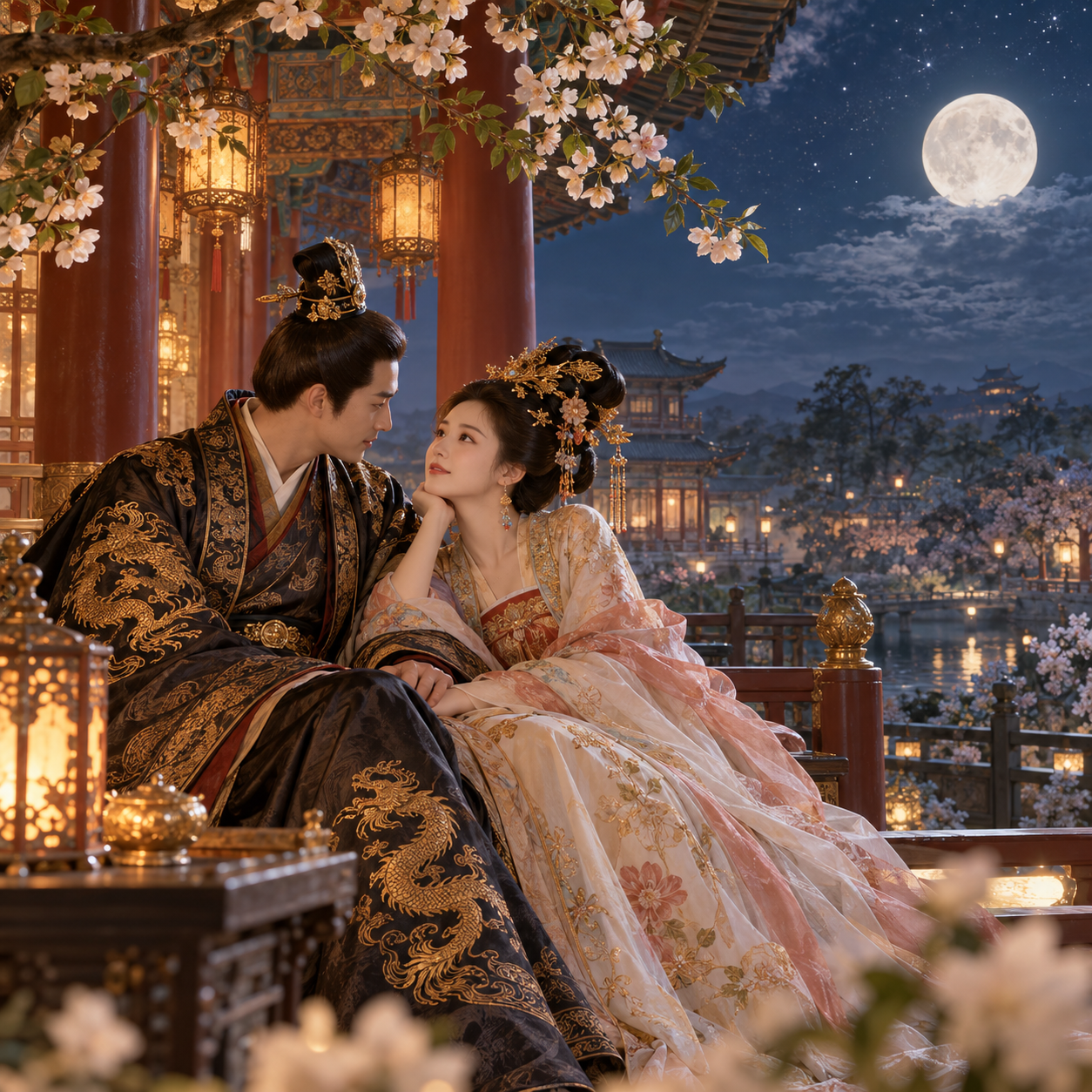
Emperor Minghuang of Tang favored beautiful women. For years after taking the throne, he kept searching for a beauty, but found none.
A daughter of the Yang family had just grown to womanhood, exquisitely lovely; raised in secluded inner chambers, she was unknown to outsiders in her peerless beauty.
Her natural beauty, enough to captivate cities and kingdoms, made it hard for her to remain unnoticed; sure enough, before long she became a consort of Emperor Minghuang of Tang.
When she glanced back and smiled, a thousand charms unfolded; every consort in the six palaces paled beside her.
In the lingering chill of spring, the emperor granted her a bath in Huaqing Pool, where warm, soothing spring water washed her skin, smooth as congealed cream.
Her maids supported her, delicate and graceful as a lotus emerging from water; from then on, she began to receive the emperor's favor.
Her hair was like clouds, her face like a flower, and she wore a golden dangling hair ornament. Within the warm hibiscus curtains, she shared a spring night with the emperor.
Deep in love, they regret only that the spring night is short, sleeping until the sun is high. Enamored of tender intimacy, the emperor no longer attends the early court.
Receiving the ruler's affection and attending his drinking, she was busy without a moment's leisure. In spring she accompanied him on outings, and every night she shared his bed.
There were no fewer than three thousand consorts and concubines in the rear palace, yet she alone enjoyed the emperor's favor.
She dresses and adorns herself in the golden chamber, nestling playfully beside the emperor every night; when the drinking and feasting end in the jade tower, her tipsiness lends her still more charm.
Because of her, her brothers and sisters all received lands and noble titles; the Yang family's glory inspired envy.
Thus parents throughout the realm changed their minds, coming to value daughters above sons.
On Mount Li, the jade halls and splendid towers of Huaqing Palace soar into the clouds; wherever the clear breeze passes, celestial music drifts in every direction.
Soft songs and graceful dances kept perfect time; every melody of pipes and strings was full of spirit. The emperor watched all day, yet never tired of them.
The rebellion's war drums from Yuyang thundered deafeningly, and the palace ceased playing the Rainbow Skirt and Feathered Robe Melody.
Dust suddenly swirled through the ninefold palace, and the emperor fled southwest with a great retinue of officials and beautiful consorts.
The procession advances and halts, having traveled barely more than a hundred li west of Chang'an.
The six armies halted and refused to advance, demanding Yang Yuhuan’s death. The sovereign had no choice but to have her strangled below Mawei Slope.
The ornaments from the imperial consort's hair lie scattered across the ground, with no one to gather them: kingfisher-feather plumes, golden bird ornaments, jade hairpins—precious adornments, one after another.
The sovereign wished to save her but could not. Covering his face, he wept; looking back at the scene of his beloved consort's cruel death, he could not stop his tears of blood.
The bleak autumn wind sweeps away fallen leaves, and the yellow dust has vanished; winding along the plank roads, the procession takes the ancient route through Sword Gate.
At the foot of Mount Emei, travelers are few; the banners have lost their color, the sun and moon their light.
Shu’s lovely mountains and waters stirred the emperor’s longing. Gazing at the moon from his temporary palace, he saw only desolation; listening to music on rainy nights, he heard sorrow in every note.
After the rebellion was quelled, the emperor returned to Chang’an. Passing Mawei Slope, the sights reminded him of her, and he lingered, unable to move on.
Below lush Mawei Slope, in a desolate earthen grave, the beauty's face is seen no more; only her tomb lies among the hills.
Ruler and ministers looked at one another, tears soaking their robes. Gazing east toward the capital in grief, they let their horses carry them back to court.
Returning, he found the pools and gardens unchanged: lotuses still grew beside Taiye Pool, and the drooping willows of Weiyang Palace remained as before.
The hibiscus blossoms resemble Yuhuan’s face, and willow leaves her brows; how could this sight fail to stir grief?
The spring wind opens peach and plum blossoms; the scene remains, but she is gone, and grief is unbearable. Autumn rain drips on parasol-tree leaves, making the lonely scene still more desolate.
Xingqing Palace and Ganlu Hall were desolate everywhere, overgrown with autumn grass. Fallen leaves covered the palace steps, long left unswept.
The performer’s hair is snow-white, and the palace women’s rosy beauty has faded. At night, fireflies flit through the palace; the solitary lamp burns out, yet the emperor still cannot sleep.
I count the slow strokes of bells and drums; the more I count, the longer the night seems. I gaze at the bright River of Stars until dawn breaks in the east.
Frost flowers form heavily again on the paired roof tiles; who shares the emperor’s sleep beneath the cold kingfisher quilt?
A year has passed since life and death divided us; why have you never come to me in a dream?
A Daoist priest from Linqiong was staying in Chang’an; he was said to be able to summon the imperial consort’s soul through magic.
He was moved by the sovereign's longing for his beloved consort. Accepting the imperial command, he dared not delay and searched diligently, riding the winds in every direction.
Riding the clouds into the sky, darting back and forth like lightning, he searched heaven above and the underworld below, all without success.
Suddenly he heard of an immortal mountain out at sea, surrounded by white clouds.
Exquisitely wrought towers and pavilions are borne upon auspicious clouds of five colors. Countless heavenly immortals and goddesses appear, each graceful and enchanting.
Among them was one named Taizhen, with skin like snow and a face like a flower, seemingly the very Consort Yang the sovereign sought.
The Daoist came to the west side of the golden palace, knocked softly at the courtyard gate carved from jade, and called out, asking Xiaoyu to have the maid Shuangcheng announce his arrival.
Hearing that the emperor’s messenger had arrived, Taizhen woke with a start inside her bed curtains. She put on her clothes, pushed aside her pillow, and stepped out. Screens were opened one after another, and the pearl curtain was lowered.
Just awakened, her cloudlike hair only half arranged, she descends from the terrace before she has time to finish dressing, her flowered crown still askew.
A gentle immortal breeze stirs her sleeves, making them flutter softly, graceful as the dance of Rainbow Skirts and Feathered Robes. Stillness
Lonely sorrow clouds her face, tears streaming down it, like pear blossoms drenched in spring rain.
She gazed with feeling at the emperor's envoy and entrusted him with her heartfelt thanks to the sovereign. Since their lasting parting on Mawei Slope, both news and the sight of one another had faded into obscurity.
The bond of love within Zhaoyang Palace was severed long ago; the loneliness in Penglai Palace still has long to endure.
Turning back to look down upon the human world, I find Chang'an hidden, with only dust and mist remaining.
Only the tokens from those days can express my deep affection; take the inlaid box and gold hairpin to the emperor as keepsakes.
She kept one prong of the golden hairpin and one half of the inlaid box; the hairpin's gold was split, and the box's precious inlay divided.
May our loving hearts remain as steadfast and firm as gold and jeweled inlay; in heaven or on earth, there will always be a chance to meet again.
At parting, she earnestly entrusted the Daoist adept with a message for the emperor expressing her feelings; the pledge within it was known only to the emperor and herself.
On the seventh day of the seventh month that year, in the Hall of Everlasting Life, at midnight with no one else around, we made vows as enduring as mountains and seas.
In heaven, may we be birds flying wing to wing; on earth, may we be branches growing intertwined.
Even heaven and earth, enduring as they are, must eventually end; but this regret across life and death will never have an end.
汉皇: originally Emperor Wu of Han; here it refers indirectly to Tang Xuanzong. Tang writers often used Han to stand for Tang.
重色: to be enamored of feminine beauty.
倾国: a woman of peerless beauty. In the Han dynasty, Li Yannian sang to Emperor Wu: 「北方有佳人,绝世而独立。一顾倾人城,再顾倾人国。宁不知倾城与倾国,佳人难再得。」 (“In the north there is a beauty, unmatched, standing alone. One glance overturns a city; another overturns a kingdom. Who does not know that cities and kingdoms may fall? Yet such a beauty is hard to find again.”) Later, “倾国倾城” (“overturning kingdoms and cities”) became an expression for a beautiful woman.
御宇: to command all within the realm, meaning to rule the world. Jia Changsha of the Han dynasty, “On the Faults of Qin”: “振长策而御宇内” (“Brandishing a long whip, he ruled all beneath heaven”).
杨家有女: Yang Xuanyan, a household affairs official in Shuzhou, had a daughter, Yang Yuhuan, who was raised from childhood by her uncle Yang Xuangui. At seventeen, in the twenty-third year of Kaiyuan, she was formally made consort to Li Mao, Prince of Shou, a son of Emperor Xuanzong. At twenty-seven, Xuanzong made her a Precious Consort. Bai Juyi's phrase “养在深闺人未识” (raised in secluded chambers, unknown to others) deliberately avoids a sensitive subject concerning the emperor.
丽质: beautiful natural appearance.
六宫粉黛: all the emperor’s consorts in the palace. Ancient emperors maintained six palaces: one principal chamber for daily government affairs and five private chambers for rest, collectively called the Six Palaces. 粉黛 originally refers to women’s cosmetics: powder for the face and dark pigment for the eyebrows. Here it stands for the women of the Six Palaces.
无颜色: meaning that, by comparison, all have lost their beauty.
华清池: the Huaqing hot springs, at the foot of Mount Li south of today’s Lintong District, Xi’an. Tangquan Palace was built in the eighteenth year of Zhenguan in the Tang dynasty, renamed Wenquan Palace in the second year of Xianheng, and expanded and renamed Huaqing Palace in the sixth year of Tianbao. Emperor Xuanzong stayed here every winter and spring.
凝脂: describes skin as fair, tender, and moist as congealed fat. The Book of Songs, “A Fair Lady” in “Airs of Wei,” says「肤如凝脂」—“her skin is like congealed fat.”
侍儿: a palace maid.
新承恩泽: newly receiving the emperor's favor.
金步摇: a gold hair ornament, fashioned with gold and silver wires coiled into floral shapes and decorated with dangling pearls and similar ornaments. Worn in the hair at the temples, it sways gracefully as the wearer walks.
芙蓉帐: bed curtains embroidered with lotus flowers, describing their exquisite beauty. Xiao Gang's Playfully Written in Xie Huilian's Style, in Thirteen Rhymes: “珠绳翡翠帷,绮幕芙蓉帐。” Pearl cords and kingfisher-green drapes, patterned hangings and lotus-embroidered curtains.
春宵: the wedding night.
佳丽三千: Three thousand beauties. The “后汉书·皇后纪” (Book of the Later Han, Annals of the Empresses) states: “自武元之后,世增淫费,乃至掖庭三千。” (“After Emperors Wu and Yuan, extravagant spending increased with each reign, until the palace women's quarters held three thousand.”) The phrase indicates the great number of women in the imperial harem. According to the “旧唐书·宦官传” (Old Book of Tang, Biographies of Eunuchs) and other records, during the Kaiyuan and Tianbao eras there were roughly forty thousand palace women across Chang'an's three palaces—the inner palace, Daming, and Xingqing—the princes' Ten Residences, the imperial grandsons' Hundred Grandsons Court, and the eastern capital's inner palace and Shangyang Palace.
金屋: “a golden house.” The Stories of Emperor Wu of Han records that when the emperor was a child, his aunt held him on her lap and asked whether he wanted her daughter Ajiao as his wife. He replied with a smile: “若得阿娇,当以金屋藏之。” (“If I could have Ajiao, I would keep her in a golden house.”)
列土: to grant lands as fiefs. According to the Old Book of Tang’s “Biographies of Empresses and Consorts” and other sources, Yang Guifei had three elder sisters, all of whom Xuanzong granted the title of Lady of a State. The eldest, known as the First Aunt, became Lady of Han. The Third Aunt became Lady of Guo. The Eighth Aunt became Lady of Qin. Her father, Xuanyan, was posthumously granted the titles of Grand Commandant and Duke of Qi in succession. Her mother was made Lady of Liang. Her uncle Xuangui became Minister of the Court of Imperial Entertainments. Her second cousin Xian became Minister of the Court of State Ceremonial. Qi became an Attendant Censor and married Princess Taihua, daughter of Consort Wu Hui. Her older kinsman Guozhong became Right Chancellor. 姊妹: sisters.
可怜: Lovely; worthy of admiration or envy.
不重生男重生女: valuing daughters over sons. Chen Hong's Account of the Song of Everlasting Sorrow records popular verses of the time: “生女勿悲酸,生男勿喜欢” (Do not grieve at a daughter's birth or rejoice at a son's), and “男不封侯女作妃,看女却为门上楣” (Sons gain no marquisate, while daughters become imperial consorts; daughters instead bring honor to the household).
骊宫: Huaqing Palace on Mount Li. Mount Li is in present-day Lintong, Shaanxi.
凝丝竹: string and wind instruments accompanying with a gentle, unhurried melody.
Yuyang: a commandery covering areas including present-day Pinggu County in Beijing and Ji County in Tianjin. At the time it lay within the jurisdiction of An Lushan, military commissioner of Pinglu, Fanyang, and Hedong. In the winter of the fourteenth year of Tianbao, An Lushan launched his rebellion in Fanyang.
鼙鼓: small drums used by ancient cavalry, here referring to war.
霓 (ní) 裳羽衣曲: “Rainbow Skirts and Feathered Robes,” the name of a dance melody. It is said to have been presented by Yang Jingshu, military governor of Xiliang, during the Tang Kaiyuan era, then revised and given lyrics by Emperor Xuanzong and renamed. The music sought to evoke an ethereal realm of immortals and the figures of celestial maidens.
九重城阙: the capital with its ninefold gates; here, Chang'an.
烟尘生: war breaks out. 阙 means the towers flanking the entrance to an ancient palace, and more broadly a palace or imperial residence. “Nine Arguments” in the Songs of Chu: 君之门以九重—“Your lordship’s gates stand nine layers deep.”
千乘(shèng)万骑西南行: a thousand chariots and ten thousand horsemen travel southwest. In the sixth month of the fifteenth year of Tianbao, An Lushan broke through Tong Pass and approached Chang'an. Xuanzong fled southwest through Yanqiu Gate with Yang Guifei and others. The accompanying guards were actually few; 「千乘万骑」 (a thousand chariots and ten thousand horsemen) is hyperbole. 乘: one chariot drawn by four horses. 骑: one rider on one horse.
翠华: banners decorated with kingfisher feathers, used in the emperor's ceremonial procession. Sima Xiangru's “上林赋” (Rhapsody on the Imperial Park): 建翠华之旗,树灵鼍之鼓。 (Raise banners adorned with kingfisher feathers; set up drums of sacred alligator hide.)
百余里: refers to reaching Mawei Slope, more than a hundred li from Chang'an.
「翠华摇摇行复止,西出都门百余里。」 (“The kingfisher-feathered imperial standard swayed, moving and stopping, more than a hundred li west of the capital gates.”): Li Longji fled west to Mawei Station, over a hundred li from Chang’an, in present-day Xingping, Shaanxi. His accompanying imperial guards mutinied, refused to advance, and demanded the deaths of the siblings Yang Guozhong and Yang Yuhuan to appease public anger. To preserve himself, Emperor Xuanzong had no choice but to comply.
六军: the emperor's armies. 《周礼·夏官·司马》:王六军。— The Rites of Zhou, “Offices of Summer, Minister of War,” states: “The king has six armies.” According to the annals of Xuanzong in the Old and New Books of Tang, the Comprehensive Mirror for Aid in Government, and other records: in the sixth month of the fifteenth year of Tianbao, Geshu Han reached Tong Pass, where his subordinate Huoba Guiren seized him and surrendered to An Lushan. Tong Pass fell, and the capital was thrown into panic. Xuanzong planned to flee to Shu but issued an edict announcing that he would lead a campaign in person. After the court audience ended, officials and commoners were terrified. At dawn on the yiwei day, Xuanzong fled through Yanqiu Gate. His attendants included only the chief ministers Yang Guozhong and Wei Jiansu, the eunuch Gao Lishi, the crown prince, princes, consorts, and princesses; many imperial grandchildren and those below them could not catch up. On the bingchen day, they halted at Mawei Station, north of Xingping County in present-day Shaanxi, and the armies refused to advance. Chen Xuanli, Grand General of the Dragon Martial Army, submitted: “The rebel Hu troops threaten the palace in the name of executing Guozhong, yet resentment and suspicion are also widespread among those within and outside the court. Now the state is in peril and Your Majesty's journey is unsettled. Your Majesty should heed the people's feelings and, for the greater good of the state, bring Guozhong and his followers to justice.” Tibetan envoys happened to stop Guozhong at the station gate to present their grievances, and the crowd cried: “Yang Guozhong is plotting rebellion with the Tibetans!” Soldiers surrounded the station on all sides. Even after Yang Guozhong, Wei Fangjin, and their kin had been executed, the troops did not disperse. Xuanzong ordered Gao Lishi to question them. He returned to report: “The generals have executed Guozhong, but with the imperial consort still in the palace, they remain afraid.” Xuanzong then ordered Lishi to command the consort to take her own life.
宛转: describes the lingering sorrow of the beauty as she approaches death. 蛾眉: an ancient term for a beautiful woman, here referring to Imperial Consort Yang. The Book of Songs, “A Fair Lady” in “Airs of Wei,” says: 螓首蛾眉—“a cicada-like forehead and moth-like brows.”
花钿: flower-shaped ornaments made from gold, kingfisher feathers, pearls, gemstones, and similar materials.
委地: discarded on the ground.
翠翘: a hair ornament shaped like a kingfisher’s tail.
金雀: a golden bird hairpin, shaped like a phoenix, anciently called the Vermilion Bird.
玉搔头: a jade hairpin. Miscellaneous Records of the Western Capital, Volume Two: 武帝过李夫人,就取玉簪搔头。自此後宫人搔头皆用玉。—“Emperor Wu visited Lady Li and took a jade hairpin to scratch his head. Thereafter, palace women all used jade to scratch their heads.”
云栈: a plank road rising high into the clouds.
萦纡(yíngyū): to wind and coil.
剑阁: Jiange, also called Jianmen Pass, north of present-day Jiange County, Sichuan, an important… on the route from Qin into Shu
A road. Here the mountains rise like swords; where the sheer cliffs break, two peaks face each other like gates. While serving as Shu’s chancellor, Zhuge Liang had rock cut away and an elevated plank road built to allow passage.
峨嵋山: Mount Emei, in present-day Emeishan, Sichuan. Xuanzong did not pass this mountain while fleeing to Shu; here it refers broadly to the high mountains of Shu.
行宫: a temporary residence used by an emperor when traveling away from the capital.
夜雨闻铃 (“hearing bells in the night rain”): Miscellaneous Records of Emperor Ming, “Supplement”: “明皇既幸蜀,西南行。初入斜谷,霖雨涉旬,于栈道雨中闻” (“After Emperor Ming set out for Shu, he traveled southwest. On first entering Xie Valley, persistent rain lasted more than ten days; amid the rain on the plank road he heard
The bells' sound echoed among the mountains. Still mourning the Precious Consort, His Majesty took their sound to compose the ‘Rain-Soaked Bells’ melody and express his sorrow.” This passage alludes to that incident. Later, “雨霖铃” (Rain-Soaked Bells) became the name of a Song ci tune pattern.
天旋日转: A turn for the better in the political situation. In the second year of Emperor Suzong's Zhide era, Guo Ziyi's army recaptured Chang'an.
回龙驭: the emperor’s carriage returns.
不见玉颜空死处: “Her lovely face is gone; only the place of her death remains.” According to the “Biographies of Empresses and Consorts” in the Old Book of Tang, after Xuanzong returned from Shu, he ordered a palace envoy to offer sacrifices to Consort Yang and secretly instructed that she be reburied elsewhere. She had originally been wrapped in a purple quilt. Her flesh had decayed, but her scented pouch remained. A palace official presented it to the retired emperor, who gazed at it in sorrow. He then ordered her likeness painted in a separate palace hall and looked at it morning and evening.
信马: to let the horse go where it will, with no thought of urging it on with the whip.
太液: there was a Taiye Pool in the Han imperial palace.
未央: The Han dynasty had Weiyang Palace. Here these palace references all stand for the Tang imperial palace in Chang'an.
春风桃李花开夜 (nights when peach and plum blossoms open in the spring breeze): one variant reads “春风桃李花开日” (days when peach and plum blossoms open in the spring breeze).
西宫南苑: one variant reads “西宫南内”; the imperial palace precincts were called 大内. 西宫 is Taiji Palace, the western inner palace, while 南内 is Xingqing Palace. After returning to the capital, Xuanzong initially lived in the southern inner palace. In the first year of Shangyuan, the powerful eunuch Li Fuguo, acting in Suzong's name, forced Xuanzong to move to the western inner palace and banished his trusted attendants, including Gao Lishi and Chen Xuanli.
梨园弟子: the musicians and dancing women trained by Xuanzong in earlier days. 梨园: according to the New Book of Tang’s “Treatise on Rites and Music,” an institution for musical instruction in Xuanzong’s palace. Three hundred performers from the “坐部伎” (“seated ensembles”) were selected for training in song and dance, ready to perform at imperial command, and were known as the “皇帝梨园弟子” (“Emperor’s Pear Garden Disciples”).
椒房: the consort’s residence, so named because its walls were plastered with clay mixed with Sichuan pepper. 阿监: a female palace attendant and official. 青娥: young palace women. According to the “Treatise on Officials” in the New Book of Tang, the palace disciplinary office included an ajian and a deputy ajian, with status equivalent to the seventh rank.
孤灯挑尽: In earlier times, oil lamps provided light, and their oil-soaked wicks had to be lifted slightly from time to time to keep the flame bright. 挑尽 indicates that the night is far advanced. Note that the Tang palace burned candles at night rather than oil lamps; the phrase here evokes the bleakness of Xuanzong's life in his later years.
迟迟: slowly. The bells and drums that marked the night watches had fixed times for beginning and ending; here the word conveys Xuanzong’s feelings as he lies sleepless through the long night.
耿耿: faintly shining.
欲曙天: the time when a long night is about to give way to dawn.
鸳鸯瓦: paired roof tiles fitted together, one facing down and the other up. 《三国志·魏书·方技传》, “Records of the Three Kingdoms, Book of Wei, Biographies of Practitioners of Special Arts,” records that Emperor Wen dreamed two tiles fell from a palace roof and became a pair of mandarin ducks. Roof tiles joined in alternating concave and convex pairs are called yin-yang tiles, or mandarin-duck tiles.
霜华: frost crystals.
翡翠衾: a quilt embroidered with kingfishers. 《楚辞·招魂》, “Songs of Chu, Summoning the Soul”: 翡翠珠被,烂齐光些。 — Kingfisher-adorned, pearl-studded quilts shine together brilliantly. The reference emphasizes their preciousness.
谁与共: with whom to share.
临邛道士鸿都客: meaning a Daoist priest who came to Chang'an from Linqiong. Linqiong is present-day Qionglai County, Sichuan; 鸿都 refers to an immortal abode.
致魂魄: summoning the spirit of the deceased Yang Guifei.
方士: a practitioner of magical arts, here a Daoist priest.
殷勤: to do one’s utmost.
排空驭气: Riding through the clouds and mist.
穷: to exhaust; to search everywhere.
碧落: the sky.
黄泉: the realm beneath the earth.
海上仙山: immortal mountains at sea. Records of the Grand Historian, “Treatise on the Feng and Shan Sacrifices”: from the reigns of Kings Wei and Xuan and King Zhao of Yan, people were sent out to sea to seek Penglai, Fangzhang, and Yingzhou, the three sacred mountains said to lie in the Bohai Sea.
玲珑: exquisite and finely crafted.
五云: clouds of five colors.
绰约: graceful and delicately beautiful in bearing. 《庄子·逍遥游》, Zhuangzi, “Free and Easy Wandering”: 藐姑射之山,有神人居焉,肌肤若冰雪,绰约如处子。 — On distant Mount Gushe lives a divine being, with skin like ice and snow and the gentle grace of a maiden.
参差: seemingly, more or less.
金阙: golden palace towers. Volume 66 of the Imperial Reader of the Taiping Era quotes the Great Cavern Jade Scripture: within the gate of the Palace of Supreme Clarity are two towers, the golden tower on the left and the jade tower on the right. 西厢: western side chamber. The Erya, “Explaining Palaces,” states: “室有东西厢日庙。” A chamber with eastern and western wings is called a temple. The western wing is on the right.
玉扃(jiōng): a jade gate, an alternative expression for 玉阙, the jade palace gates.
转教小玉报双成: having Xiaoyu pass word to Shuangcheng, suggesting that the immortal residence has courtyard after courtyard, requiring messages to pass through intermediaries. 小玉: Xiaoyu, daughter of Fuchai, King of Wu. 双成: Shuangcheng, a legendary attendant of the Queen Mother of the West. Here both names refer figuratively to Yang Guifei's attendants on the immortal mountain.
九华帐: a canopy adorned with splendid embroidery. 九华 refers to a pattern of layered floral ornaments, emphasizing the canopy’s exquisite workmanship. The Book of Song, “Biographies of Empresses and Consorts,” says: 自汉氏昭阳之轮奂,魏室九华之照耀—“From the magnificence of the Han dynasty’s Zhaoyang Palace to the radiance of Wei’s Ninefold Flower decorations.”
珠箔: a pearl curtain.
银屏: a screen decorated with silver.
迤逦: continuously, one after another.
云鬓: Also written 「云髻」, describing a woman's luxuriant, cloudlike hair at the temples or coiffure.
新睡觉: just awakened from sleep. 觉: to wake.
袂 (mèi): a sleeve.
飘飖: a variant reading is 「飘飘」; both describe floating or fluttering.
玉容寂寞: here describes a lovely face looking dimmed and sorrowful.
阑干: Crisscrossing; here it describes tear tracks covering the face.
凝睇 (dì): to gaze intently.
昭阳殿: Zhaoyang Hall, the sleeping palace of Zhao Feiyan, a favored consort of Emperor Cheng of Han. Here it refers figuratively to the palace where Yang Guifei once lived.
蓬莱宫: the legendary immortal mountain in the sea. Here it refers to the consort's dwelling on that mountain.
人寰(huán): the human world.
旧物: the keepsake exchanged as a pledge of love with Xuanzong during her lifetime.
寄将去: to entrust to the Daoist priest to take back.
擘: to split apart.
合分钿: to divide the ornamentation on the inlaid box into two parts.
「钗留一股合一扇,钗擘黄金合分钿。」 (“She kept one prong of the hairpin and one half of the box, splitting the golden pin and dividing the inlaid case.”): she divides the golden hairpin and decorated box into two, retaining half of each.
但令: a variant reads 「但教」; both mean “if only” or “provided that.”
重寄词: as she takes her leave, the consort again entrusts him with a message.
两心知: Only Xuanzong and the Precious Consort understood it in their hearts.
长生殿: the Hall of Everlasting Life, built within Huaqing Palace on Mount Li in the first year of Tianbao. The six lines beginning with “七月” (“the seventh month”) are the poet’s invention. In “The Song of Everlasting Sorrow” in his Draft Studies and Annotations on the Poetry of Yuan Zhen and Bai Juyi, Chen Yinke writes: “长生殿七夕私誓之为後来增饰之物语,并非当时真确之事实” (“The secret vow on the Double Seventh at the Hall of Everlasting Life was a story embellished later, not an actual event of the time”). “玄宗临幸温汤必在冬季、春初寒冷之时节。今详检两唐书玄宗记无一次于夏日炎暑时幸骊山。” (“Xuanzong’s visits to the hot springs invariably took place in winter or the cold of early spring. A close examination of his annals in both Tang histories reveals no visit to Mount Li in summer’s heat.”) The so-called Hall of Everlasting Life was also a customary name for the imperial sleeping quarters in Chang’an, rather than the hall of that name in Huaqing Palace.
比翼鸟: a legendary bird said to have only one eye and one wing; male and female must join together to fly.
连理枝: two trees whose trunks embrace and grow together. The ancients often used these two images to symbolize lovers devoted to each other, never to part.
恨: regret.
绵绵: continuous and unbroken.
无绝期: with no time of ending. One variant reads “无尽期” (without end).
“Song of Everlasting Sorrow” is a long narrative poem by the Tang poet Bai Juyi. It vividly recounts the tragic love of Tang Xuanzong and Consort Yang. Drawing on historical figures and legends, the poet creates a moving story full of turns, using its artistic portrayals to convey truths of actual life and touch readers across the centuries. The poem has profoundly influenced many later literary works.
In this long narrative poem, the author uses concise language, beautiful imagery, and a blend of storytelling and lyric expression to recount the tragic love of Emperor Xuanzong of Tang and Consort Yang during the An Lushan–Shi Siming Rebellion. Their love is destroyed by a rebellion of their own making, and they endlessly suffer its bitter spiritual consequences. Xuanzong and Consort Yang were historical figures, but the poet does not confine himself to historical fact. Taking a shadow of history, contemporary legends, and songs sung in the neighborhoods, he transforms them into a winding, deeply moving story, portraying and celebrating it through an art form full of recurrence and lingering anguish. Because its story and characters are artistically transformed representations of the complex reality of human beings, the poem has continued to stir ripples in the hearts of readers through successive ages.
The poem has three parts. The first, from the opening to “惊破霓裳羽衣曲” (shattering the Rainbow Skirt and Feather Robe melody), uses thirty-two lines to portray the love between Emperor Minghuang of Tang and Yang Guifei, recounting the resulting neglect of government, disorder in the realm, and outbreak of the An Lushan Rebellion. The second, from “九重城阙烟尘生” (smoke and dust rise within the ninefold capital) to “魂魄不曾来入梦” (her spirit never came into his dreams), consists of forty-two lines describing Yang Guifei's death during the mutiny at Mawei Station and Emperor Xuanzong's subsequent longing for her. The final part, from “临邛道士鸿都客” (a Daoist from Linqiong, a visitor to Hongdu) to the end, tells how a Daoist helps Emperor Xuanzong seek Yang Guifei on an immortal mountain.
The poet opens with 「汉皇重色思倾国」 (“The Han emperor prized beauty and longed for one who could topple a kingdom”), explaining the cause of the Tang dynasty's calamity and revealing the tragic elements of the story. It seems ordinary, as though the story naturally ought to begin here and required little thought from the author. In fact, these seven characters contain a great deal and form the guiding statement of the whole poem: they reveal its tragic elements while setting the entire work in motion and governing its course. Everything that follows arises from them. The poem then unfolds in successive layers: first it tells how Tang Xuanzong prized beauty and, after searching every possible way, finally took into his embrace Consort Yang, of whom it is said, 「回眸一笑百媚生,六宫粉黛无颜色」 (“One backward glance and smile gave birth to a hundred charms; the painted beauties of the six palaces lost all their color”). It then portrays her beauty, showing her captivating grace and how it won her favor in the harem. 「姊妹弟兄皆列土」 (“Her sisters and brothers were all granted lands”): as the saying goes, 「一人得道,鸡犬升天」 (“When one person attains the Dao, even their chickens and dogs ascend to heaven”). Through Consort Yang, her family became overpoweringly influential and overbearing. Having gained her, Xuanzong lived a life of indulgence and pleasure, immersed all day in song, dance, wine, and beauty, until 「从此君王不早朝」 (“From then on, the emperor no longer attended morning court”). The poet repeatedly elaborates on this, thereby identifying the cause of the An Lushan–Shi Siming Rebellion. This section forms the foundation of the entire love tragedy and contains the internal cause of the “everlasting sorrow.” “Through this realistic portrayal of palace life, the poet introduces the story's two protagonists with no small measure of satire: an emperor who values beauty above his country and a charming consort who relies on imperial favor. It also vividly suggests that Xuanzong's infatuation with beauty, to the detriment of the state, is the root of the tragedy.
In this tragedy of love, Yang Guifei’s death is a pivotal event. In the second section, the poet describes in detail the emperor and his forces fleeing in panic toward the southwest after the An Lushan Rebellion broke out, particularly the destruction of Tang Xuanzong and Yang Guifei’s love amid the upheaval. This is precisely what leads to her death. 「六军不发」—“the six armies refuse to advance”—and their demand for her execution show that Xuanzong’s favor and infatuation have already provoked public anger. Here the poet depicts their final separation in six lines: 「六军不发无奈何,宛转蛾眉马前死。花钿委地无人收,翠翘金雀玉搔头。君王掩面救不得,回看血泪相和流。」—“The six armies will not move; nothing can be done. The graceful beauty dies before the horses. Floral ornaments lie scattered, with no one to gather them: kingfisher-feather pins, golden birds, and jade hairpins. The emperor covers his face, unable to save her; looking back, blood and tears mingle as they flow.” Grief overflows the words. Especially in 「君王掩面救不得,回看血泪相和流」—“The emperor covers his face, unable to save her; looking back, blood and tears mingle as they flow”—the poet’s delicate touch vividly conveys Xuanzong’s inner conflict and anguish: he cannot bear to relinquish his beloved, yet cannot rescue her.
Rather than directly describing Emperor Xuanzong's suffering from longing after Yang Guifei's death, the poet seizes upon the heart-wrenching 「恨」 (sorrow) within his inner world to express a tender, desolate yearning. From 「君臣相顾尽沾衣」 (Sovereign and ministers look at one another, their robes all wet with tears) to 「魂魄不曾来入梦」 (Her spirit has never entered his dreams), the poem describes Emperor Ming's return from Shu to the capital after conditions stabilize, with the journey through Mawei awakening painful memories. After his return, every sight stirs grief, and he cannot dispel the sadness of thinking of her morning and night. Back in the palace, the surroundings remain but she is gone. By day, objects awaken sorrow; by night, he 「孤灯挑尽」 (tends the solitary lamp until it burns out) yet cannot 「成眠」 (fall asleep). Thinking of her day and night cannot end his lingering, agonizing longing, so he places his hopes in dreams. How many months have separated the living and the dead, yet 「魂魄不曾来入梦」 (her spirit has never entered his dreams). The 「恨」 (sorrow) of 「长恨」 (everlasting sorrow) moves the soul.
From 「临邛道士鸿都客」 (“A Daoist from Linqiong, a visitor to Hongdu”) to the poem’s end, the Daoist helps Emperor Xuanzong of Tang search for Yang Guifei. The poet uses a romantic mode, ascending to heaven one moment and descending beneath the earth the next: 「上穷碧落下黄泉,两处茫茫皆不见」 (“He searched the blue heavens above and the Yellow Springs below; in both boundless realms, she was nowhere to be seen”). Eventually, Yang Guifei is found on a misty, elusive island of immortals at sea. She reappears in that enchanted realm as 「玉容寂寞泪阑干,梨花一枝春带雨」 (“Her jade-like face lonely, tears streaming down—a branch of pear blossom bearing spring rain”). She warmly welcomes the Han emperor’s messenger, brimming with affection, entrusting him with keepsakes and words, and renewing her former vow. This answers Xuanzong’s longing for her and further deepens and develops the theme of “everlasting regret.” The poem closes with 「天长地久有时尽,此恨绵绵无绝期」 (“Even enduring heaven and earth will one day end; this regret flows on without an end”). These lines state the central theme, respond to the opening, and achieve 「清音有馀」 (“a clear note that continues to resonate”), leaving readers room for association and reflection.
The first artistic pleasure offered by “Song of Everlasting Sorrow” lies in its moving, winding story and its ingenious, distinctive conception. The whole poem centers on “长恨” (everlasting sorrow), yet the poet begins with “重色” (prizing beauty), dwelling on it at great length. “日高起” (rising when the sun is high), “不早朝” (forgoing morning court), “夜专夜” (claiming night after night), and “看不足” (never tiring of looking) seem to depict joy at its utmost, almost a comedy; yet this extreme joy throws the endless sorrow that follows into sharp relief. Tang Xuanzong's indulgence harms the realm and brings about a political tragedy, which in turn causes the tragedy of his love with Consort Yang. The maker of the tragedy ultimately becomes its central sufferer: this is the story's distinctive twist and the reason its lovers must endure everlasting sorrow. Many earlier readers found an admonitory meaning in the poem; that meaning resides here. In the scene of Consort Yang's death at Mawei Slope, the poet works with extraordinary delicacy, vividly embodying Xuanzong's inner conflict and pain: he cannot bear to surrender his beloved, yet cannot save her. It is this final parting, in which “血泪相和流” (blood and tears flow together), that gives rise to unending sorrow. The poet then devotes many lines to repeatedly rendering Xuanzong's longing for Consort Yang from different angles. Yet the plot does not remain fixed at a single emotional point. As the characters' inner worlds unfold layer by layer, and the scenery answering their feelings continually changes, time and story move forward; their thoughts and emotions open up and propel the plot. Xuanzong flees toward Shu after the fatal separation, his heart full of anguish and grief. Returning to the capital, he passes familiar places that awaken painful memories. Back in the palace, objects stir his sorrow by day, and he tosses sleeplessly at night. Thinking of her day and night without finding her, he places his hopes in dreams, only to find that “悠悠生死别经年,魂魄不曾来入梦” (long years have passed since life and death divided them, yet her spirit has never entered his dreams). By this point, the sorrow of everlasting sorrow has been portrayed with profoundly moving force, and the story could seemingly end here. But the poet changes direction and opens another realm. On the bright wings of imagination, he conceives an enchanting immortal world, bringing the tragic plot to its climax and giving the story further turns, rises, and waves. The shift is unexpected yet entirely understandable. Through the continual conflict and collision between subjective desire and objective reality, the poem fully expresses the characters' endlessly turning emotions, making the story still more intricate and moving.
The Song of Everlasting Sorrow is a narrative poem with a strong lyrical element. In telling the story and portraying its characters, the poet draws on expressive techniques characteristic of traditional Chinese poetry, harmoniously combining narrative, scenery, and emotion to create a recurring, circling lyrical movement. At times he invests the scenery with the characters' thoughts and feelings, letting its refracted light illuminate their state of mind; at others he selects distinctive scenes and objects around them and reveals their inner feelings through their responses. Layer upon layer, he gives fitting expression to emotions stored deep within that are difficult to articulate. As Emperor Xuanzong flees southwest, yellow dust, plank roads, and high mountains surround him; the sunlight is dim, the banners lack luster, and autumn is desolate. This mournful autumn scenery heightens his sorrow. In Shu, even amid green mountains and clear waters, he cannot forget her, morning or evening. Shu's landscapes are beautiful, but to the lonely, grieving Xuanzong, the mountains' 「青」 (green) and the waters' 「碧」 (blue-green) alike bring pain. Nature's beauty requires a tranquil mind to be enjoyed; lacking one, he suffers all the more. Beautiful scenery thus conveys grief, deepening the emotion another degree. Moonlight at the temporary palace and bells on a rainy night are already evocative. By seizing on these ordinary yet distinctive things, the poet leads us into a realm of heartbreak. Sight and sound, color and tone interweave, and the language and cadence also express the character's inner sorrow and desolation, adding another layer. On the return to the capital, 「天旋地转」 (heaven and earth turn around): the reversal of events should bring happiness, yet passing old places without seeing her jade-like face makes him weep. Painful memory adds another layer to the narrative. After his return to Chang'an, 「归来池苑皆依旧,太液芙蓉未央柳。芙蓉如面柳如眉,对此如何不泪垂」 (Returning, he finds the pools and gardens unchanged: lotuses of Taiye, willows of Weiyang. The lotuses resemble her face, the willows her brows; how could he face them without tears?). By day, surroundings and scenery call the beloved to mind: the sights remain, but she is gone, and he cannot help weeping. In the lotuses of Taiye Pool and the graceful willows of Weiyang Palace, he seems to see Yang Guifei's face. This reveals an extraordinarily complex and subtle inner life. 「夕殿萤飞思悄然,孤灯挑尽未成眠。迟迟钟鼓初长夜,耿耿星河欲曙天。」 (Fireflies drift through the evening hall; his thoughts fall silent. He tends the lone lamp to its end, still unable to sleep. Slow bells and drums begin the long night; the bright River of Stars approaches dawn.) From dusk to daybreak, these lines concentrate on his sleeplessness, haunted by longing. This painful yearning persists on 「春风桃李花开日」 (days when peach and plum blossoms open in the spring wind) as it does at 「秋雨梧桐叶落时」 (times when parasol-tree leaves fall in autumn rain). Seeing the former 「梨园弟子」 (Pear Garden performers) and 「阿监青娥」 (palace attendants and young women) now white-haired and aged stirs still more memories of past happiness, naturally leaving him grief-stricken. From swirling yellow dust to Shu's green mountains, from rain at the temporary palace to triumphant return, from day to night and spring to autumn, objects everywhere awaken sorrow, and sights constantly call her to mind. From every direction, the poem repeatedly intensifies its protagonist's anguished pursuit and search. Unable to find her in waking life, he searches in dreams; unable to find her in dreams, he searches in the immortal realm. Through these turns and returns, with feeling built up layer upon layer, the character's emotions circle upward to a climax. Through precisely this repeated intensification, lyric expression, and circling movement, the poet makes the character's thoughts and feelings deeper and richer, giving the poem a 「肌理细腻」 (delicately wrought texture) and greater artistic power.
Let words find a melody
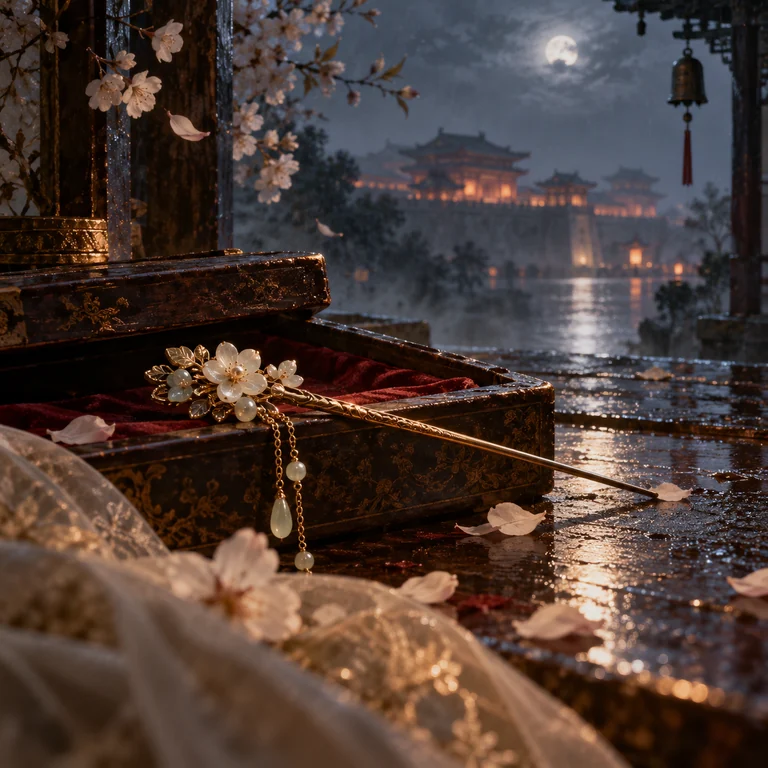
From a poem into a story
Rong Sheng accepts a broken gold hairpin and agrees to find Lord Pei’s late wife, said to have died for love, hoping to earn enough to treat his sister’s eyes. Yet the first things to surface in the bronze basin are a pair of worn-out shoes. The woman who appears afterward is no peerless beauty, nor does she acknowledge the old romance celebrated in song. From behind a screen, Lord Pei tells him to try again. But the woman says the hairpin is hers and asks him to find those shoes.
Start readingAI-assisted writing · Fictional characters and events
