
Writing of What I Saw at Night
Song dynasty・Ye Shaoweng

Song dynasty・Ye Shaoweng
萧萧梧叶送寒声,— Rustling parasol-tree leaves carry the sound of cold,
The autumn wind upon the river stirs a traveler's feelings.
I know that children are teasing out crickets,
Deep in the night, a single lamp shines by the fence.
The animation remains in its original Chinese.
The animation is ready.
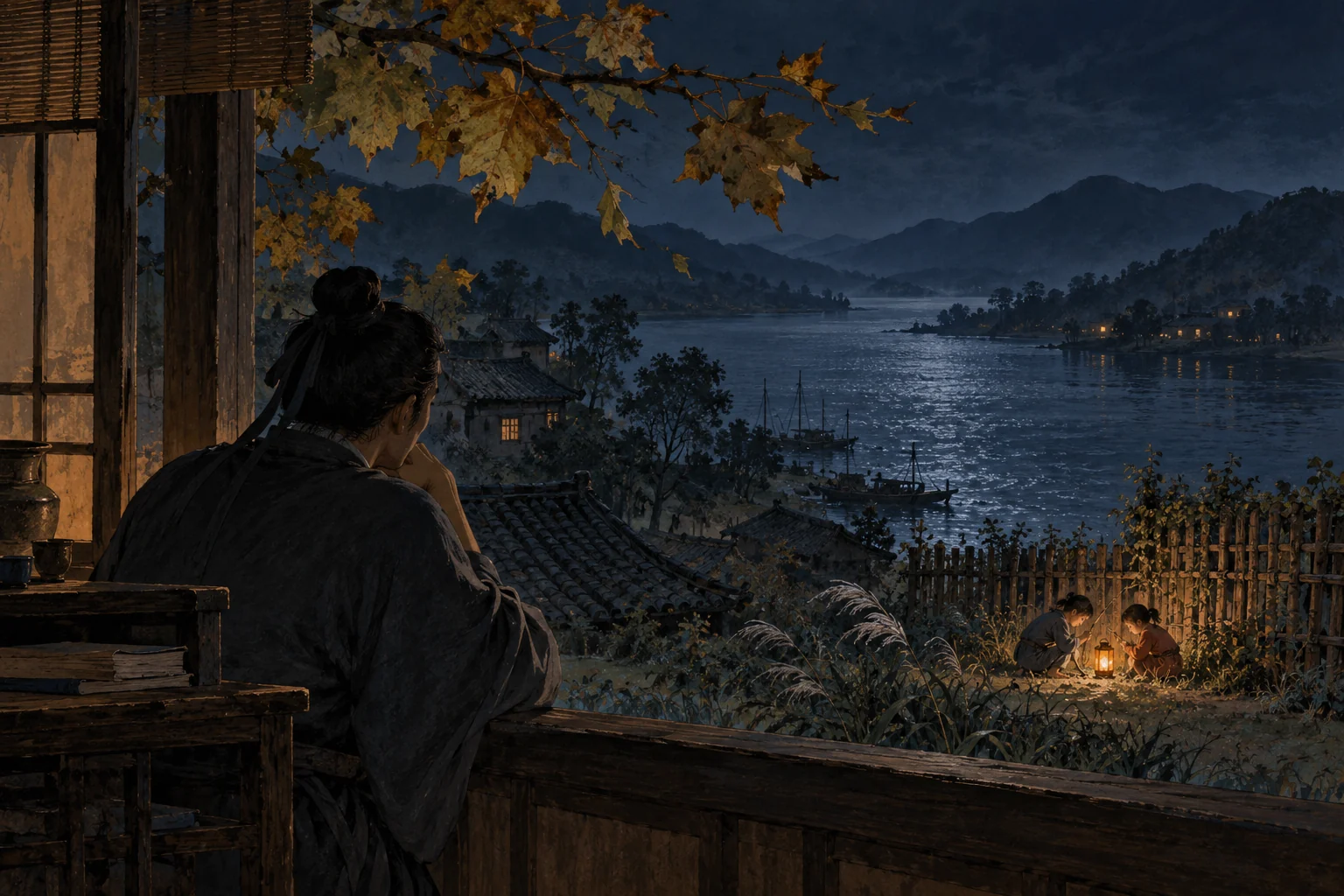
Parasol-tree leaves rustle in the wind, as though bringing the chill of the autumn night close beside me.
The autumn wind blowing across the river stirs homesickness in me, a traveler far from home.
I imagine children beside the fence, holding slender twigs and searching through the grass for hidden crickets.
The night is already so deep, yet a little lamp still shines beside that fence.
夜书所见: recording at night the scenes one has seen. “书” here means to write or record.
萧萧: here describes the rustling sound of wind blowing through Chinese parasol tree leaves.
梧叶: leaves of the Chinese parasol tree, a feature that explicitly signals autumn in the poem.
寒声: a sound that makes one feel cold. The poet connects the sound of leaves with the autumn chill felt by the body.
客情: feelings experienced while living away from home; in context, they may be understood to include homesickness.
挑: pronounced tiǎo, to poke or stir with something long and slender. Here it describes children probing for crickets, rather than carrying a load on the shoulder.
促织: a cricket, also called 蛐蛐.
篱落: a fence.
知有: to know or infer that something is there. The final two lines can also be understood as “seeing a light and thinking of children's activities”; details left unwritten need not be treated as things the author personally witnessed.
“Recording What I Saw at Night” is a seven-character quatrain about an autumn night away from home. The sound of parasol-tree leaves, the autumn wind on the river, and a small light beside a fence connect a traveler’s thoughts with children’s nighttime activities. “书” in the title means to record; this reading does not infer a specific year, location, or personal experience of the author from the poem’s meaning. The translations, annotations, and appreciation below are newly prepared reading guides, not the author’s original preface.
The poem lets readers hear before they see. In the first line, “萧萧,” rustling, brings the fine sound of wind through parasol-tree leaves into the night; “送,” send, gives that sound a direction, toward a person. The leaves' sound belongs to hearing, while “寒,” cold, is a bodily sensation. Combined in “寒声,” a cold sound, they make autumn more than scenery outside the window: it enters the traveler's feelings.
The second line pushes the view out across the river, then draws it inward with “动客情” (“stirs a traveler’s feelings”). The poet neither lists reasons for homesickness nor states how long he has been away, leaving only the word “客” (“traveler”). From it, readers understand that, facing the same autumn wind, this person carries concerns that prevent him from returning home as securely as a local resident might. Although the opening two lines offer a broad expanse, the human figure within it seems alone.
The turn comes with “儿童” (“children”). Rather than continuing to state the traveler's sorrow directly, the poem turns its gaze toward children active at night. The word “挑” (“probe”) sets the scene in motion: the children's attention rests among grass blades and insect calls, their movements light but intent. This small, immediate pleasure contrasts with the thoughts stirred in the traveler by the autumn wind. The children's ease does not dispel his sorrow; instead, it deepens our understanding of how adults feel after leaving home.
The final line gathers the entire night scene into “一灯” (“a single lamp”). “夜深” (“deep into the night”) establishes the surrounding darkness and stillness; “一” (“one”) emphasizes the light’s smallness while making it especially distinct. Although the sentence places “知有儿童” (“I know there are children”) before “一灯明” (“a single lamp shines”), readers may understand the sequence in reverse: seeing light beside the fence prompts the thought that children may be searching for insects there. What is visible and what is imagined thus illuminate each other.
This lamp belongs first to someone else’s life; it is no proof that the poet has reached his own doorstep. It may evoke everyday life at home or childhood pleasures, or it may simply be a small light that makes a traveler’s night feel more welcoming. The poem assigns no single memory to the reader, still less depicts an actual homecoming. Recognizing this openness allows us to read, alongside homesickness, the poem’s attentiveness to ordinary life.
From parasol-tree leaves and river wind to a fence and lamplight, the scene gradually narrows while the emotion finds an increasingly tangible focus. “送” (carry), “动” (stir), “挑” (probe), and “明” (shine) link sound, feeling, action, and light, giving these four brief lines a clear progression. Their lingering effect comes from a little warmth in the cold night, rather than an impassioned declaration that settles the meaning of homesickness.
Let words find a melody

From a poem into a story
Shen Heng, who earns his living copying books beside the river, keeps postponing his return home. One autumn night, two children beside the hedge damage a paper lantern and come seeking his skill; if he stops writing to repair it, he will receive less pay when he delivers his manuscript tomorrow morning. When the lantern shines again, he finally finishes the letter home he has never dared to send.
Start readingAI-assisted writing · Fictional characters and events
