
Dielianhua · Having Known All the Bitterness of Parting Far from Home
Qing dynasty・Wang Guowei

Qing dynasty・Wang Guowei
阅尽天涯离别苦。不道归来,零落花如许。花底相看无一语,绿窗春与天俱莫。— I have tasted all the bitterness of parting at the ends of the earth. Who could have thought that, on returning, I would find the flowers so fallen and scattered? Beneath the blossoms we look at each other without a word; by the green window, spring and daylight fade together.
I had hoped to tell my longing beneath the lamp. One thread of new joy, a thousand upon thousand threads of old sorrow. Hardest to keep in this world: a youthful face leaving the mirror, flowers leaving the tree.
The animation remains in its original Chinese.
The animation is ready.
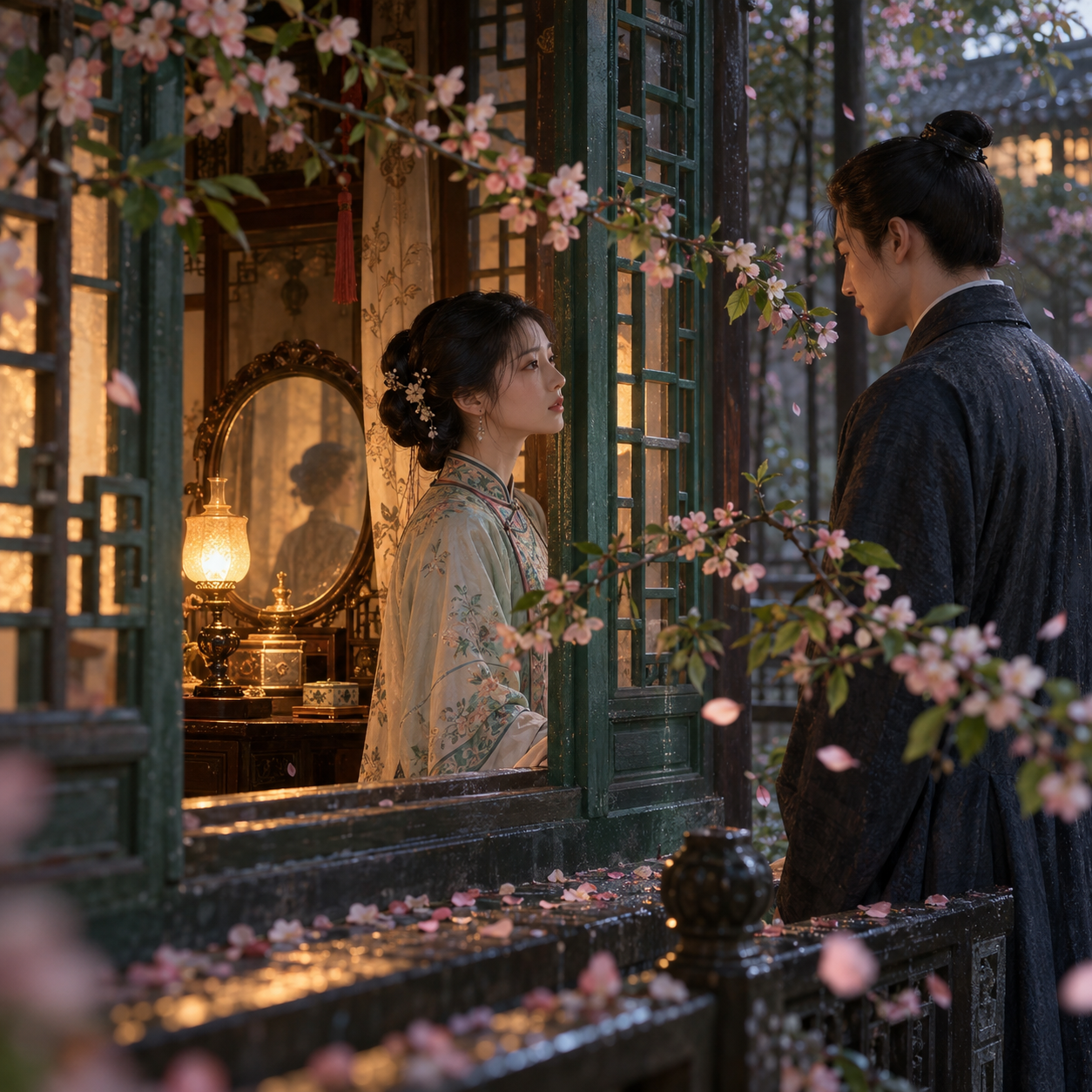
I had long endured the pain of parting far from home, never imagining that on my return I would find the flowers so scattered and faded. Beneath the blossoms, she and I gazed sadly at each other, neither speaking a word. The fragrant spring beneath the green window, too, had grown late, keeping pace with the season.
I had planned, beneath the lamp late at night, to tell in detail of my longing since we parted. Yet a little new joy stirred endless old sorrow. What is hardest to keep in this world is youth, which leaves the mirror never to return, and fallen blossoms drifting from the tree.
蝶恋花 (Dielianhua): a lyric tune pattern, also called 凤栖梧 (Phoenix Perching on the Parasol Tree), 鹊踏枝 (Magpie on the Branch), and other names. It has sixty characters in two stanzas, each with four oblique-tone rhymes.
阅: to experience.
不道: unexpectedly.
如许: Like this.
绿窗: a green gauze window, referring to a woman’s quarters. Wei Duanji’s “Pusaman”: “劝我早归家,绿窗人似花。” (“She urges me to return home early; by the green window, she is like a flower.”)
莫: used for 「暮」, meaning evening.
新欢: the joy of reunion after a long separation.
旧恨: the longstanding pain of longing.
朱颜辞镜花辞树 (“Youthful beauty leaves the mirror, flowers leave the tree”): Feng Zhengzhong of the Southern Tang, “Quetazhi”: “日日花前常病酒,不辞镜里朱颜瘦。” (“Day after day before the flowers, I am often ill from wine; I do not mind my youthful face growing thin in the mirror.”)
In the spring of the thirty-first year of Guangxu (1905 CE), the lyric poet returned to his hometown of Haining after long years on the road. His wife, née Mo, had always been frail and sickly; reunited after a long separation, he found her looking still more haggard and was overcome with sorrow. This lyric may have been written at that time.
“阅尽天涯离别苦” (Having known to the full the pain of parting at the world's far ends) opens by stating directly the anguish of long separation. Parting is indeed painful, but in the poet's eyes even reunion brings pain: time mercilessly sweeps away beauty, and one measure of joy in reunion cannot outweigh ten measures of suffering through long separation. Shakespeare's Sonnets says, “一切少男少女皆将如扫烟筒者同归于灰烬” (All young men and women, like chimney sweepers, will return to ashes). This is precisely the deeper meaning of Wang Guowei's “最是人间留不住,朱颜辞镜花辞树” (What this world can least hold back: youthful beauty leaving the mirror, blossoms leaving the tree).
The three lines beginning with “阅尽,” “having experienced it all,” in the first stanza describe how the pain of partings far from home cannot equal the sorrow of passing time. This doubling gives the feeling particular depth. In the two lines beginning “花底,” “beneath the flowers,” “无一语,” “not a word,” makes the sadness even keener. Late spring and late day symbolize the lovers' advancing years. The author uses flowers as a metaphor for people. In “零落花如许,” “flowers fallen and faded like this,” the flowers surely suggest his wife. What has faded is her youth and beauty. After enduring so many years of painful separation, the poet returns in high spirits, only to encounter this unexpected state of affairs. Shame, regret, love, and tenderness crowd his heart: parting is bitter, but reunion is more bitter still. Most exquisite is “花底相看无一语,” “beneath the flowers, we look at each other without a word.” Here the flowers undoubtedly mean the flowering trees in the courtyard. Beneath them he gazes at the human “flower”; blossoms and face reflect each other, becoming a seamless whole. Nature's flowers and the human flower both begin to fade in this late spring. What is really fading, the metaphor suggests, is their shared youth.
The three lines beginning “待把” (“I would take”) in the lower stanza place greater emphasis on the sorrow of approaching old age. That former separation wasted a splendid spring, and its countless tangled regrets cannot be erased. In the two lines beginning “最是” (“Above all”), “辞镜” (“bidding farewell to the mirror”) is a fresh expression, working the wonder of turning iron into gold. The repetition of “辞” (“to bid farewell”) is also effective. In the lower stanza, the author moves time forward into night and the setting into the bedchamber: “花底” (“beneath the flowers”) becomes “灯下” (“beneath the lamp”). Husband and wife speak tenderly, telling each other of their years of separation. Can this brief lovely night, this fleeting reunion, offset so much suffering from longing? Even if endless “旧恨” (“old regrets”) now vanished like smoke and all became “新欢” (“renewed joy”), what remains unbearably beyond remedy is that youth has passed and rosy beauty has faded, just as the flowering tree outside the window is quietly shedding its blossoms. “最是人间留不住” (“Above all, what this world cannot hold on to”) is written with profound anguish. Lady Mo died of illness two years later and indeed could not be “held on to”; the line thus became an ominous prophecy unhappily fulfilled.
Departing from earlier poets’ celebrations of reunion, this lyric expresses its pain, giving it a strongly tragic character. Throughout, writing about flowers means writing about people, and both stanzas turn toward a deeper layer of meaning. Yet the upper stanza marks its turn explicitly with “不道” (“little knowing”), while the lower stanza turns implicitly—a highly accomplished and distinctive touch.
The entire lyric never leaves the word “花,” “flower.” Although these “flowers” do not all refer to the same thing, they keep the reader immersed in a world of floral shadows, naturally evoking a mood of poignant beauty. Perhaps this is the “境界,” the poetic realm, that the author so often praised. The first three lines of the opening stanza use flowers as a metaphor for a person. In “零落花如许,” “how the flower has faded,” the “flower” immediately becomes a metaphor for his wife. What has faded is her youth, her beauty. Over the years, the poet has endured so much anguish from separation; now he returns in high spirits, only to find things like this. Shame, regret, love, and tenderness crowd his heart: parting was bitter, but reunion is more bitter still. Most exquisite is the line “花底相看无一语”—“Beneath the flowers we look at each other without a word.” Here “flowers” undoubtedly means the flowering trees in the courtyard. Beneath the flowers he looks at another “flower”; blossoms and face reflect each other, becoming one seamless whole. Nature’s flowers and the human “flower” are both beginning to fade in this late spring. What has faded even more, in truth, is the youth they squandered through years of living apart.
The second stanza moves time into night and the setting into the bedchamber: “花底” (beneath the flowers) becomes “灯下” (beneath the lamp). Husband and wife speak softly and intimately, telling each other of the longing accumulated over years apart. This brief lovely night, this fleeting reunion, cannot offset so much suffering in separation. Even if all the boundless “旧恨” (old sorrows) could vanish from now on and turn into “新欢” (new joy), what remains unbearably helpless is that youth has already passed and their once-radiant faces have dimmed, just as the tree's flower shadows outside the window are quietly fading. How devastating the line “最是人间留不住” (“Above all, these are what this world cannot keep”).
Departing from earlier poets' celebrations of reunion, this lyric expresses reunion's pain and carries a strong tragic coloring. Throughout, writing about flowers is also writing about people, and both stanzas make a turn that reaches a layer deeper. In the first stanza, however, the turn is explicitly marked by “不道” (“never expecting”), while in the second it is implicit—an ingenious and highly accomplished technique.
The three lines beginning “阅尽” (having experienced to the full): I had already endured all the pain of separation at the world's far ends; little did I expect to return and find the flowers so scattered and fallen. These three lines are excellent. The pain of separation far away cannot compare with the sorrow of time passing. By intensifying the sorrow, they make the meaning especially profound.
The two lines beginning “花底” (beneath the flowers): she and I gaze sadly at each other beneath the flowers, neither saying a word. The fragrant spring beneath the green window, like the season itself, has also grown late. “无一语” (not a single word) deepens the sorrow. Spring's end and day's end symbolize the waning years of the lovers.
The three lines beginning “待把,” “I had hoped to,” describe the intention to recount, beneath a lamp late at night, the longing felt since their separation. Yet a little new happiness stirs limitless old sorrow. These three lines place greater emphasis on the sadness of life’s decline. Their separation squandered the splendid springtime of their lives, leaving countless intertwined grievances that cannot be dispelled.
The two lines beginning “最是” mean: what is hardest to keep in this world is youth, which leaves the mirror never to return, and fallen blossoms drifting from the tree. “辞镜,” leaving the mirror, is a fresh expression, with the marvelous touch of turning iron into gold. The repeated use of “辞,” leave, is also effective.
Let words find a melody
From a poem into a story
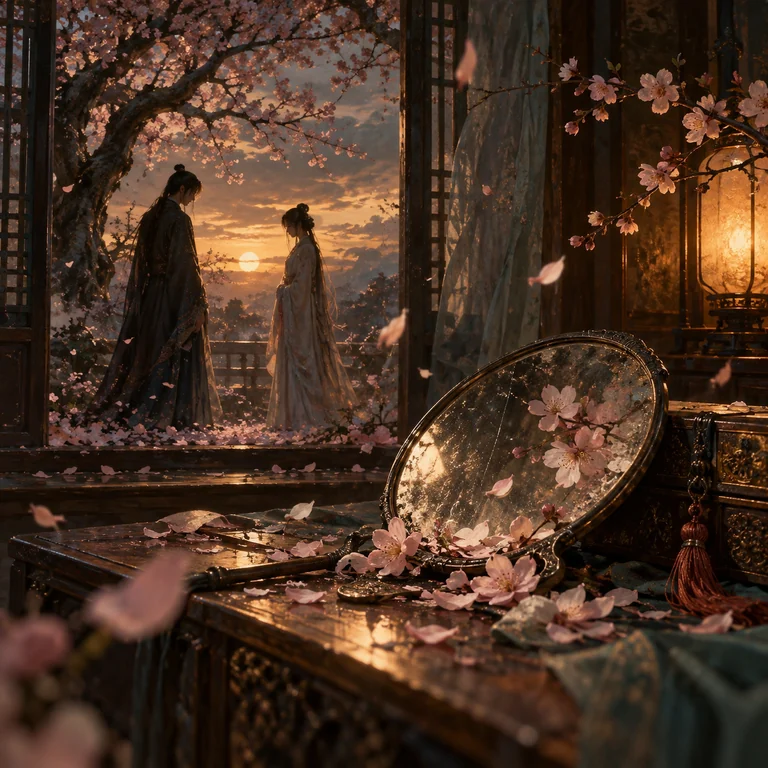
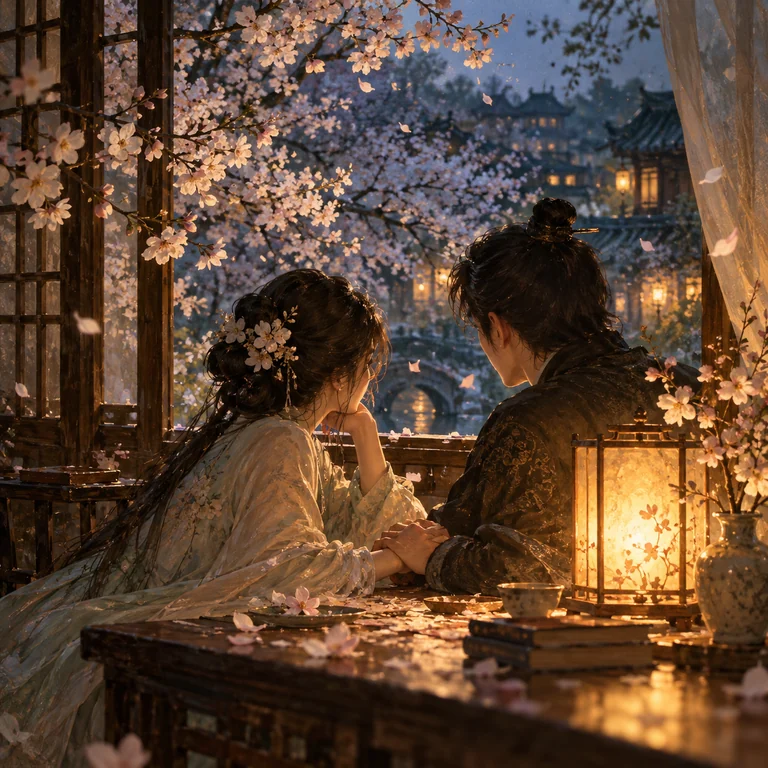
Xie Wei has waited eight years for her husband, yet after news of his return arrives, she buys an enchanted mirror. For five taels, it can preserve her twenty-year-old face for three more days; she wants to greet him with it. Cheng Zheng also looks young when he walks through the door, but the hand holding his chopsticks will not obey him. Across the table, they force smiles and skirt the changes in one another, while the day the mirror maker has appointed to collect an old possession draws near.
Start readingAI-assisted writing · Fictional characters and events
