
Expanded Washing Stream Sand · Lotus Fragrance Fades, Green Leaves Wither
Five Dynasties・Li Jing

Five Dynasties・Li Jing
Lotus fragrance fades, green leaves wither; the west wind stirs sorrow among the green waves. Again I wither with the lovely season, unable to bear the sight.
In fine rain I wake from dreams; Jisai lies far away. In the little tower, the jade sheng sounds through to the end, cold. How many tears, how boundless the sorrow, as I lean against the railing.
The animation remains in its original Chinese.
The animation is ready.

The lotus fragrance has faded, and the emerald leaves have withered; the west wind passes over green ripples as though stirring sorrow with them. I too grow haggard as lovely days decline; I truly cannot bear to look again upon this scene.
I wake from a dream amid fine rain, and the one I long for is still far away on the frontier. Alone in the little upper room, I play the sheng melodies over and over to their end; even the jade sheng grows cold. Who knows how many tears, how much endless sorrow—at last I can only lean against the railing.
菡萏 (hàn dàn): lotus flowers. 香销: fragrance fading away. 韶光: beautiful days, also suggesting youth. 不堪: unable to endure.
梦回: waking from a dream, not returning to one. 鸡塞: short for Jilu Fortress, here broadly referring to the distant frontier. 吹彻: to play a tune through to its end, also suggesting that the playing has continued a long time.
玉笙: a finely crafted sheng, a mouth organ. 何限: limitless, without end. 栏干: a railing.
Reading guide: Through autumn scenery and longing for someone far away, Li Jing writes of the feeling of life's decline. Fading flowers and leaves, a person's haggard appearance, and loneliness after waking from a dream echo one another. The work may carry reflections on his own circumstances, but there is no need to force the person remembered and every detail into specific historical events.
The opening describes both fading fragrance and withered leaves, as beauty retreats from smell and sight alike. “共憔悴,” “withering together,” then draws the person and passing time into the same change, giving autumnal sorrow a personal dimension.
Neither the dream nor the sheng music in the second stanza relieves the sorrow: on waking, the distance remains; when the tune ends, the cold remains. The ending contracts into the single gesture “倚栏干,” leaning against the railing. The earlier tears and anguish find no resolution, only congeal in that prolonged standing posture.
Let words find a melody
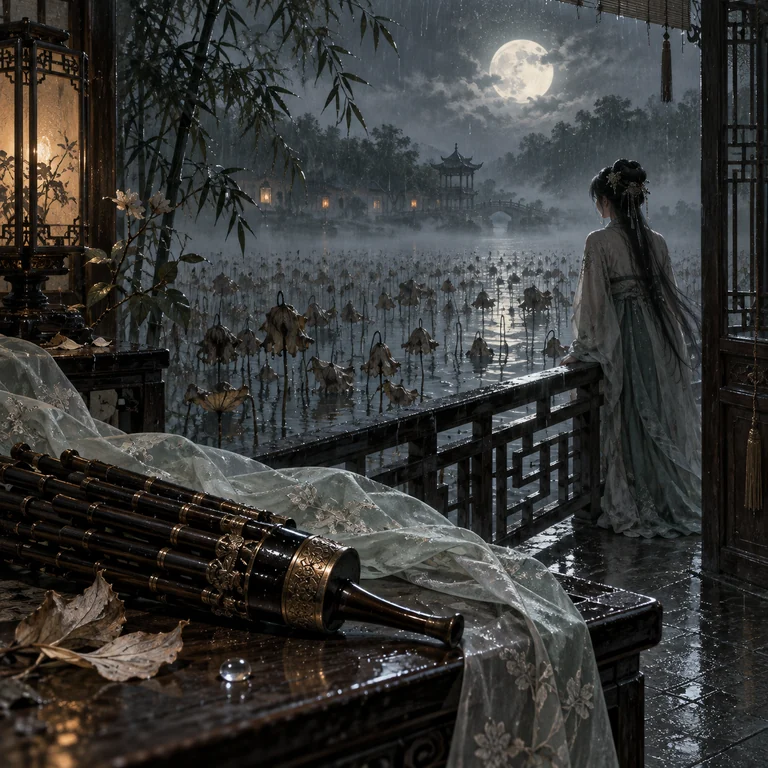

From a poem into a story
For eight years, Meng Heng has stopped whenever she reaches the third section of the old tune. Her listeners sigh over her hard fate, then pay to hear her next time. What the banquet hall bought was her late husband’s “final work” and the gray clothes she wears; little by little, she herself has grown afraid to smile onstage. But A Zhi, a boy who repairs sheng mouth organs, says her fingering does not quite suit the instrument in her hands. Meng Heng impatiently tries to send him away, yet he squats beside the pond, blowing a reed leaf until it sounds like a sick duck.
Start readingAI-assisted writing · Fictional characters and events
