
In the Mountains
Tang dynasty・Wang Wei

Tang dynasty・Wang Wei
In Jing Stream, white stones emerge,
The weather grows cold, red leaves grow sparse.
On the mountain path there is no rain at all,
空翠湿人衣。— The green haze in the air dampens one's clothes.
The animation remains in its original Chinese.
The animation is ready.
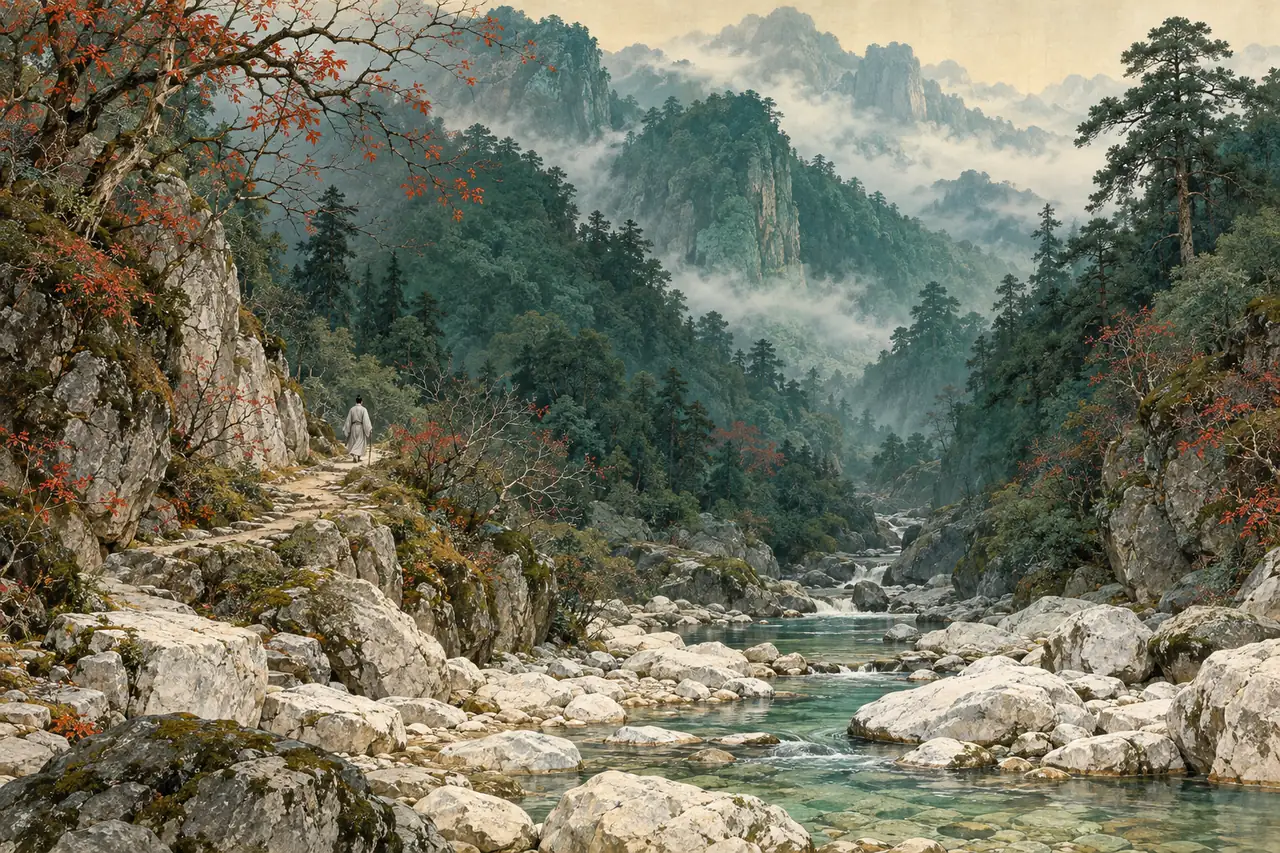
The waters of Jing Stream have grown shallow, exposing white stones above the surface.
The weather is growing colder, and red leaves on the branches are already sparse.
There had been no rain on the mountain path,
Yet the deep green of the mountains filling the air makes one feel as though one's clothes, too, have grown damp.
山中 (In the Mountains): the title commonly used today. Volume 128 of the Complete Tang Poems includes these four lines as the first of Wang Wei's Two Poems Without Titles. They are presented here separately under the familiar title, without incorporating the other poem.
荆溪: the stream’s name in the poem. Ancient texts also write it as “荆谿”; “谿” and “溪” both mean “stream.” No further conclusion about a specific walking route is drawn here from the verse.
白石出: white stones in the stream emerge above the water. “出” describes the stones being exposed when the water is shallow.
天寒: cold weather; together with the sparse red leaves, it marks the transition from autumn to winter. It does not establish a particular year or date.
稀: sparse or scattered, referring to the few red leaves remaining on the branches.
元: originally, in fact. This page uses the text “山路元无雨” (There is in fact no rain on the mountain path); another Wikisource page titled In the Mountains has “山路天无雨” (The sky brings no rain to the mountain path), differing from the first of Two Poems Without Titles in the Complete Tang Poems. The text has been checked against the latter, and the two versions have not been blended.
空翠: the green of the mountains suffusing the air, conveying both color and the feeling of being surrounded by dense greenery.
湿人衣: to make one's clothes seem damp. Read alongside “无雨” (no rain), this evokes a cool, moist sensation inspired by the mountain's colors; it need not mean that actual rain has soaked the clothes.
In the Mountains is a five-character quatrain by Wang Wei, describing what he sees and feels while walking along a mountain stream as the chill deepens. White stones, sparse red leaves, and rich green foliage illuminate one another within twenty characters. The final two lines move from “无雨” (no rain) to “湿衣” (damp clothes), leaving a richly layered sensory impression. This presentation takes the text of the first of Two Untitled Poems in volume 128 of the Complete Tang Poems as its baseline, while using the now-common title In the Mountains. No inference about the specific year of composition or itinerary is made from the materials consulted here. This paragraph and the translation, notes, and appreciation below are newly prepared reading guides, not the author's original preface.
The opening line begins with the stream, yet instead of describing its flow directly, it lets the white stones “出” (“emerge”). That single word brings the relationship between water and stone to life: when the water is shallow, the stones show; the more clearly their color appears, the easier it is to imagine the stream’s clarity and shallowness. White here is no empty background, but the first recognizable form and color through which the reader enters the mountain scene.
The second line adds “天寒” (“the weather is cold”), bringing bodily temperature into the scene. “红叶稀” (“red leaves are sparse”) supplies seasonal information while altering the composition. The red leaves do not fill the view in a mass, but appear as scattered points; precisely because they are few, their red and the preceding line’s white stones each stand out distinctly. The poem does not directly equate coldness and sparseness with decline, nor attach a reflection on the poet’s life to them. A reading should preserve the weight of the scenery itself.
The first two lines show details: stones in the stream and leaves on branches. The third turns to the “山路,” mountain path, bringing human movement into the poem and widening the view from a few objects to the whole surroundings. “元无雨,” there is no rain at all, first makes an explicit denial, as though identifying and clarifying a sensation. It pauses the reader: if there is no rain, why does the next line say “湿,” wet?
The answer lies in “空翠” (green filling the air). Deep green is no longer merely the color of distant trees: it seems to fill the air and surround the traveler. “湿” (wet) gives visible greenness the tactile coolness and moisture of touch; color seems able to approach the body, crossing the distance between clothing and forest. This sensation is not a claim requiring verification against weather records, but the poet's expression of being immersed in dense green.
Placed together, “无雨” (“no rain”) and “湿衣” (“wet clothes”) do not cancel each other out. If one simply explains that rain later fell in the mountains, the observation in the preceding line loses its purpose; if one treats “wet” merely as a rhetorical term, the reader misses the vivid bodily sensation. Read together, the lines show how poetry allows actual sight and inward sensation to coexist: the clothes may not really have been drenched, yet the cool moisture conveyed by the mountain's colors is enough to make one feel that they are wet.
The poem's colors move from white and red toward green, while the scene expands from stream stones and lingering leaves to the mountain path and the air. The final line turns to the human figure, so readers seem to follow the traveler into the mountains rather than merely viewing a picture from outside. The poem describes no return journey, decision to become a recluse, or major turning point in life; its completeness lies within this single walk and its sensations. Its twenty characters leave us with mountain color still abundant in the cold, and a moment of contact between person and landscape.
Let words find a melody

From a poem into a story
Gu Qinghe makes her living copying designs. To pay for food and lodging at an inn, she paints a screen of red leaves, yet on Cold Mountain she finds white stone and lush green. Drawing a route for a stranger entangles her in damaged goods, an exclusive master pattern, and an old bridge awaiting repair. Traveling between the mountain town and the city, she weighs wages, personal obligations, and her art, learning to take responsibility for what she paints—and what she fails to paint.
Start readingAI-assisted writing · Fictional characters and events
