
Quatrain · Two Orioles Sing amid Emerald Willows
Tang dynasty・Du Fu

Tang dynasty・Du Fu
两个黄鹂鸣翠柳,一行白鹭上青天。— Two golden orioles sing among emerald willows; a line of white egrets rises into the blue sky.
The window frames the Western Ranges’ thousand-year snow; at the gate lie boats from Eastern Wu, ten thousand li away.
The animation remains in its original Chinese.
The animation is ready.
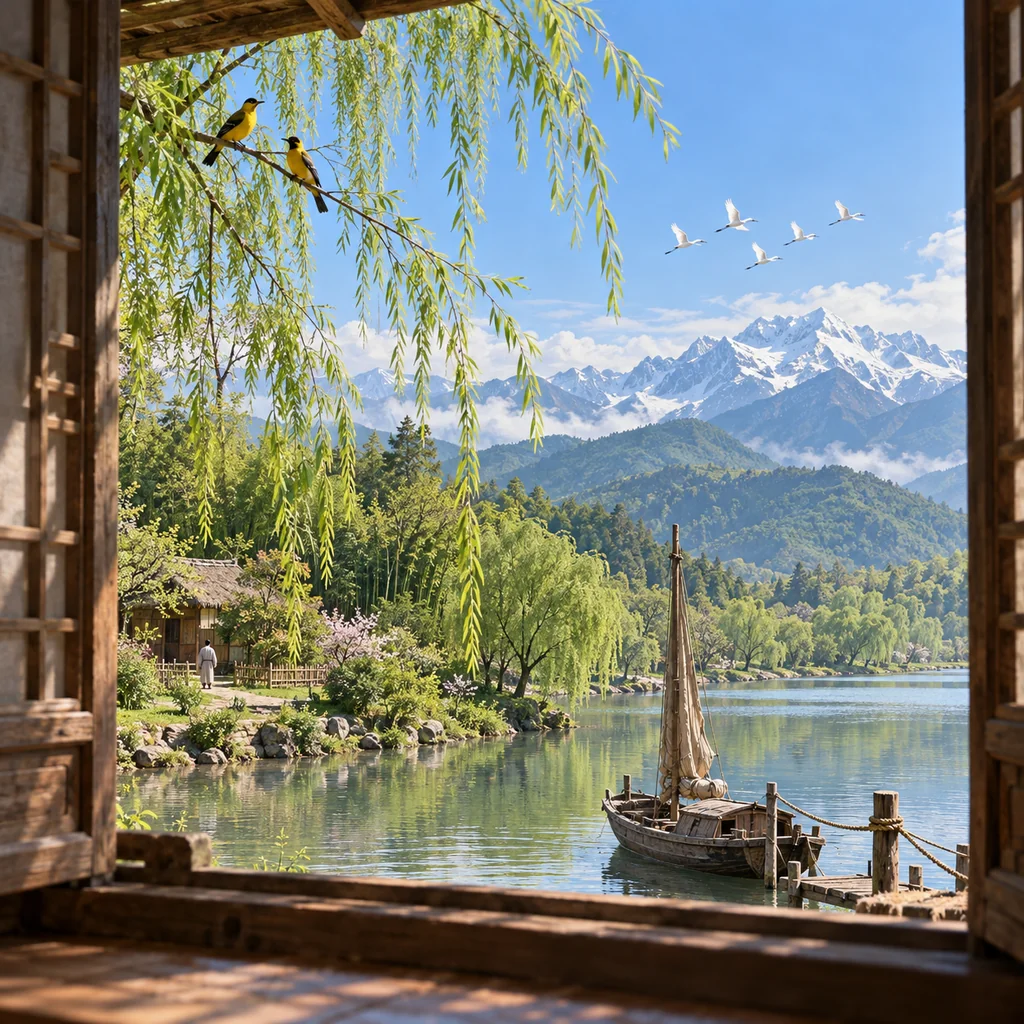
Two golden orioles sing among emerald willow branches; a line of white egrets flies toward the high blue sky.
Through the window, the snow that lies unmelted year after year on the western mountains fills the view; outside the door, beside the water, lie ships that sail the long route to and from Eastern Wu.
绝句: a poetic form known as the quatrain. This is the third of Du Fu’s Four Quatrains; its opening line has been added to the title to distinguish it from other works with the same title.
黄鹂: the oriole, a brightly colored bird with a melodious song. 翠柳: emerald-green willows. 两个, “two,” and 一行, “a line,” describe the birds’ number and formation respectively.
上: To fly upward. 青天: A clear blue sky.
含: to contain or encompass. 窗含: the window frame brings the snowy distant mountains into view, like a picture within a border.
西岭: mountain ridges west of Chengdu. 千秋雪: snow accumulated in the mountains over many years; “a thousand autumns” emphasizes its long duration, rather than suggesting that snow is falling outside the window.
泊: to moor a boat by the shore. 东吴: here, the Wu region along the lower Yangtze; it does not place the poem in the Three Kingdoms period. 万里船: vessels capable of traveling great distances by water; “ten thousand li” describes their voyage, not their hull length.
Reading guide: This seven-character quatrain unfolds from spring sights near the thatched cottage. Orioles, green willows, white egrets, and blue sky bring vivid sounds and colors, while the window and doorway extend the gaze toward distant mountains and the Yangtze waterway. Keep both the green willows and mountain snow in view: spring is flourishing nearby, while the distant high mountains still hold snow accumulated over the years. There is no contradiction. Although each line presents a separate scene, their viewpoint and balanced phrasing connect them into a broad picture of life.
The first two lines move from nearby branches into the high sky, with colors changing along with the space: yellow and emerald complement each other, while white and blue create a bright sense of near and far. The orioles awaken spring through sound, and the egrets draw the gaze skyward in a line. One remains among the branches, the other rises, giving the scene different speeds. The numerical expressions do more than complete the parallelism: the intimacy of two birds and the extended line of a flock offer small and expansive scales respectively.
The final two lines suddenly return to the dwelling’s window and door, yet the view does not narrow. “含” brings the snow on faraway mountains into the window frame, while “泊” pauses boats that have traveled long distances before the viewer’s eyes. A thousand ages and ten thousand miles connect an everyday view to vast stretches of time and space. The snow does not overwhelm the feeling of spring, and the boats are no isolated ornaments: they make the thatched cottage a place connected to the wider world. The poem’s parallel couplets are orderly without being rigid, because each preserves visible movement, sound, and distance. Reading it feels like naturally lifting one’s eyes, turning, and looking afar.
Let words find a melody
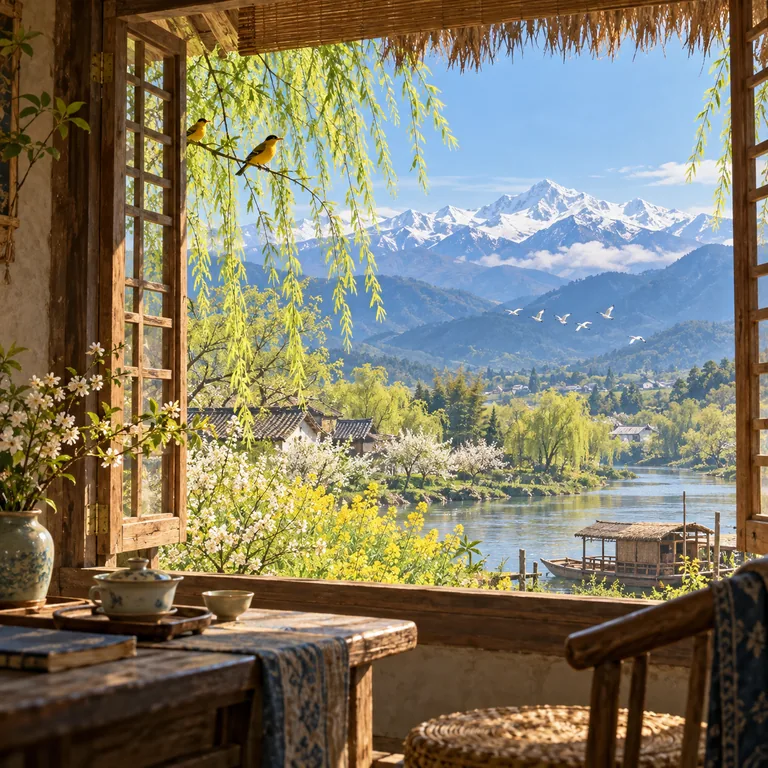

From a poem into a story
Luo Qu buys his first cargo boat, measures out sleeping places for two in the cabin, and comes to fetch his wife to travel with him to Eastern Wu. But Cheng Bi brings eighteen peony plants, their roots still packed in earth: they must be planted today, and there is no room for them in the hold full of salt. Both remember the future they discussed before marrying, yet they never made clear which would be their home this year: the small house with a west-facing window, or the cargo boat outside its door.
Start readingAI-assisted writing · Fictional characters and events
