
Thoughts on a Quiet Night
Tang dynasty・Li Bai

Tang dynasty・Li Bai
Before my bed lies bright moonlight; I wonder if it is frost upon the ground.
I raise my head to gaze at the bright moon, then lower it, thinking of home.
The animation remains in its original Chinese.
The animation is ready.
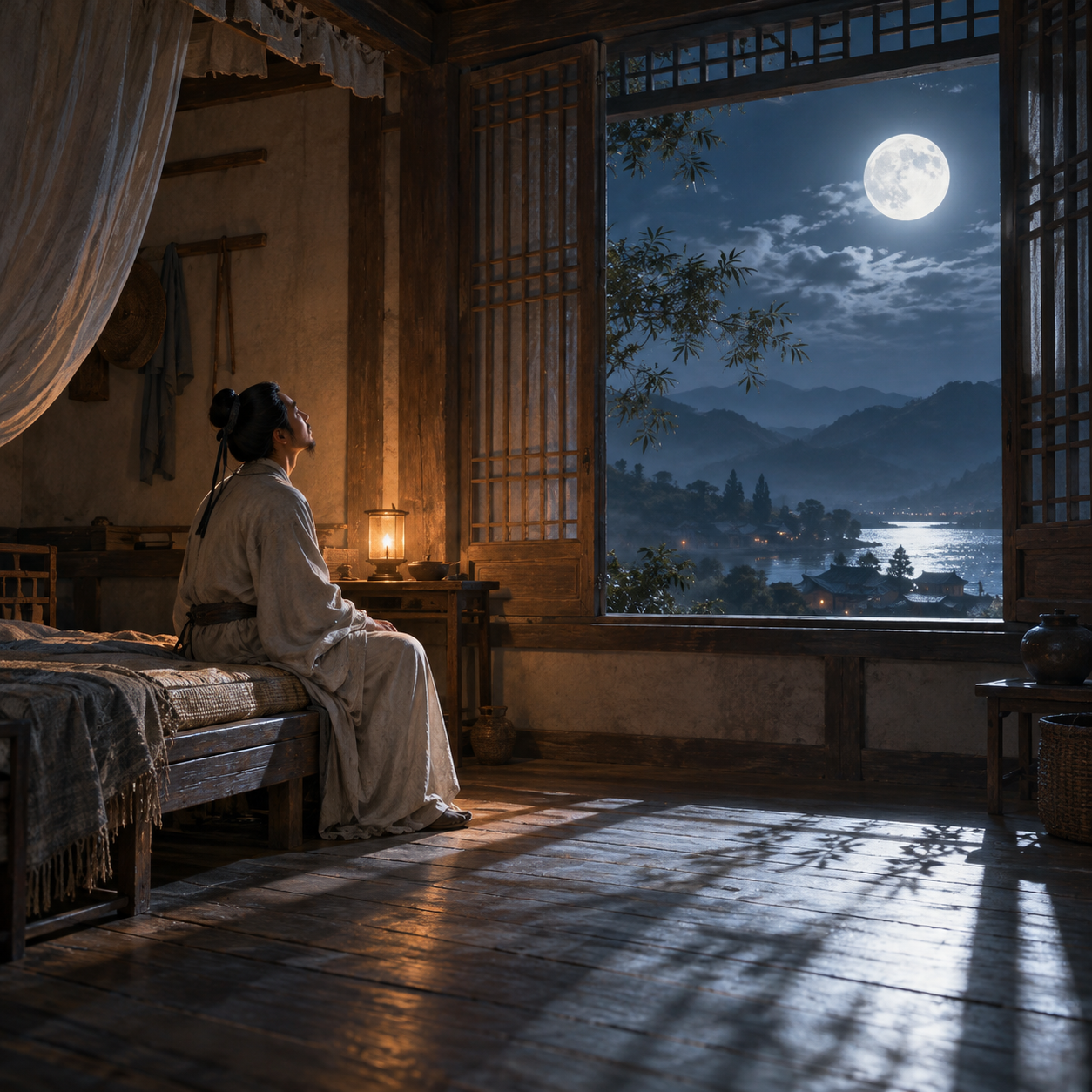
Bright moonlight spills before my bed; for a moment I mistake it for frost spread over the ground. I raise my head to gaze at the bright moon above, then lower it and think of my distant home.
静夜思: thoughts arising on a quiet night. 疑: to think something is, to mistake for. 举头: to raise one's head. 思: to miss, to long for.
“霜,” “frost,” is an illusion caused by moonlight; there need not be actual frost in the poem. What exactly 床 refers to has long been debated, and reading need not impose one particular arrangement of a room.
This page follows the commonly circulated text, “床前明月光” (“Bright moonlight before my bed”) and “举头望明月” (“I raise my head to gaze at the bright moon”); Song editions and other versions instead have “床前看月光” (“Before my bed, I watch the moonlight”) and “举头望山月” (“I raise my head to gaze at the moon above the mountains”).
Reading guide: This five-character quatrain moves from seeing the moon at night to longing for home. It gives neither an itinerary nor the time spent away, distilling instead a moment's feeling so that readers in different circumstances can recognize the emotions of being far from their native place.
“疑” (“seems”) gives the opening a sense of something not yet fully discerned. The shared pale, clear coloring of moonlight and frost also conveys the coolness of the quiet night. Rather than elaborately describing the moonlight, the poet lets the scene naturally awaken feeling.
“举头” (raising the head) and “低头” (lowering the head) form a small upward and downward movement, completing the shift from the moon before the poet’s eyes to the homeland in his heart. The ending offers no further explanation of his longing; its spare language leaves a lingering depth of feeling.
Let words find a melody
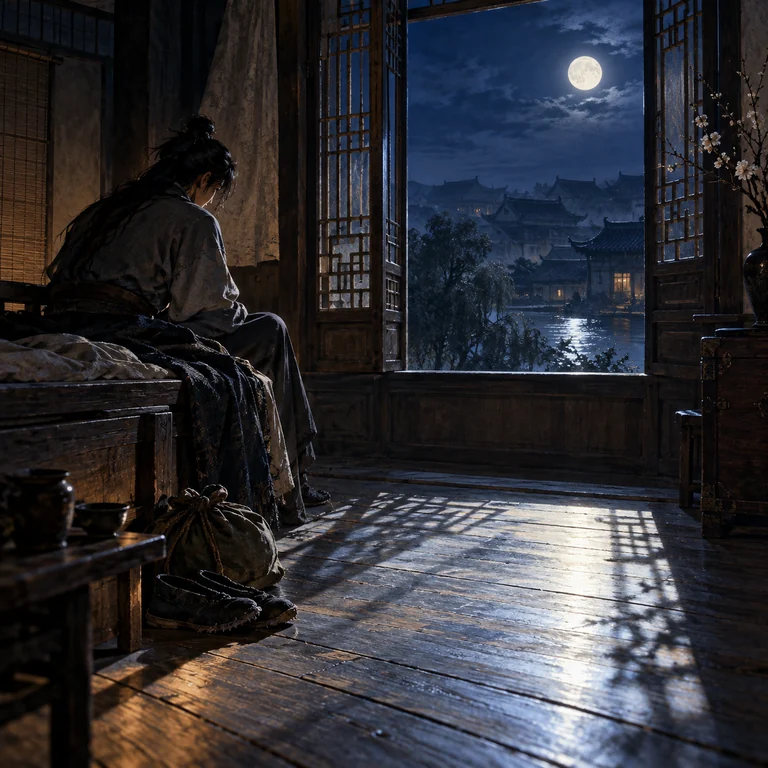
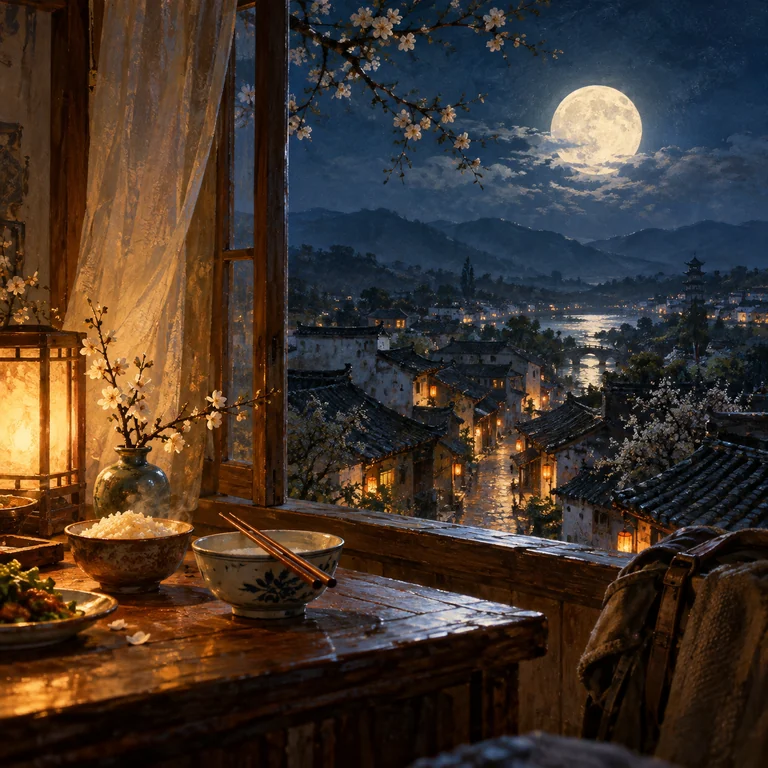
From a poem into a story
After twelve years keeping an inn, Chen Yan hears a guest name his hometown for the first time and nearly waives the room charge altogether. Two more people arrive soon afterward, each naming Baijing Town—yet that town burned to empty ground the year its people fled. Moonlight whitens the guest hall as the three speak of the same old well. One says he has a family genealogy; another remembers only a patch of winter shadow.
Start readingAI-assisted writing · Fictional characters and events
