
Nian Nu Jiao · Ascending Stone City, Using Dongpo's Rhymes in Their Original Order
Yuan dynasty・Sadula

Yuan dynasty・Sadula
From atop Stone City, I see the sky hang low over Wu and Chu, nothing obstructing my gaze. I point out the strategic ground held by the Six Dynasties; only green mountains remain like walls. Banners blotted out the sun, warships' masts and oars reached the clouds, and white bones lay scattered like snow. North and south of one great river, how many heroes have been worn away.
Desolate stands the summer palace; along the imperial road in the east wind, fragrant grass grows year after year. The setting sun falls on deserted pine paths, where ghostly fires flicker high and low. Songs and dances before the wine cup, splendor in the mirror, have silently turned dark hair gray. Grief for the rise and fall of ages; over the Qinhuai, one expanse of moonlight!
The animation remains in its original Chinese.
The animation is ready.
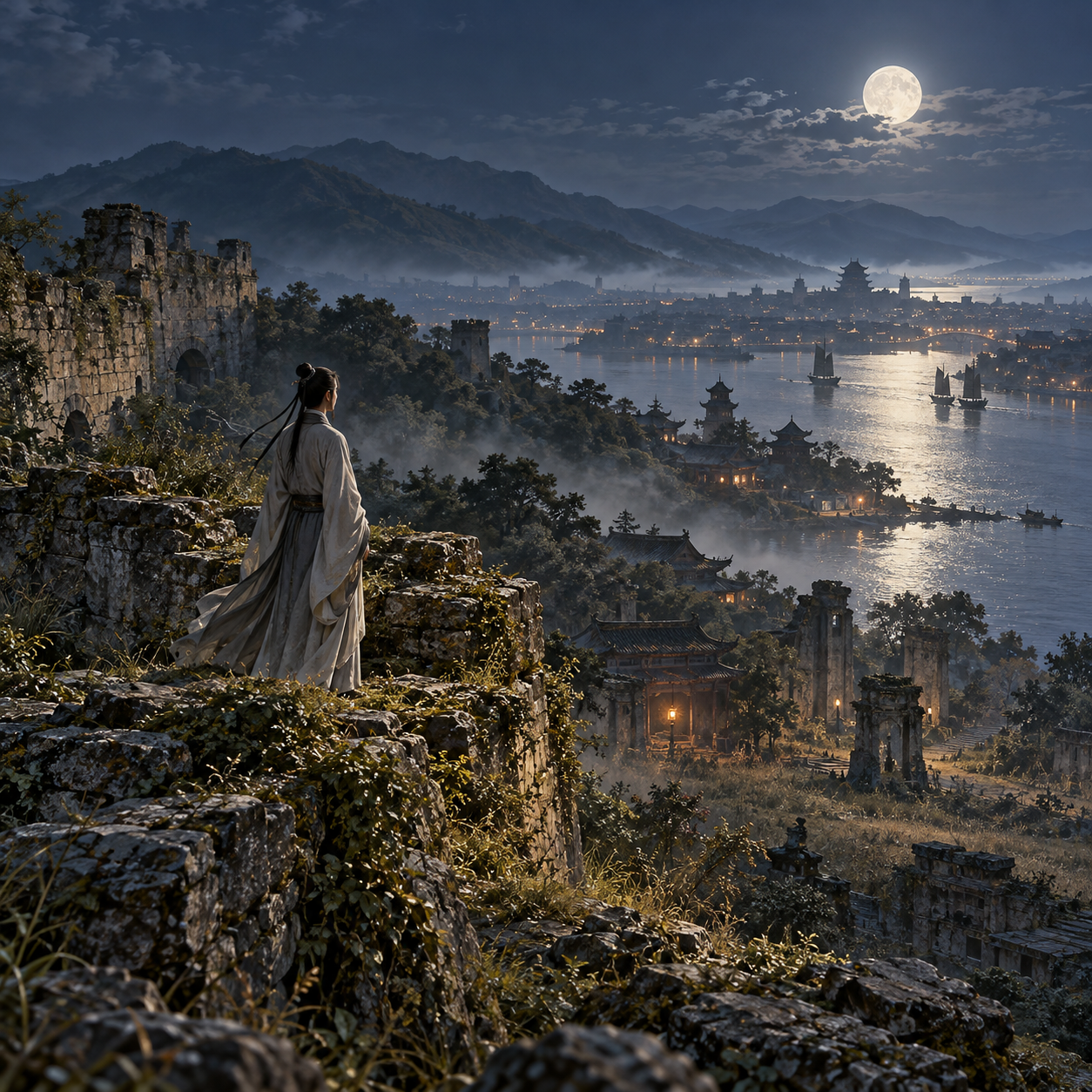
Climbing Stone City, I see the lands and sky of Wu and Chu seem to lie low beneath my eyes, my view broad and unobstructed. I point out the strategic places once held by the Six Dynasties; now only green mountains remain like walls. In those days banners blotted out the sun, and the masts and oars of warships reached the clouds, yet war left white bones scattered like snow. North and south of this great river, who knows how many heroes have been worn away.
The former summer palace now stands desolate; along the road once traveled by imperial carriages, only fragrant grass grows year after year in the east wind. The setting sun shines on deserted pine paths, where ghostly lights flicker. Songs and dances before the wine cup and splendor in the mirror have become the past, silently turning dark hair white. The rise and fall of ages brings sorrow; over the Qinhuai River, there is still only an expanse of bright moonlight.
石头城: The ancient city in present-day Nanjing. 次东坡韵: Composed using the same rhyme words in the same order as Su Shi's To the Tune of Nian Nujiao: Remembering the Past at Red Cliff. 吴楚: The middle and lower reaches of the Yangtze.
六朝: the Six Dynasties—Wu, Eastern Jin, Song, Qi, Liang, and Chen—which successively established their capitals in the Jiankang area. 形胜: strategically advantageous terrain. 樯橹: masts and ship equipment, standing for warships or naval forces.
离宫: an imperial palace apart from the principal palace in the capital. 辇路: a road traveled by the emperor's carriage. 鬼火: the eerie nighttime lights that ancient people described in graveyards and similar places, used here to intensify the desolation.
青青发: black hair, dark tresses. 秦淮: the Qinhuai River, which flows through Nanjing and is associated with the history of the Six Dynasties.
Reading guide: Sadula climbs the ancient city of Jinling and writes a lyric reflecting on the past using the rhymes of Su Shi's Red Cliff lyric. Through the former lands of the Six Dynasties, it asks what splendor and war have left behind, linking the rise and fall of past generations with the aging of people in the present.
The first stanza moves from the expansive view atop a height to battle formations in history. Flags blotting out the sun are immediately followed by bones white as snow, exposing the other side of flourishing military might. The enduring green mountains further highlight the succession of human affairs.
The second stanza gathers the vast war into surviving traces—an imperial retreat, a carriage road, paths among pines. Fragrant grass grows year after year, but the former rulers are gone. Instead of ending with a verdict on the dynasty, the poem leaves the bright moon over the Qinhuai shining upon past and present, allowing the sense of rise and fall to settle into an enduring landscape.
Let words find a melody
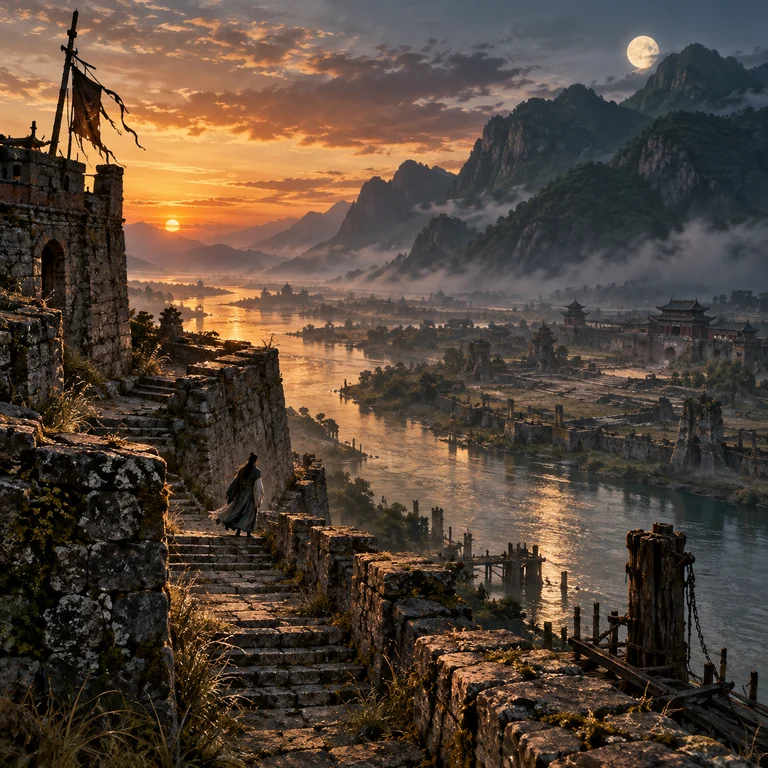
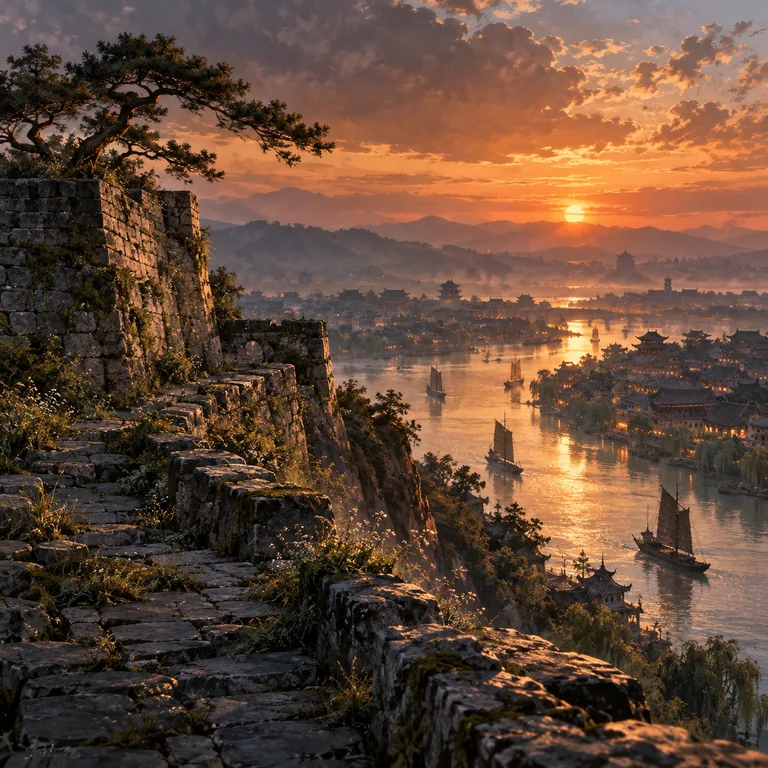
From a poem into a story
Lu Qi is an expert at carving imperial reign titles. Of thirty-six “imperial bricks,” only one remains unsold because he carved its characters upside down. A new job dismantling a palace wall arrives, but his apprentice Dongsheng keeps crouching beside the bricks, studying the tiny names of people worth no money. An antiques dealer presses him to assemble a wall of imperial traces from the Six Dynasties, with payment enough to build the new house his wife has wanted for years. Yet a clay pellet that drops from a cracked brick makes Dongsheng refuse to bring his hammer down any faster.
Start readingAI-assisted writing · Fictional characters and events
