
Crossing the Sea on the Night of the Twentieth Day of the Sixth Month
Song dynasty・Su Shi

Song dynasty・Su Shi
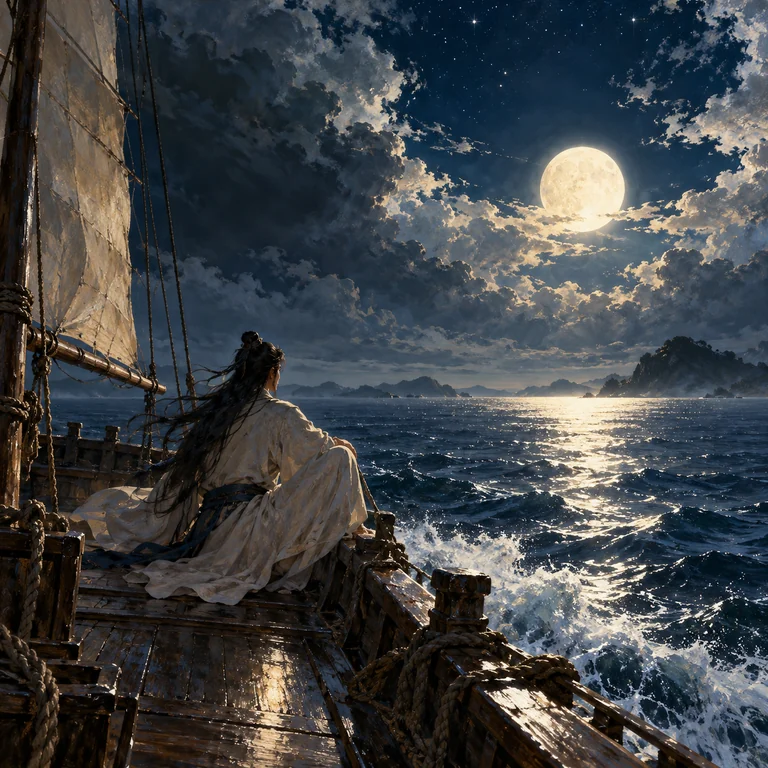
Orion lies slantwise, the Dipper turns—it is almost the third watch; relentless rain and ceaseless wind at last know how to clear.
Clouds disperse and the moon shines—who has adorned them? The face of heaven and the hue of the sea are clear by nature.
All that remains is the old sage of Lu's wish to sail away on a raft; dimly I recognize the music played by Xuanyuan.
Though I faced death nine times in the southern wilderness, I have no regrets; this wondrous journey surpasses all others in my life.
The animation remains in its original Chinese.
The animation is ready.

The stars of Shen slope across the sky, and the Northern Dipper has turned; the third watch is near. The relentless rain and the wind that blew all night have finally learned to clear. Clouds scatter and the moon shines—who has adorned this heaven and earth? The sky and sea are naturally this clear.
Now I retain only Confucius’s wish to take a wooden raft out to sea, and seem to understand a little of the music the Yellow Emperor played upon the vast plain. Even after surviving mortal perils in the remote southern wilderness, I bear no resentment; this extraordinary journey deserves to rank foremost among the experiences of my life.
参 (shēn)、斗: names of stellar constellations. 三更: around midnight. 终风: persistent, fierce wind, paired with bitter rain in the poem. 解: to understand or be able to.
鲁叟: Confucius. The Analects records his sigh about taking a raft out to sea. 桴(fú): a wooden raft. 轩辕: the Yellow Emperor; the music alludes to the story of his performance of “Xianchi” in the “Turning of Heaven” chapter of the Zhuangzi, associating the ocean’s waves with the magnificent music of nature.
南荒: an ancient term for remote southern regions. 九死: an emphatic expression for extreme danger and hardship. 冠: to rank first.
Reading guide: In the third year of Yuanfu (1100), Su Shi left Hainan, where he had lived in exile, and returned north. He wrote this poem while crossing the sea on the night of the twentieth day of the sixth month. The shift from wind and rain to clear skies is both a natural change during the voyage and an expansive moment from which to reflect on his years of exile.
The strongest phrase in the first half is “本澄清,” clear by nature: once the clouds disperse, the bright, pure world is revealed. The poet does not take a passing gloom as the whole of the world. The question sounds light, yet contains a judgment formed after weathering turmoil.
The second half expands the experience at sea through allusions to Confucius and the Yellow Emperor, finally arriving at “吾不恨” (“I have no regrets”). This does not mean hardship is absent: “九死” (“nine deaths”) has already explicitly acknowledged its severity. Having recognized it, the poet gives the experience another kind of value.
Let words find a melody

From a poem into a story
After seventeen years in exile, Rong Shuo finally gains permission to return north, only to hear the hull crack as the boat nears shore. His medicine chest holds his late wife’s ashes and unsent letters home; the constable carries government silver at his waist. A boy who stowed away urges them to let go quickly. A second wave bears down before any shore lights appear. The broken plank left among the waves is too narrow: when all three cling to it, it sinks.
Start readingAI-assisted writing · Fictional characters and events
