
Willow Branches with Added Notes
Tang dynasty・Wen Tingyun

Tang dynasty・Wen Tingyun
【I】
A foot of deep-red silk surpasses pale yeast-yellow; by nature, old things cannot match the new.
Even the peach pit of joined delight brings sorrow,inside, it turns out, there is another heart。
【II】
Lighting a lamp deep in a well, I earnestly counsel you; on your long journey, my love, do not delay your return.
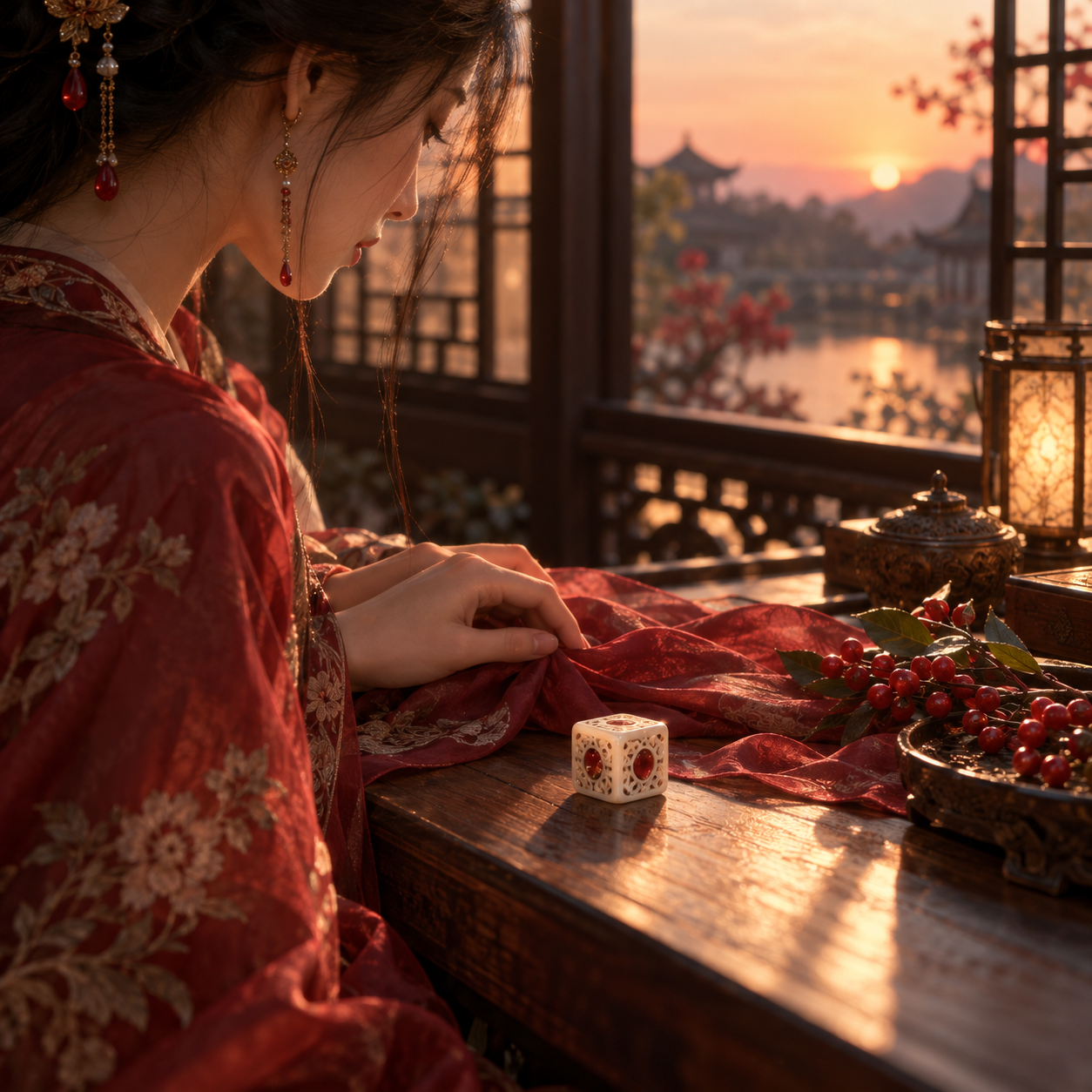
Red beans are set in finely fashioned dice; do you know this longing that reaches to the bone?
The animation remains in its original Chinese.
The animation is ready.
I
Over time, a deep-red skirt becomes covered in pale-yellow dust; since ancient times, old things have never pleased people as much as new ones.
You and I should have been as steadfastly joined as a paired walnut; how could I have known that someone else was already in your heart, leaving me at last with resentment toward you?
II
Like lighting a candle at the bottom of a well, I charge you deeply and earnestly: though you are leaving me to travel far away, my heart will journey with you. Remember to return soon; do not miss the appointed time.
Every red dot on the delicate dice in your hand is a red bean of deepest longing; do you know that what penetrates to the bone is my longing for you?
胜曲尘: a variant reads “蒙曲尘,” meaning “covered in yeast-colored dust.”
深烛: pronounced like 深嘱, “to earnestly counsel.” This is a phonetic pun expressing a woman’s earnest counsel to her lover.
伊: a personal pronoun, 「你」 (you).
长行: changxing, an ancient board game popular in the Tang dynasty. Li Zhao's Supplement to the History of the Tang, final volume, states: 「今之博戏,有长行最盛。其具有局有子,子有黄黑各十五,掷采之骰有二。」 This means: Among games played today, changxing is the most popular. Its equipment consists of a board and pieces, fifteen yellow and fifteen black, and two dice for casting. The game's name is used here as a pun on a long journey. 围棋: Go, a traditional Chinese board game. Its variations are extremely complex and its principles profound; a game between skilled players often takes several traditional two-hour periods, or even days, to decide. Here 「围棋」 (wéiqí, Go) puns on 「违期」 (wéiqī, missing an appointed date), urging 「郎」, the beloved man, not to miss his promised return.
玲珑: delicate and exquisitely crafted.
骰(tóu)子: dice, gaming implements traditionally said to have been invented by Cao Zhi of the Three Kingdoms. Originally made of jade, they later came to be made of bone. Their colored pips also gave them the name 色子. Each is a small cube with one to six circular pips on its six faces; the one and four are red, while the other numbers are black. These red pips are likened to red beans, symbols of longing.
The line “入骨相思知不知” (“Do you know this longing that reaches into the bone?”): the red dots penetrating dice made of bone serve as a metaphor for longing that reaches into one’s very bones. “入骨” (“into the bone”) is a double meaning expressed through allusion.
Wen Feiqing’s poetry and lyrics are often ornate and sensuous, alive with fragrance and color, their phrases embroidered and painted, carved in gold and inlaid with brilliant hues that dazzle the eye. These two lines, however, possess deep feeling and lingering resonance, and may rightly be called pure and beautiful.
Red beans are also called “相思子,” or longing seeds, while dice were often made of bone. Placing red beans in dice becomes a metaphor for longing that penetrates the bones. The imagery draws entirely on ordinary objects, yet its ingenious conception feels fresh. It reads without obscurity, instead possessing what might be called “眉目清秀”—a clear, graceful charm—and abundant wit. The pun is skillfully handled, with distinctive feeling and profound meaning.
Moreover, “玲珑” in the preceding line appears to describe the delicately crafted dice, yet hints at the lover’s “七巧玲珑心,” an exquisitely perceptive heart. The following “知不知” (“do you know, or do you not?”) is crisp yet gently indirect; its circling, repeated question has a distinctive force when heard and is deeply affecting.
This piece speaks in a woman's voice, expressing her attachment to her lover. Its opening two lines are words of earnest advice. In 「井底点灯深烛伊」, the four characters 「井底点灯」 mean lighting a lamp at the bottom of a well. Why light a lamp there in particular? Because a lamp at the bottom of a well must be a candle deep down. 「深烛」, “a deep candle,” thus suggests its homophone 「深嘱」, “to exhort earnestly.” 「伊」 is a personal pronoun, here meaning “you.” 「深烛伊」 therefore means “I earnestly implore you.” Clearly, the author deliberately uses a homophonic pun to tell the story, making the meaning more obscure.
Since she speaks of 「深嘱」, “earnest exhortation,” what is she urging? The next line tells us: 「共郎长行莫围棋」. 共 is a preposition meaning “with,” and 「共郎」 explicitly shows the woman together with her lover. The immediately following 「长行」 also hints that this is a moment of parting, which explains her repeated, tender entreaties. Here 「长行」 and 「围棋」 form another pair of homophonic puns. Changxing is the name of a gambling game. Tang anecdotes record that it was played with dice and, being easy to learn, attracted players who 「颇或耽玩,至有废庆吊、忘寝休、辍饮食者」 — “sometimes became so absorbed that they neglected congratulations and condolences, forgot sleep and rest, and stopped eating and drinking” — according to the final volume of “Supplement to the History of the Tang.” It was a lowbrow form of gambling. Weiqi, by contrast, is a traditional Chinese board game whose profound principles made it a pastime for cultivated scholars. Why, then, would she earnestly remind her departing husband that she could play changxing with him but would not play weiqi? Her words carry another meaning: she uses the game's name 「长行」 to suggest “a long journey,” and 「围棋」 to suggest “delaying the date of return.” She is telling him, “On your distant journey, be sure not to miss the day you are due home!” In daily life, people often hint through such homophonic puns when they wish to convey something they cannot conveniently say outright. Here these two game names delicately express the woman's deeply hidden feelings. They reveal her tenderness and affection, though the coded language is excessively obscure.
「玲珑骰子安红豆,入骨相思知不知?」—“Red beans are set in delicate dice; do you know this longing that penetrates to the bone?” These last two lines lead from「长行」, the game of changxing, to「骰子」, dice. Each red dot on those finely crafted dice resembles a red bean, the emblem of deepest longing, and is embedded in bone: do you know that it expresses my longing for you, which reaches into my very marrow? This naturally deepens the purpose of the earnest injunction in the second line,「长行莫围棋」—“Play changxing, but do not play weiqi,” with the latter also suggesting “do not miss the appointed date.” Her「共郎长行」—playing changxing with her husband—was also intended to use the「骰子」employed in this board game to remind him: when you play changxing with dice, do you know that every red dot is a red bean embedded in bone, representing my bone-deep longing for you? So you must never delay or miss your return. This line captures with great precision her concern for her husband and the intense love that makes parting so difficult!「入骨相思」, “longing that penetrates to the bone,” carries a double meaning, its lingering tenderness overwhelming the heart. In the poem’s structure, it corresponds to the earlier「深嘱」, earnest urging, to return soon and「莫违期」, not miss the appointed date. First the woman earnestly urges him while「共郎长行」, playing changxing together; later, when the traveler has「违期」, missed the date and failed to return, she feels「入骨相思」, bone-deep longing. Finally, the questioning, emotionally charged「知不知」—“do you know?”—gently gathers the whole poem together, then reveals this loving woman’s anxious hope for the traveler’s early return. The three characters「知不知」fully convey the length of her separation, the difficulty of reunion, the depth and pain of longing, and even her lack of anyone to whom she can speak. The ending feels natural and leaves an inexhaustible aftertaste. What readers feel is the sincere, ardent love deep within the heroine’s heart. A woman’s devotion of this kind makes the poem all the more moving. The seven characters「入骨相思知不知」—“Do you know this bone-deep longing?”—are the finishing touch that brings the entire poem to life.
Let words find a melody
From a poem into a story
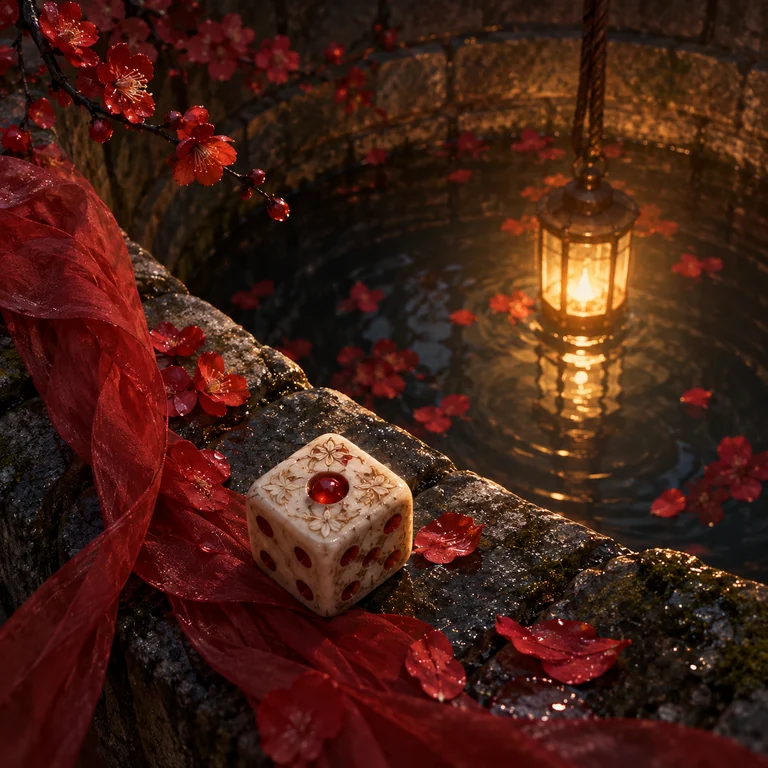
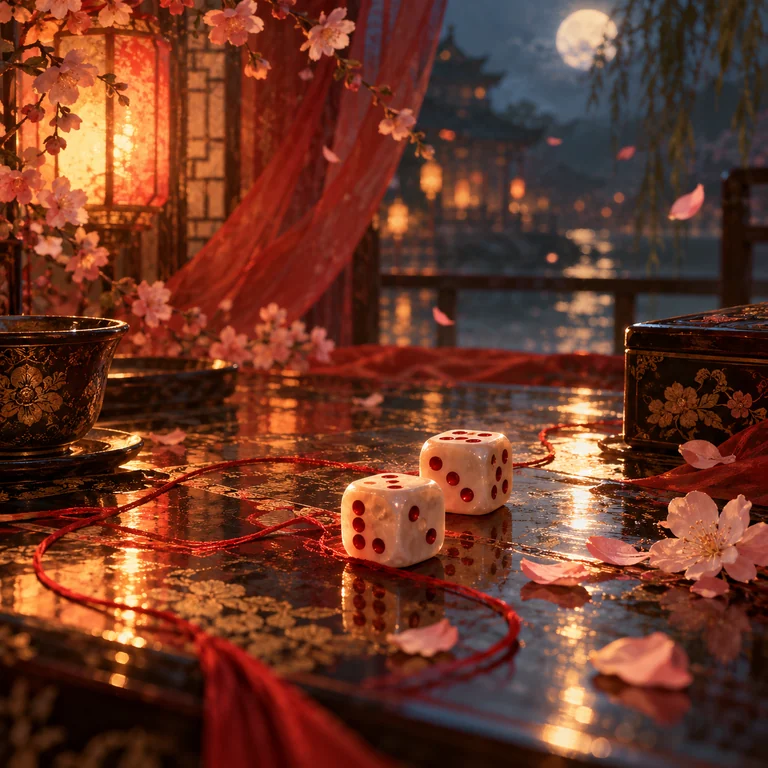
On the third day of her marriage, the intricately carved die on Xu Dou’s wrist falls and splits in two. A red bean rolls out, but inside is also a slip of paper bearing an unfamiliar woman’s birth date and purchase price. Her husband carves dice by day and always goes to the gambling house in the west of the city at night. When he gave her the die, he spoke of longing that reached into the bones. From her father, she learned to read wood grain and open seams. This time, her thin blade must probe somewhere she has never asked about.
Start readingAI-assisted writing · Fictional characters and events
