
Song of the Autumn Wind
Western and Eastern Han・Liu Che

Western and Eastern Han・Liu Che
The autumn wind rises, white clouds fly; grasses and trees yellow and fall, and geese return south.
Orchids bear lovely blossoms, chrysanthemums have fragrance; I cherish a beautiful person whom I cannot forget.
We float in a towered ship across the Fen River, traversing midstream and raising white waves.
Pipes and drums resound, and the rowing song begins; joy reaches its height, yet sorrow grows abundant.
How brief is youth and vigor—what can we do about old age!
The animation remains in its original Chinese.
The animation is ready.
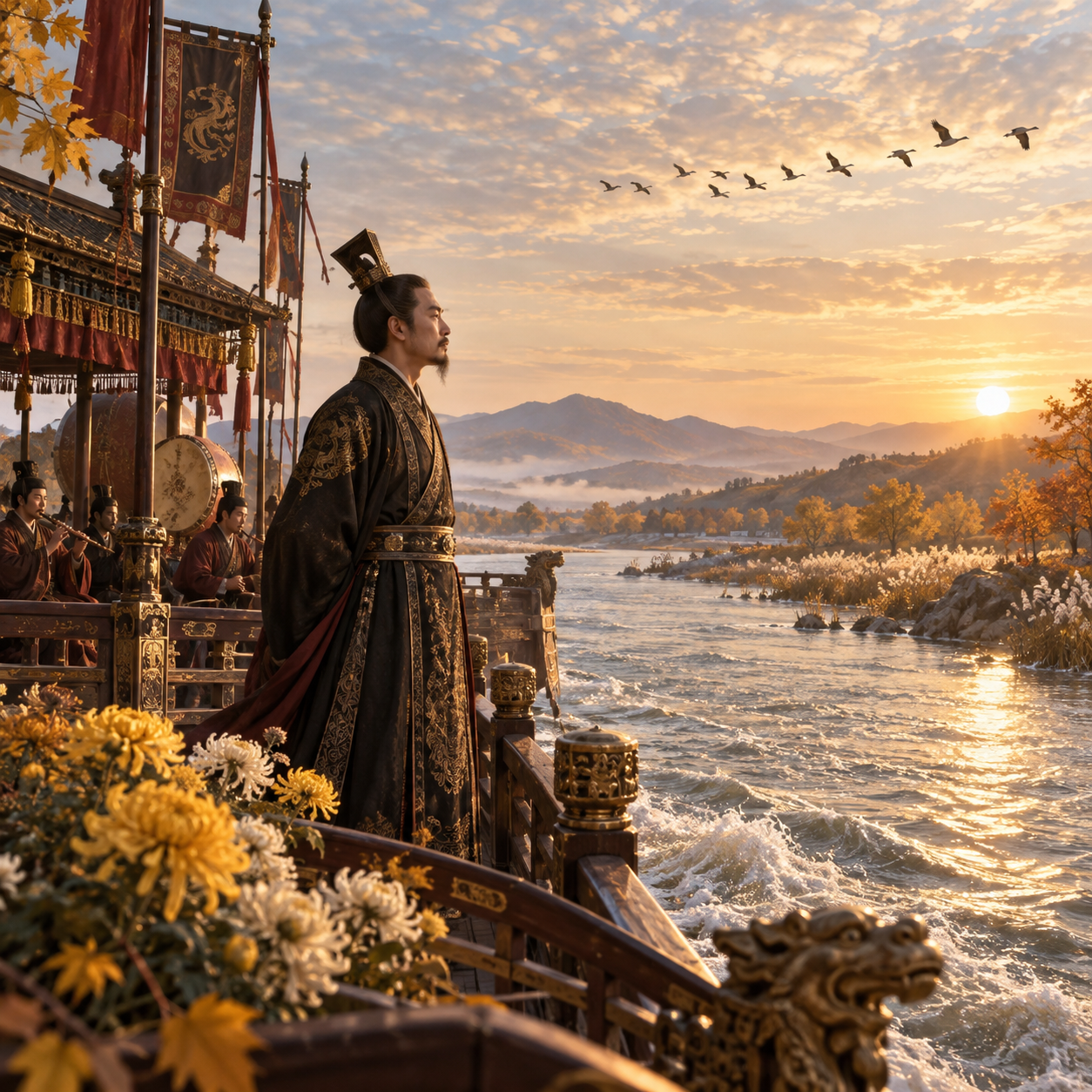
The autumn wind rises, white clouds drift, grasses and trees yellow and fall, and geese return south. Orchids bear lovely blossoms, and chrysanthemums release their fragrance; I long for a beautiful person and can never forget.
Aboard a tall, towered boat, we cross the Fen River, moving through the middle of its current and stirring white waves. Flutes and drums sound together, and a boating song rises aboard; as joy reaches its height, sorrow grows with it. How long can youth and vigor last? And faced with old age, what can one do!
兮: a particle that slows and sustains a lyrical exclamation. 秀: to flower. 佳人: a beautiful or admirable person; the poem's referent need not be forcibly identified with any particular individual.
楼船: a large, multidecked boat. 济: to cross. 汾河: the Fen River, in present-day Shanxi. 素波: white waves. 棹 (zhào) 歌: songs sung while boating.
奈老何: What can one do about growing old? The expression carries a sigh at something irreversible.
Introduction: This song is traditionally attributed to Emperor Wu of Han, Liu Che. Centered on an autumn boat excursion, it moves from seasonal scenery and longing for someone to feasting, pleasure, and aging. Its most striking feature is the coexistence of joy and sorrow: even an emperor’s grand entertainments cannot dispel the sense that life is brief.
The autumn wind, southbound geese, orchids, and chrysanthemums give the passing season vivid sound and color. In the middle section, a grand boat crosses the current as pipes and drums sound together; the scene suddenly grows magnificent, seeming to suppress the sadness of the opening.
Yet “欢乐极兮哀情多” (“At the height of joy, sorrow abounds”) turns the emotion back again. The ending no longer elaborates on imperial ceremony, leaving only a question about passing years; public splendor thus contracts into an experience of life that the individual, too, cannot escape.
Let words find a melody
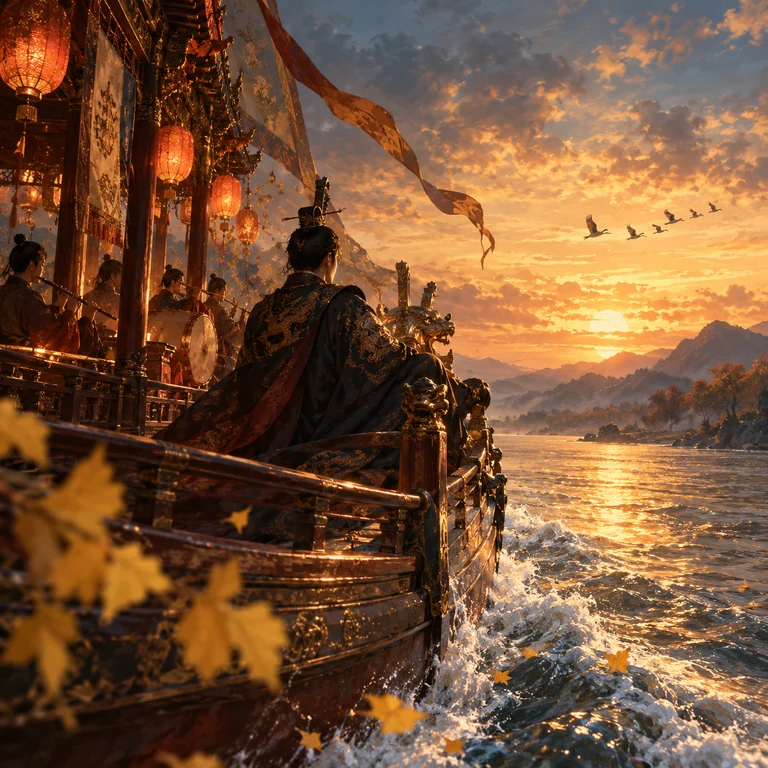

From a poem into a story
The prince’s autumn rites will reenact a ceremonial voyage from thirty years ago, and Qi Chuan is once again assigned the seventh rowing position. He has barely lifted the long oar halfway when his right shoulder locks. The reward could repair his family’s leaking roof, and he does not want to lose the job. But Han Yu, who has come to take over, brings a piece of his late father’s broken oar and asks him to identify it. Before the flutes and drums have sounded, the old man can already hear the water from that night.
Start readingAI-assisted writing · Fictional characters and events
