
Late Autumn in Chang’an / An Autumn View / Autumn Evening
Tang dynasty・Zhao Gu

Tang dynasty・Zhao Gu
Clouds and mist drift chill and forlorn through dawn; the Han palaces loom stirringly against the high autumn sky.
A few fading stars, geese cross the frontier sky, one long flute note, someone leans against a tower.
Purple chrysanthemums half-open stand quiet by the fence; the islet’s lotuses grieve, their red robes all fallen.
The perch are at their finest—why not go home? In vain I wear a southern cap, playing the prisoner of Chu.
The animation remains in its original Chinese.
The animation is ready.
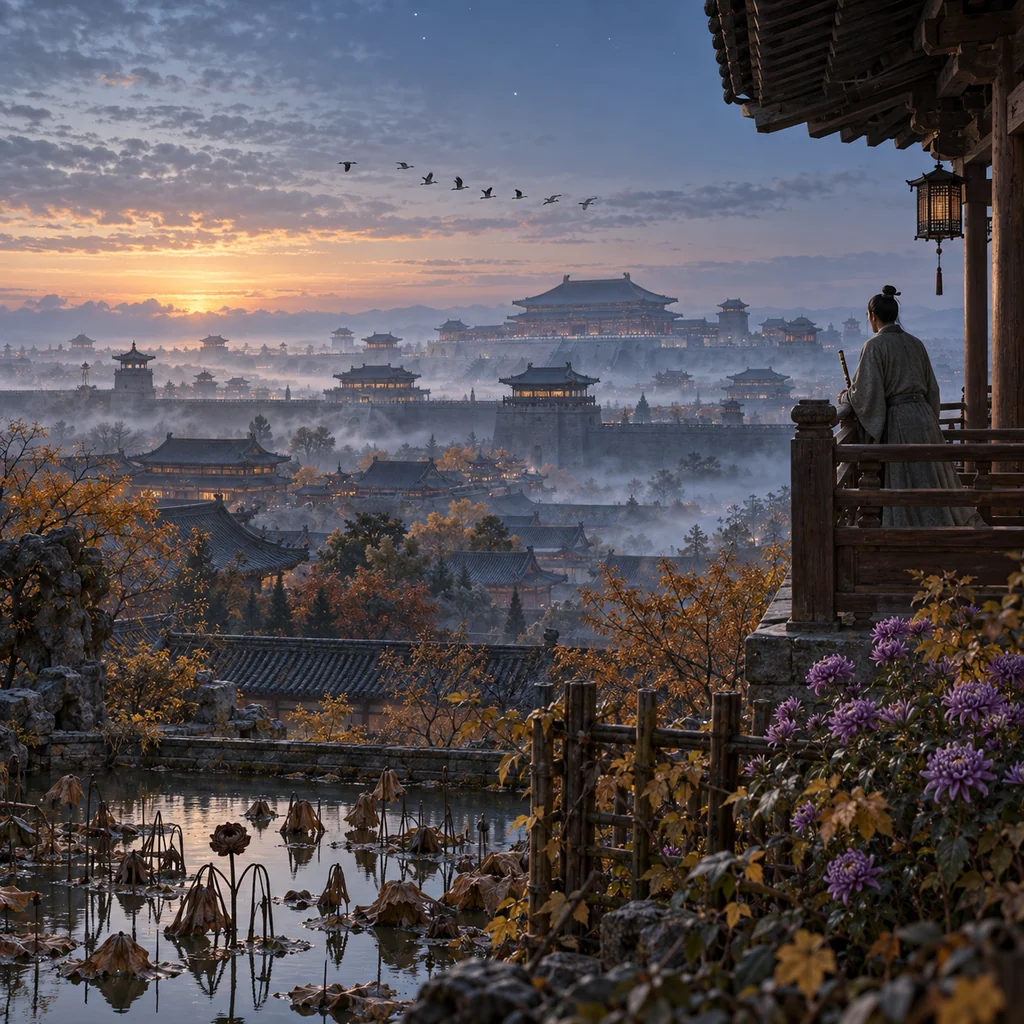
Clouds and mist bearing autumn's chill drift through the light before dawn; the capital's palaces tower so high they seem to touch the late-autumn sky.
Beneath a few fading stars, wild geese cross the vast frontier sky; a long flute note sounds, and someone is leaning against a high tower.
The purple chrysanthemums beside the fence are only half in bloom, quiet and wordless; the lotuses by the river islet have shed all their red petals, as though burdened with sorrow.
Now the perch back home are at their best, yet I still do not return, merely keeping myself in a foreign land like a prisoner wearing a Chu cap.
Title: This poem is also titled “Autumn View,” “Autumn Evening,” and “An Autumn View of Chang’an,” among other variants. Late autumn means that the season is deepening; “approaching dawn” and “fading stars” clearly establish that the scene occurs just before daybreak. The alternative title “Autumn Evening” should not lead to depicting it as nightfall.
云雾: Clouds and mist in the sky. The text checked in the Complete Tang Poems reads “云物” (“cloud formations”); “凄凉” (“desolate”) also has the variant “凄清” (“chill and clear”). This page retains “云雾凄凉” (“clouds and mist, chill and desolate”) from the existing source data, without mixing in changes to other words or lines. 拂曙: Approaching daybreak. 流: To flow.
汉家宫阙: the Han dynasty stands for the Tang, referring to the palaces of Chang'an; it does not reclassify Zhao Gu as a Han poet. 阙, pronounced què, means the raised towers outside palace gates and can also stand for a palace. 动高秋: an exaggeration suggesting that the towering palaces stir the autumn sky; 高秋 conveys both a high, clear autumn sky and the depth of the season.
残星: the scattered stars still visible as dawn approaches. 雁横塞: a formation of geese crossing the sky over frontier passes; 横 means “to cross”; 塞, pronounced sài, means “frontier pass.” This opens up the space of the distant view, rather than suggesting a frontier battlefield directly below the tower in Chang’an.
长笛一声人倚楼: “A note from a long flute; someone leans upon a tower.” The flute and the person leaning on the building join sound and sight in one scene. The line does not elaborate their relationship, so neither person’s identity or life story needs to be fixed.
紫艳: a vivid purple, here referring to chrysanthemums by the fence. 半开: not yet fully in bloom. 红衣: “red robes,” a metaphor for red lotus petals, not a person dressed in red. 渚, pronounced zhǔ, is a small patch of land in water; 渚莲 means lotuses beside such an islet.
鲈鱼正美: “the perch are at their finest,” an allusion to Zhang Han of the Jin dynasty, who, when the autumn wind rose, longed for wild rice shoots, water-shield soup, and sliced raw perch from Wu, and returned home. The remembered flavors evoke homesickness and the desire to return. The figure and events in the allusion cannot be taken directly as part of Zhao Gu’s own life.
南冠: a hat from Chu. The Zuo Commentary, “Ninth Year of Duke Cheng,” records that Zhong Yi, imprisoned in Jin, still wore his southern hat and played the music of Chu. This later became an allusion to captivity and homesickness. 空: in vain. 学楚囚: the speaker compares himself to the prisoner from Chu to convey feeling constrained while living away from home. This does not establish that the poet was actually in prison, nor does the hat establish noble birth.
Reading guide: This seven-character regulated poem portrays the capital before dawn in late autumn, bringing lofty palaces, scattered stars and departing geese, chrysanthemums by fences, and withered lotuses successively into view. A flute's sound lends an audible echo to the distant gaze. Only the final couplet voices homesickness, without turning it into a story of someone already setting off home. Notice two opposing directions: the geese can fly away, while the person leaning against the tower remains; chrysanthemums are blooming, while lotuses have faded. Each scene has its own seasonal rhythm, making the person's decision to stay or leave seem harder.
The opening couplet lays out the broad contours of Chang’an at dawn. Clouds and mist move, while the palace towers stand high; motion and stillness illuminate each other, making the autumn sky feel both vast and cold. There is no need to embellish these palaces with scenes of lavish banquets. Dawn light and deep autumn already give the buildings an air of distance: someone living in the capital may still be unable to enter the magnificent world before them.
The second couplet gathers the broad landscape into a few distinct points. Stars are sparse, geese cross the sky, the flute sounds only once, and someone merely leans against a tower: the wording is restrained, yet each detail reaches beyond itself. The geese's flight draws the gaze into the distance, while the flute crosses the boundary of the visible and reaches the listener's heart. The poem does not explain who plays or who listens; that omission leaves an echo, keeping the feelings of travel and exile from being confined to one person's brief biography.
Chrysanthemums by the fence and lotuses beside the islet draw the gaze downward again. Half-open blooms contrast with petals entirely fallen, while vivid purple answers red robes, giving autumn two simultaneous faces: unfolding and vanishing. Stillness and sorrow are not the flowers’ actual speech, but emotions the observer casts upon the scene. Only in the final couplet do the allusions to food and headwear fully express homesickness: Zhang Han’s return becomes a desirable possibility, while the Chu prisoner’s remaining seems to mirror the poet’s present circumstances. “不归去” (“why not go home?”) and “空” (“in vain”) preserve self-questioning and hesitation. The poem’s resonance lies in that step still untaken; a fulfilled ending of worldly success or retirement cannot simply be supplied for it.
Let words find a melody
From a poem into a story
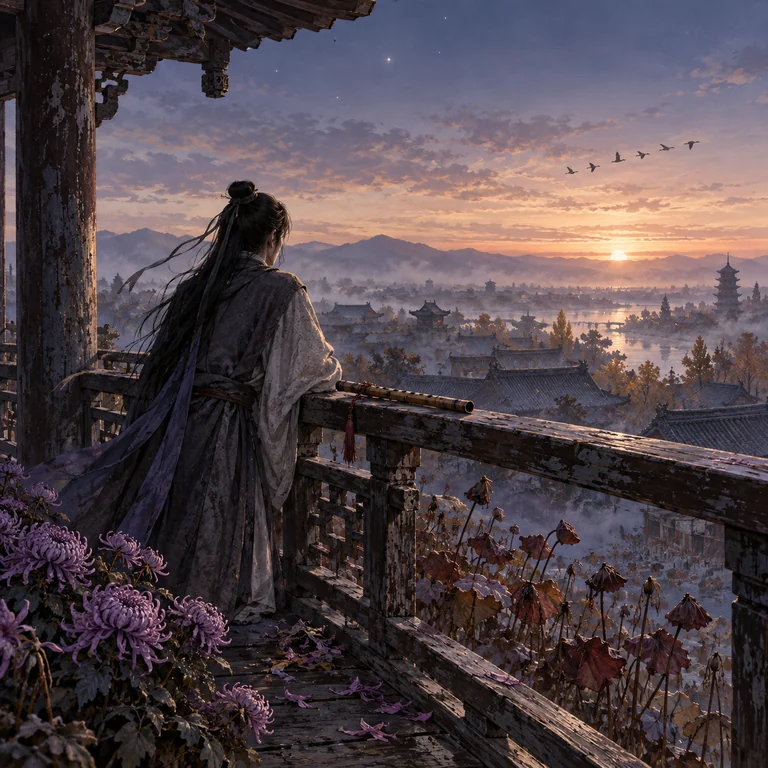
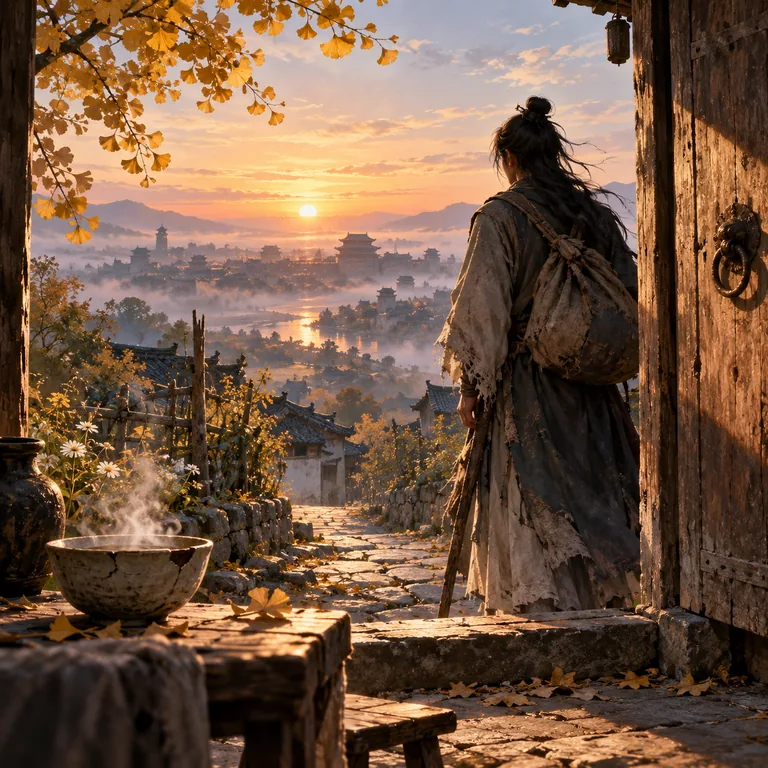
Imprisoned for forgery for two years, He Jiu has finally worked the window timbers loose and copied the cargo labels. At dawn, he plans to slip into a paper cart leaving the city. But Shi Zhao, who agreed to go with him, brings in a barrel of oil that night, its pungent smell seeping through the gaps. The two guards are about to go to the duty room for shift-change tea. Wheels are already rumbling beyond the wall. The road home he has plotted for so long suddenly holds something they never agreed on.
Start readingAI-assisted writing · Fictional characters and events
