
Remembering My Brothers East of the Mountains on the Ninth Day of the Ninth Month
Tang dynasty・Wang Wei

Tang dynasty・Wang Wei
Alone in a strange land, a stranger myself, at every festival I miss my family twice as much.
Far away, I know my brothers climb the heights; all wear dogwood sprigs, with one man missing.
The animation remains in its original Chinese.
The animation is ready.
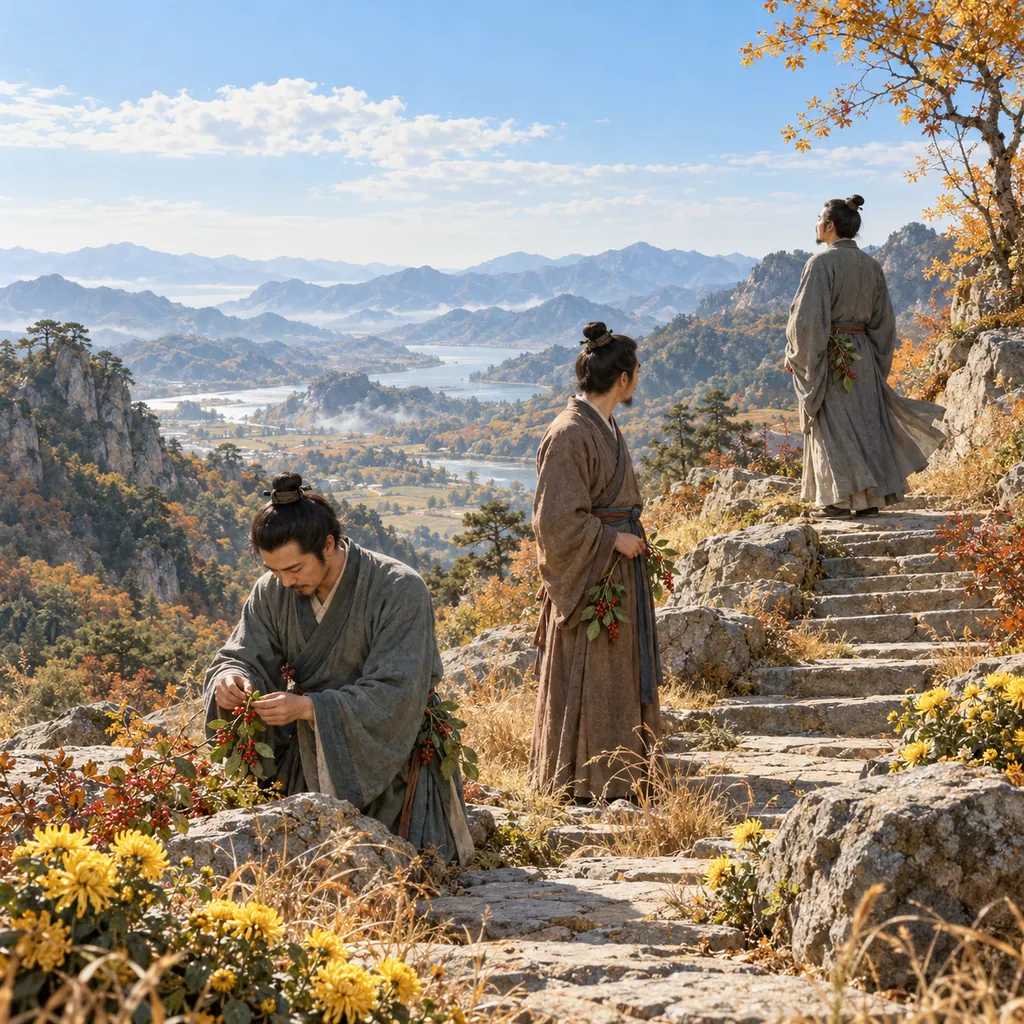
Living alone far from home, I always feel the loneliness of an outsider; whenever a festival calls for reunion, my longing for my family grows especially deep.
Far away, I imagine my brothers already at the place where they have climbed the heights, each wearing a sprig of cornel; beside them, one person is missing—me.
九月九日: the ninth day of the ninth lunar month, the Double Ninth Festival. 忆: to miss or remember.
山东: east of the mountains; here it refers to the poet's home region east of Mount Hua, and should not be equated directly with the boundaries of today's Shandong Province. 兄弟: siblings, close kin.
独: Alone. 异乡: A place away from one's hometown. 为异客: To live as a guest in another place. 为 means to act as or become; 异客 means a traveler staying away from home.
每逢: whenever one encounters. 佳节: a fine festival; here, the immediate setting is the Double Ninth Festival. 倍: more, especially; it need not mean precisely twice as much. 亲: loved ones; family.
遥知: to picture or imagine something across a great distance; the following scene of climbing to a height unfolds in the speaker’s homesick imagination. 登高: the Double Ninth Festival custom of ascending to a high place.
遍: all, everyone. 插: to tuck in and wear. 茱萸: cornel, an aromatic plant; on the Double Ninth Festival, people traditionally wore it to pray for protection from calamity. It is not fennel.
少一人: “one person missing,” namely the poem’s “I,” who is staying far from home. The empty place among the family expresses the longing on both sides.
Reading guide: The Double Ninth Festival is often associated with customs such as climbing heights and wearing sprigs of dogwood. Festive gatherings can also make those living away from home especially conscious of their separation from loved ones. The first half of this seven-character quatrain directly expresses longing for family; the second turns toward the distant brothers, imagining that they too will feel someone is missing when they gather. Notice how “独” (alone), “异” (foreign), and “少” (one fewer) echo one another, without treating the imagined scene as something witnessed firsthand.
The first line tightly joins “独” (“alone”) with two instances of “异” (“other” or “foreign”). Rather than creating loneliness through desolate scenery, it first identifies a person’s estrangement from his surroundings: even with others nearby, he remains a traveler away from home. The second line broadens the present Double Ninth Festival into “每逢佳节” (“whenever a festive day arrives”), giving a momentary feeling the force of something repeatedly experienced. “倍” (“doubly”) describes a sudden deepening of emotion. Loved ones are always in his thoughts; festivals merely make that attachment harder to set aside.
What moves us in the final two lines is that longing no longer circles around “I am so lonely.” “遥知” (“I know from afar”) opens the space, bringing the distant brothers' ascent into view. “遍插” (“all wearing sprigs”) should suggest a complete, lively gathering, yet the ending falls on “少一人” (“one person missing”). The absence has no shape, but readers can feel it among those gathered. The poet misses his family and imagines himself being missed by them, turning a one-way outpouring into mutual attachment. The poem barely elaborates on the distance across mountains and rivers, yet that distance is already present in a scene unseen but still imaginable. A simple seasonal custom thus acquires tangible human weight.
Let words find a melody

From a poem into a story
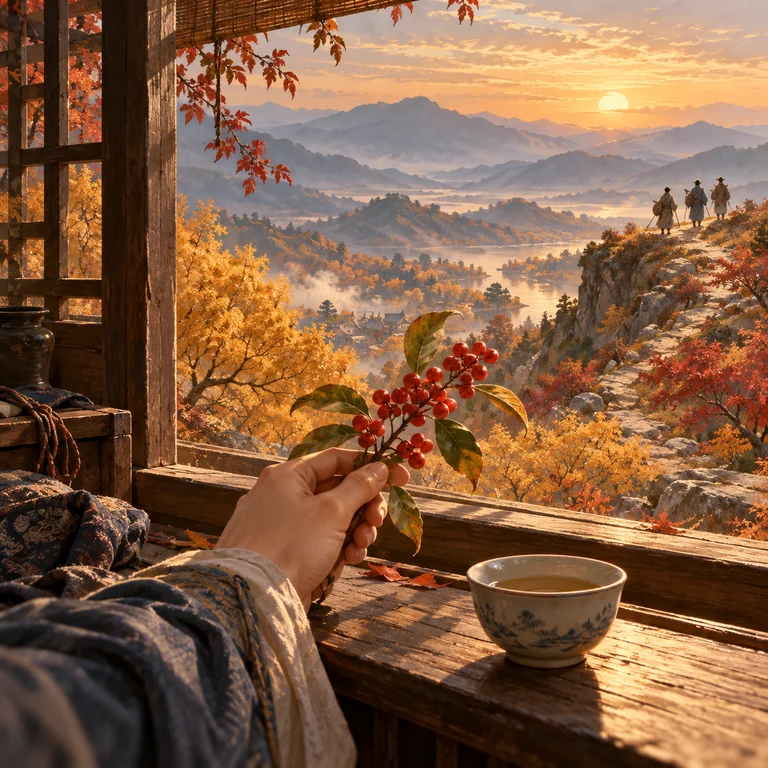
Pei Ji has traveled two hundred li to compete for the Double Ninth brocade banner, but his elder brother, who usually tends his safety rope, lies ill in the previous town. The festival organizer values his reputation as a man who roams the world alone. An unfamiliar rope handler offers to help, yet Pei Ji dares not entrust his life to him. The ten-tael prize would let his brother rest for an entire season. He accepts the dogwood an old woman offers, still unsure to whom he should give the extra sprig.
Start readingAI-assisted writing · Fictional characters and events
