
Song of the North Wind
Tang dynasty・Li Bai

Tang dynasty・Li Bai
烛龙栖寒门,光曜犹旦开。— The Torch Dragon dwells at the Gate of Cold; its radiance still opens like the dawn.
Why do the sun and moon fail to shine here,where only the north wind comes raging down from heaven。
Snowflakes over the Yan Mountains are as large as mats, each blown down upon Xuanyuan Terrace.
幽州思妇十二月,停歌罢笑双蛾摧。— In Youzhou, in the twelfth month, a wife longs for her husband; her singing and laughter cease, her mothlike brows droop in grief.
Leaning by the door, I watch the passersby, thinking of you at the Great Wall, where the bitter cold is truly pitiful.
When we parted, you took up your sword to defend the frontier, leaving this gold-decorated, tiger-patterned quiver.
Inside are a pair of white-feathered arrows; spiders weave webs, and dust gathers.
The arrows remain in vain; he has died in battle and will never return.
I cannot bear to see these things; I burn them, and they are already ash.
The Yellow River might yet be stopped with handfuls of earth; grief amid the north wind’s rain and snow is harder to cut short.
The animation remains in its original Chinese.
The animation is ready.
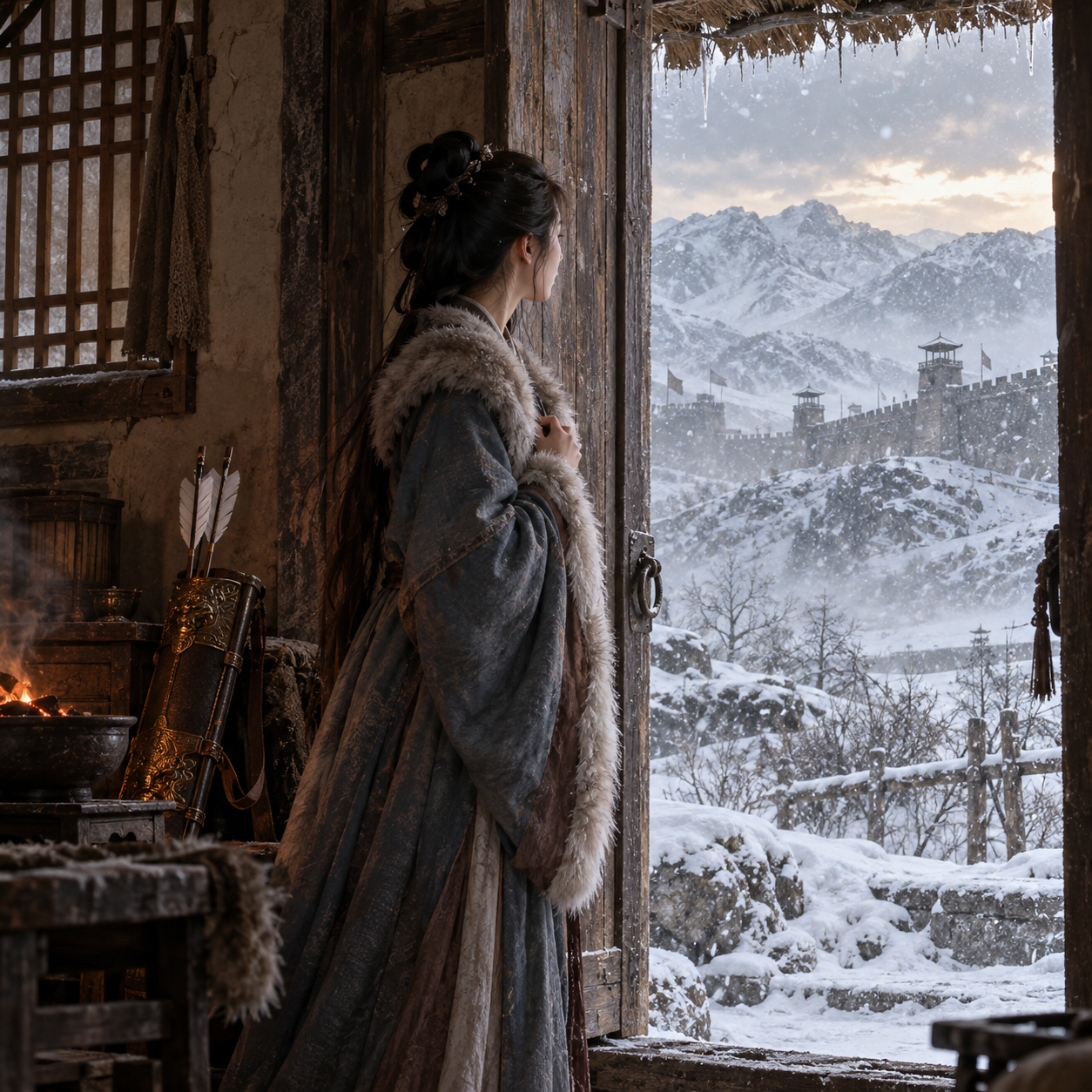
The Torch Dragon dwells in the bitterly cold north, where daylight can still appear when it opens its shining eyes; why do neither sun nor moon shine on this place, where only the north wind comes howling furiously from the sky? Snowflakes on Mount Yan are as large as mats, falling one by one toward Xuanyuan Terrace.
In Youzhou, a woman longs for her husband. In the bitter cold of the twelfth month, her songs and laughter cease, and her brows remain tightly drawn. Leaning in the doorway, she waits for the traveler, grieving to think of you enduring bitter cold on guard at the Great Wall. At parting, you took up your sword to aid the frontier, leaving this finely ornamented quiver patterned with tigers; inside are still two white-feathered arrows, now tangled with cobwebs and thick with dust.
The arrows remain, but their owner has died in battle and can never return. Unable to bear the sight of these belongings, I burn them to ashes. Deep as the Yellow River is, one can still imagine blocking it with handfuls of earth; yet nothing can stem this endless grief amid the north wind, rain, and snow.
烛龙: the Torch Dragon, a deity said to dwell in the north, whose open eyes bring day and closed eyes bring night. 寒门: the bitterly cold far north. 轩辕台: Xuanyuan Terrace, the name of an ancient site associated with legends of the Yellow Emperor.
双蛾: a woman's eyebrows, curved like moth antennae. 摧: drooping in sorrow. 良可哀: truly pitiable. 鞞靫(bǐng chá): a quiver; 金 (gold) and 虎文 (tiger pattern) describe its decoration.
白羽箭: arrows fletched with white feathers. 雨雪: snow falling; 雨 is pronounced yù. 裁: to cut off or eliminate.
“雪花大如席” (“snowflakes as large as mats”) and “黄河捧土尚可塞” (“the Yellow River could still be blocked with handfuls of earth”) are both deliberate exaggerations. The former heightens the severity of the cold; the latter emphasizes, by contrast, that grief and resentment cannot be exhausted.
Reading guide: This yuefu poem moves from the extreme cold of the north to a wife longing for her husband amid war. Myth and hyperbole create a grand opening, before the focus narrows to a dust-covered quiver, giving the abstract bitterness of the frontier the concrete form of a family's grief at losing a loved one.
The poem centers on “箭空在,人今战死不复回” (“The arrows remain in vain; the man has died in battle and will never return”). Before this come waiting and recollection; afterward comes despair in the face of death. The short clauses abruptly interrupt the unfolding long lines, as though an inescapable fact has pressed down upon the narrative.
Burning the things left behind cannot erase grief. The ending calls the impossible act of “捧土塞河” (blocking a river with handfuls of earth) still achievable, highlighting how much harder grief and anguish are to end and giving the opening's fierce wind and snow the weight of human feeling.
Let words find a melody
From a poem into a story
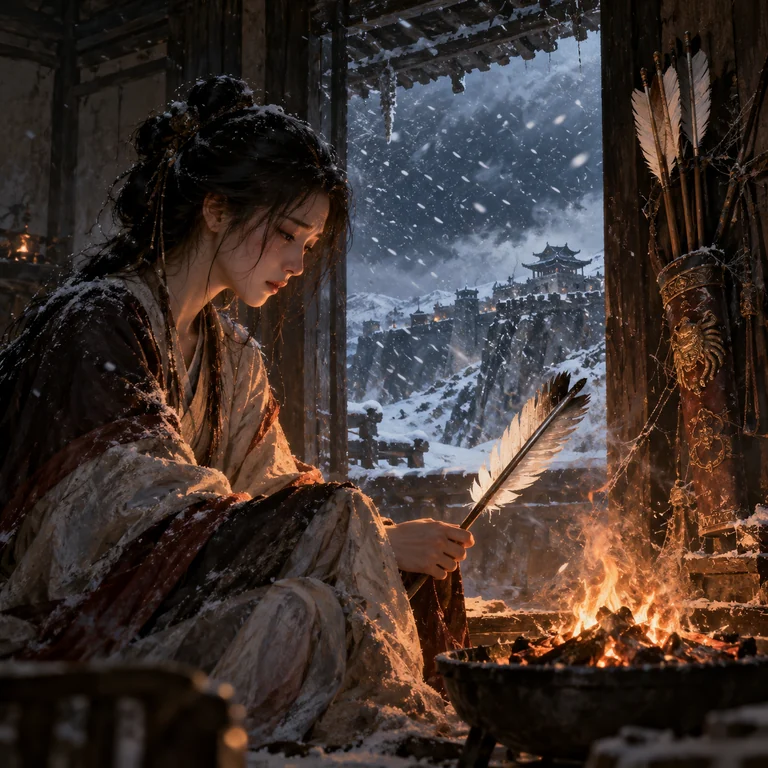
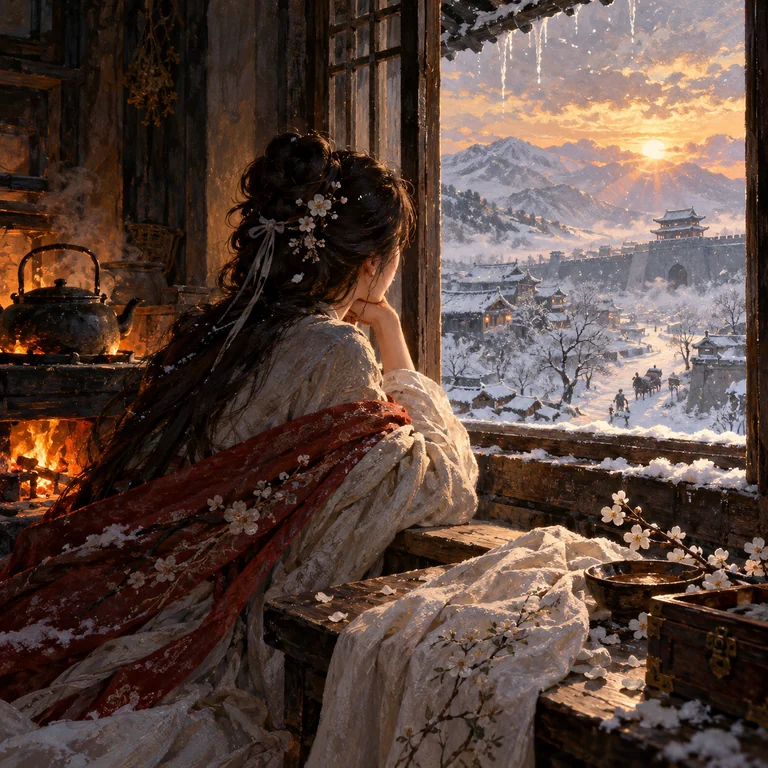
On a night of wind and snow, a boy carrying a northern bow collapses outside A-Shuang’s door, half a white-feathered arrow clenched in his palm. The blue-green thread wound around it is the very thread she wrapped herself when sending her husband to war. The matching arrow still gathers dust on a beam inside. The boy cannot speak her language, and an uncle from her clan is already approaching with his blade drawn. The news of a return she has awaited for years now rests in the hands of a boy her clansmen regard as an enemy.
Start readingAI-assisted writing · Fictional characters and events
