
Yumeiren
Five Dynasties and Ten Kingdoms・Li Yu

Five Dynasties and Ten Kingdoms・Li Yu
When will spring flowers and autumn moons end, how much of the past remains in memory. Last night the east wind came again to the little tower, in the bright moonlight I cannot bear to look back toward my lost kingdom.
Carved railings and jade steps should still remain; only the rosy faces have changed. How much sorrow can you hold? Just like a river of spring water flowing east.
The animation remains in its original Chinese.
The animation is ready.
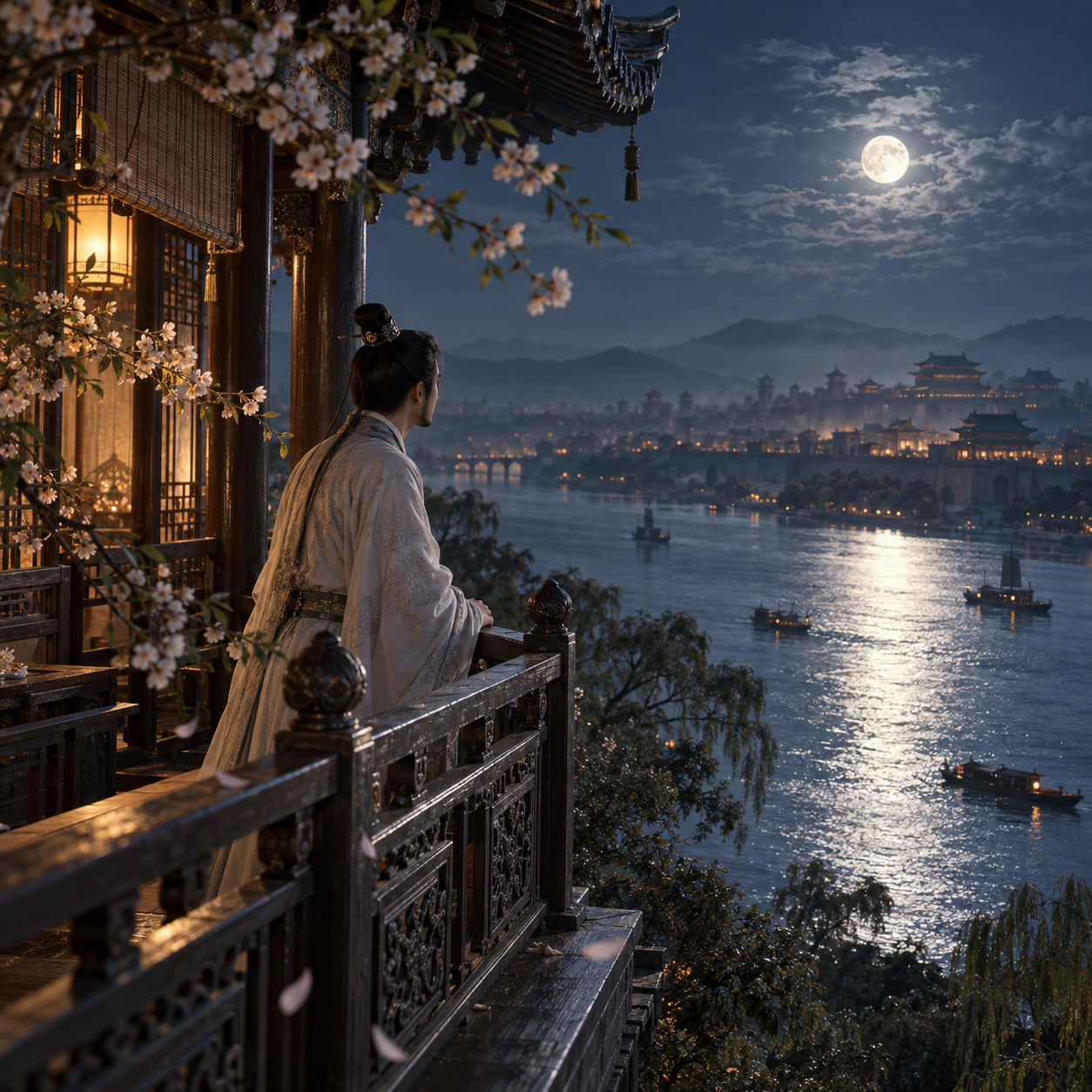
When will this year’s passing days ever end, and how much of the past remains? Last night, the spring wind returned to the little tower; on this night with the bright moon high above, how can I bear the pain of remembering my lost homeland!
The finely carved railings and jade steps should still be there, but the person I long for has grown old. If you ask how much sorrow fills my heart, it is like this endless spring river surging eastward.
虞美人: originally a tune of the Tang court’s music bureau, later used as a ci tune pattern. Its earliest subject was a flower that sprang from the ground after the death of Xiang Yu’s beloved Lady Yu, from whom it took its name. It is also called “A River of Spring Water,” “Water in a Jade Vessel,” and “The Twelve Peaks of Mount Wu,” among other names. It has two stanzas totaling fifty-six characters, each stanza containing four lines, with two oblique-tone rhymes followed by two level-tone rhymes.
了: to conclude or finish.
故国: the former Southern Tang capital, Jinling, present-day Nanjing.
雕栏玉砌: the carved railings and jade steps of the former Southern Tang palace far away in Jinling. 砌 means steps.
应犹: “should still”; a variant reads「依然」(“still as before”).
朱颜改: those remembered have grown old. 朱颜, also 红颜, refers to a young woman's rosy face and, by extension, a maiden; here it means the palace women of the former Southern Tang.
君: the author referring to himself.
能: variants read 「都」, “all,” 「那」, “how,” 「还」, “still,” or 「却」, “yet.”
According to tradition, on the night of the Double Seventh Festival, the poet ordered a singing girl to perform this lyric. After Emperor Taizong of Song, Zhao Guangyi, learned of it, he sent poisoned wine that killed him, making this something of a final lyric. It is a lament for life: through the sharp contrast between nature’s permanence and human life’s uncertainty, the author expresses the grief of suddenly feeling life emptied of meaning after his kingdom’s fall. The language is clear, concise, graceful, and fresh. Beginning with a question and ending with an answer, it moves from questioning heaven and others to questioning himself. Its sorrowful yet at times impassioned tone, together with an artful structure that twists, circles, and flows freely, carries his irrepressible grief throughout, creating a beauty that deeply moves the reader.
This lyric by Li, the Later Ruler, owes much of its broad resonance to the emotionally compelling, symbolic metaphor in its final line, which makes sorrow both concrete and abstract. The poet does not explicitly state the actual substance of his sorrow—his longing for a former life of extravagant pleasure—but shows only its outward form: 「恰似一江春水向东流 (“just like a river of spring waters flowing east”). Readers can therefore readily find an answering feeling within themselves and borrow the line to express similar emotions of their own. Although people's sorrows differ in substance, they can all take an outward form like 「恰似一江春水向东流」 (“just like a river of spring waters flowing east”). Because 「形象往往大于思想」 (“an image often exceeds the thought it embodies”), this lyric has resonated widely and been recited across the ages.
The Later Lord Li’s longing for his lost kingdom may not deserve sympathy: the past he yearned for was inseparable from imperial life amid 「雕栏玉砌」 (“carved railings and jade steps”) and the palace’s private affairs of love by day and night. Yet this widely cherished masterpiece does possess distinctive artistic qualities:
“春花秋月何时了” (“When will spring flowers and autumn moons come to an end?”) shows that, as a prisoner, the lyricist fears the painful memories these sights awaken. Most people regard “春花秋月” (“spring flowers and autumn moons”) as beautiful, yet the author fervently hopes they will soon “了” (“end”). The “东风” (“east wind”) at the little tower brings news of spring, but instead provokes his lament that he “不堪回首” (“cannot bear to look back”). These things all stir his sense that the surroundings endure while human circumstances have changed, throwing into relief his sorrow at imprisonment in a foreign land. They portray, truthfully and deeply, the state of mind of a ruler of the southern realm who once lived amid jeweled company and sumptuous feasts, but has become a prisoner whose long songs serve as weeping. “往事知多少?” (“How many things of the past remain in memory?”) Looking back, he sees countless events from his reign vividly before him. Historical accounts record that, as ruler, Li Houzhu indulged daily in sensual pleasures, neglected government, and unjustly executed remonstrating ministers… Through this line, it is not difficult to see that this last ruler of Southern Tang, reduced from a formidable sovereign to a prisoner, feels more than grief and indignation at this moment: there is also some remorse. “小楼昨夜又东风,故国不堪回首月明中。” (“Last night the east wind returned to the little tower; beneath the bright moon, I cannot bear to look back on my former kingdom.”) Spring wind once again brushes the little tower where he ekes out his life, and spring flowers will soon bloom in profusion. Yet the Southern Tang dynasty, the Li family's state—his own homeland—has long since fallen. Confined in his prison dwelling, the poet hears the spring wind and gazes at the bright moon. The scene stirs countless sorrows, leaving him unable to sleep. The single word “又” (“again”) indicates that this scene and these feelings have recurred many times; such mental anguish is truly hard to endure. “Again” marks the seasonal return of “spring flowers and autumn moons”: another year has passed since his surrender to Song, deepening the sorrow expressed in the first two lines and leading into memories of his former kingdom.
「雕栏玉砌应犹在,只是朱颜改。」 (“The carved railings and jade steps should still remain; only the rosy faces have changed.”) Though 「故国不堪回首」 (“the lost homeland is unbearable to look back upon”), he cannot help but 「回首」 (“look back”). These two lines give concrete form to looking back upon the lost homeland—the splendid palaces of the former capital, Jinling, probably remain, but the rosy faces of the palace women who lost their country have changed. Implicit here is the Last Ruler Li’s grief at his land passing to another ruling house and his realm being transformed! While 「朱颜」 (“rosy faces”) specifically refers to the beauties of the former palace, it also symbolizes all the beautiful things and the happy life of the past. In these six lines, the poet strives to fuse the contrasts between lovely scenery and sorrow, past and present, landscape and human affairs. Above all, the powerful contrast between nature’s permanence and the upheavals of human life allows the grief and remorse pent up in his heart to pour forth through artful turns, crystallizing in the immortal closing lines—「问君能有几多愁?恰似一江春水向东流。」 (“How much sorrow can you hold? Just like a river of spring water flowing east.”) First, a thought-provoking question identifies the abstract subject, 「愁」 (“sorrow”); then the vivid image of rushing river 「水」 (“water”) supplies the answer. Comparing a heart full of grief to a river full of spring water is strikingly apt and vivid. It conveys not only sorrow’s lasting reach and depth, but also its surging turbulence, fully revealing the force and profundity of emotion in motion. By comparison, Liu Yuxi’s line in “Bamboo Branch Songs,” 「水流无限似侬愁」 (“The water flows endlessly, like my sorrow”), seems somewhat too direct, while Qin Guan’s “River City,” 「便作春江都是泪,流不尽,许多愁」 (“Even if the spring river were all tears, it could not carry away so much sorrow”), presses the point too far, weakening its emotional power.
In clear, concise, graceful, and fresh language, the lyric uses metaphor, personification, contrast, rhetorical questions, and other devices to distill and fully express the poet’s sincere feelings.
Let words find a melody
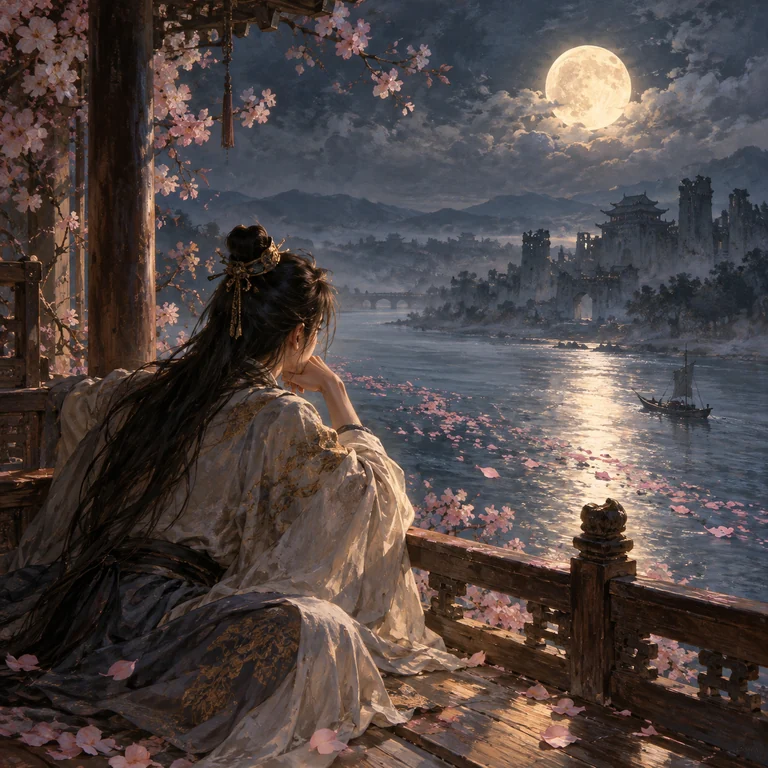
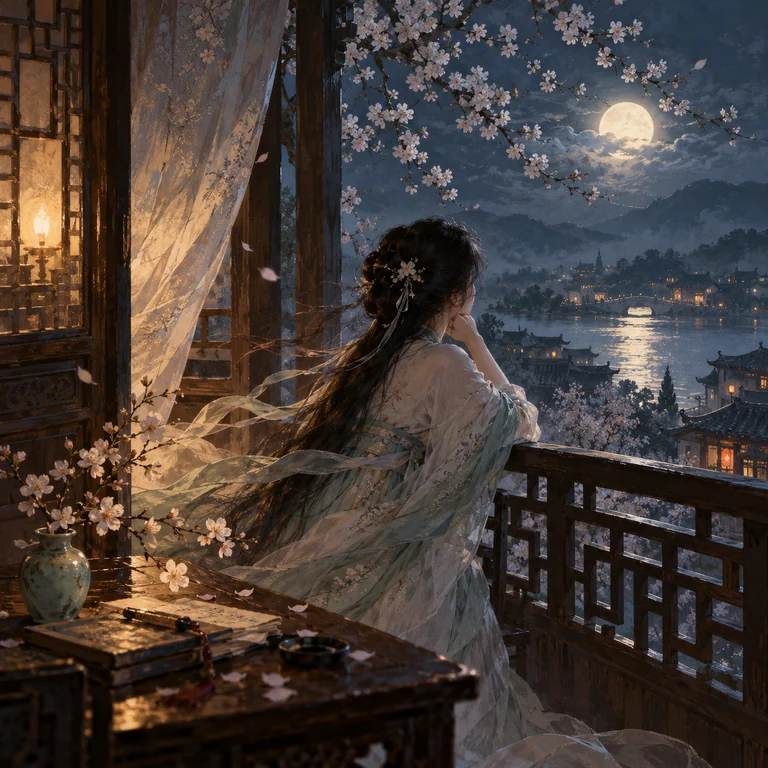
From a poem into a story
The moment Lu Qing paints over the old palace’s south gate with a wall, he forgets which street his mother lives on. He has been ordered to paint his former kingdom in everlasting spring for the new ruler. Towers, terraces, and crabapple blossoms must all remain as they were, but no way out may be left. The flute master in the prison tower is also beginning to forget the river of their old city. As the birthday gift nears completion and the east wind rises outside the window once more, Lu Qing grips his brush, no longer daring to paint a wall lightly.
Start readingAI-assisted writing · Fictional characters and events
