
Bring in the Wine
Tang dynasty・Li Bai

Tang dynasty・Li Bai
Do you not see the Yellow River’s waters coming down from heaven,
Rushing to the sea, never to return。
Have you not seen, before the bright mirror in the lofty hall, the grief over white hair,
Black silk in the morning, snow by dusk.
When life goes well, rejoice to the full,do not leave your golden cup empty beneath the moon。
The talents Heaven gave me must have their use,a thousand in gold spent will return again。
Cook sheep and slaughter cattle, let us make merry, we must drink three hundred cups in one sitting.
Master Cen, young Danqiu, bring in the wine; let the cups never rest.
Let me sing you a song; please lend me your ear.
Bells and drums, feasts of rare delicacies are not worth prizing,I wish only to stay drunk and never wake again。
Since ancient times, sages and worthies have all known loneliness; only drinkers have left their names behind.
The Prince of Chen once feasted at Pingle, spending ten thousand for a measure of wine, giving free rein to merriment.
Why, host, speak of having little money? Just buy the wine, and I shall drink with you.
五花马,千金裘,— A five-flowered horse, a fur coat worth a thousand in gold,
Call the boy to take them out and trade them for fine wine; together with you, I shall dissolve the sorrow of all ages.
The animation remains in its original Chinese.
The animation is ready.
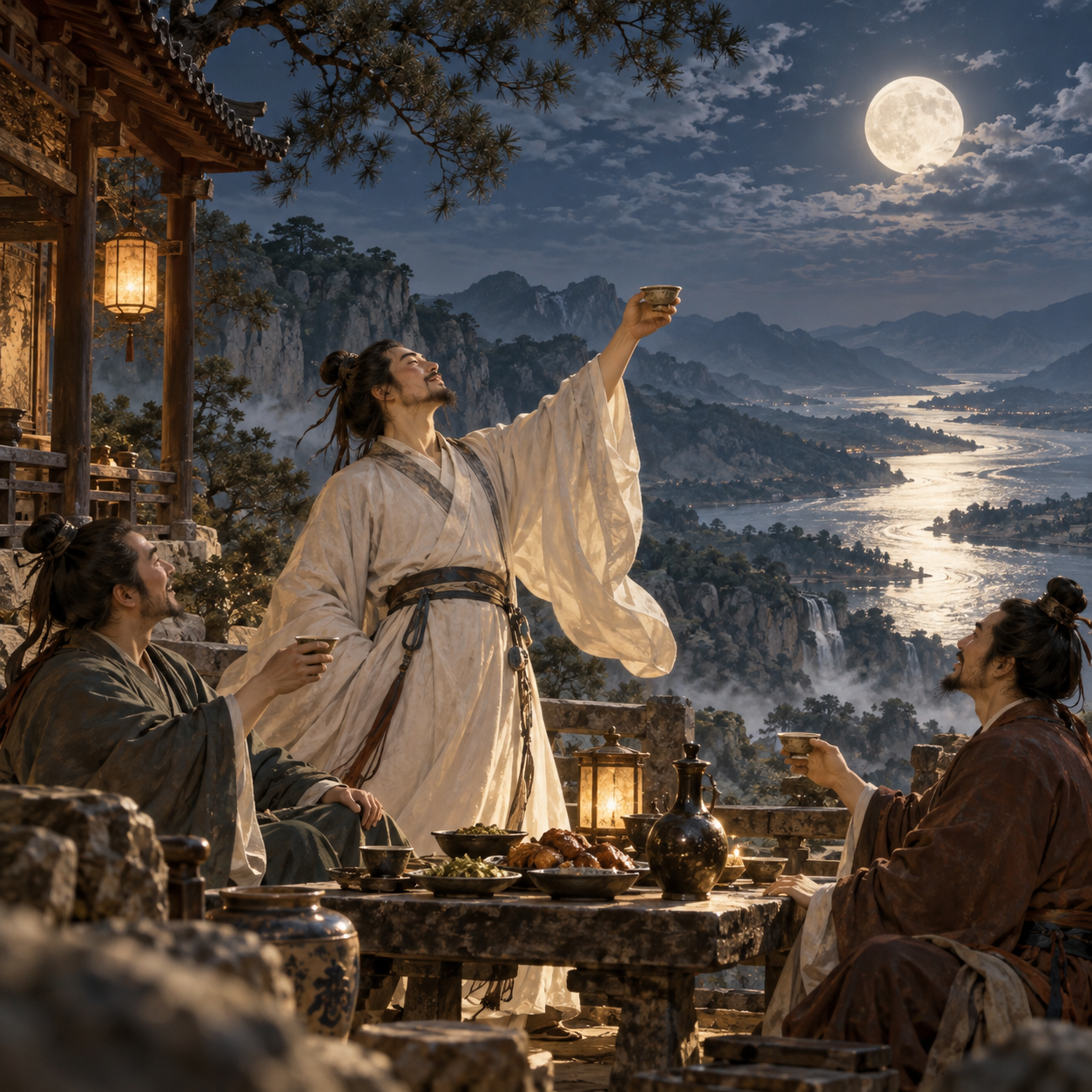
Do you not see the Yellow River's waters rushing down from heaven, their rolling waves surging straight toward the eastern sea, never to return?
Do you not see the head of white hair in the bright mirror of the lofty hall—black in the morning, yet already snow-white by evening?
(Therefore) when life goes well, one should give oneself fully to joy; do not leave this golden cup empty of wine beneath the bright moon.
Everyone is born with their own value and purpose; even if a thousand taels of gold are spent at a stroke, they can still be earned again.
Let us cook a sheep and slaughter an ox for our pleasure; drinking three hundred cups in one joyful sitting (today) would be none too much!
Master Cen, Scholar Danqiu! Drink up! Do not stop.
Let me sing a song for you, please lend me your ears and listen closely:
What is precious about a luxurious life spent feasting on rare delicacies? I wish only to remain lost in drunkenness and never wake.
Since ancient times, sages and worthies have all been neglected and lonely; only those skilled at drinking have left their good names to posterity.
Do you know how Cao Zhi, Prince of Chen, once held a feast at Pingle Pavilion? Even wine costing many thousands a measure was drunk freely, giving host and guests unrestrained delight.
My host, why say there is little money? Just buy the wine and let us drink our fill together.
Those prized horses with five-flowered manes, those costly fox-fur robes worth a thousand gold pieces—call your attendant out and have him exchange them all for fine wine, so that together we may dispel this endless sorrow of the ages!
将(qiāng)进酒: Bring in the Wine, an old yuefu title. 将 means please.
君不见: “Have you not seen?” A rhetorical expression of heightened emphasis often used in yuefu poetry.
天上来: “comes from the heavens.” The Yellow River rises in Qinghai, where the terrain is extremely high, hence this expression.
“君不见高堂明镜悲白发,朝如青丝暮成雪。”: the speaker sees his white hair in the bright mirror of a lofty hall and grieves—black as silk in the morning, white as snow by evening. 高堂: a lofty hall; 青丝: black hair.
得意: when one feels content and happy.
会须: one really ought to.
岑夫子: Cen Xun, a close friend of Li Bai.
丹丘生: Yuan Danqiu, a close friend of Li Bai.
杯莫停: do not let the cups stop; one variant reads “君莫停,” do not you stop.
与君: for you, on your behalf. 君 refers to the two men, Cen and Yuan.
倾耳听: “listen intently”; one variant reads “侧耳听” (“turn one’s ear to listen”).
钟鼓: bells and drums played at banquets in wealthy households.
馔 (zhuàn) 玉: Describes food as exquisite as jade.
不复醒 (never sober up again): some editions read “不用醒” (no need to sober up) or “不愿醒” (unwilling to sober up).
陈王: Cao Zhi, Prince Si of Chen.
平乐: Pingle, the name of a palace pavilion outside Luoyang’s western gate, a place of entertainment for the wealthy and powerful during the Han dynasty.
恣: freely and without restraint.
谑 (xuè): To jest.
言少钱: a variant reads “言钱少”; both mean “to say there is little money.”
径须: Simply; go right ahead and.
沽: to buy.
五花马: a prized horse. One explanation describes a coat patterned in five-flower markings; another describes a mane trimmed into five lobes.
尔: You.
销: used in the same sense as “消” (to dispel or dissolve).
“Bring in the Wine” was a title used for yuefu songs before the Tang dynasty, usually celebrating drinking and singing freely. In this poem, Li Bai uses the established theme to drown his sorrows in wine and express his indignation. The poem vividly reveals his proud, untamable character: on one hand, he is full of self-confidence, aloof and proud; on the other, after setbacks in his political prospects, he shows an impulse toward unrestrained pleasure. The poem's bold momentum, uninhibited feeling, and flowing language give it powerful emotional appeal.
This poem vividly portrays Li Bai's proud, untamable character: on one hand, he is full of self-confidence, aloof and proud; on the other, setbacks in his political prospects bring out an impulse toward unrestrained pleasure. Here he interprets Zhuangzi's philosophy of delight in life, expressing disdain for wealth, rank, sages, and worthies. Yet beneath his exuberant drinking and revelry lies a deep sense of unrecognized talent. Bold in spirit, unrestrained in feeling, and fluent in language, the poem is powerfully affecting. Li Bai “借题发挥” (uses the occasion to develop his own themes), drowning sorrow in wine and giving voice to his indignation.
Time passes like rivers flowing into the sea, never to return; life is painfully short, black hair turning snow-white between morning and evening. The smallness of human life seems an irredeemable tragedy, and only fine wine in a golden cup can dispel sorrow. This is sorrow in Li Bai's manner: sadness capable of grandeur, grief without collapse, extreme indignation joined to extreme freedom. On the surface, he laments how quickly life grows old; beneath it, he laments unrecognized talent. The poem opens with two sets of long parallel lines that sweep toward the reader like winds from the sky and rain from the sea, magnificent in force. “君不见黄河之水天上来,奔流到海不复回” — “Do you not see the Yellow River's waters coming from heaven, rushing to the sea, never to return?” Li Bai was then at Yingyang Mountain, not far from the Yellow River; looking out from a height, he used the river to launch his feeling. With its distant source, long course, and immense descent, the Yellow River seems to fall from heaven and pour for a thousand miles eastward to the sea. Such vastness cannot be seen by the naked eye, so this scene arises from Li Bai's imagination, something “自道所得,” “gained through his own expression,” and its language is exaggerated. The first line describes the river coming with unstoppable force; the next describes its departure, impossible to reverse. This surge and ebb creates an expansive, recurring cadence of song absent from a brief single line such as “黄河落天走东海” — “The Yellow River falls from heaven and races to the eastern sea.”
Immediately afterward comes “君不见高堂明镜悲白发,朝如青丝暮成雪” (“Do you not see, before the bright mirror in the lofty hall, grief over white hair—black silk at dawn, snow by dusk?”), like another wave rising before the first has subsided. The preceding two lines exaggerate space; these two exaggerate time. They lament life's brevity, yet instead of stating directly that life is short and people age in an instant, the poet writes “高堂明镜悲白发” (“before the bright mirror in the lofty hall, grief over white hair”), evoking someone gazing into a mirror, touching the hair at his temples, helpless to change it. Compressing the entire passage from youth to old age into “朝” and “暮”—“morning” and “evening”—makes an already brief life briefer still. This runs in the opposite direction from the preceding lines, which make an already mighty river mightier. Thus these long, parallel opening lines both offer an analogy—the river's irreversible flow suggests life's swift passing—and create a contrast: the Yellow River's greatness and permanence reveal life's smallness and fragility. This opening reaches an extreme of sorrow without becoming feeble; its grief is that of a giant, with a stirring artistic power also created by the momentum of its long parallel lines. The poet often uses this opening technique, as in “弃我去者,昨日之日不可留;乱我心者,今日之日多烦忧” (“What abandons me is yesterday, which cannot be detained; what troubles my heart is today, so full of cares”), from Farewell to Uncle Yun, a Collator, at Xie Tiao's Tower in Xuancheng. Shen Deqian remarked, “此种格调,太白从心化出” (“This kind of style flows transformed from Taibai's own heart”), showing its considerable originality. The repeated appeal “君不见” (“Do you not see?”)—usually used only occasionally at the beginning or end of a yuefu poem—greatly intensifies the emotional force here. Poetry is sometimes described as opening expansively and drawing together broadly; this is an expansive opening indeed.
“夫天地者,万物之逆旅也;光阴者,百代之过客也” (“Heaven and earth are an inn for all things; time is a passing traveler through a hundred generations,” from “Preface to a Spring Night Banquet with My Younger Cousins in the Peach and Pear Garden”). Although sorrow is unavoidable, pessimism is foreign to Li Bai's nature. To him, whenever “人生得意” (life brings fulfillment), one should have no regrets and give oneself fully to joy. Lines five and six mark a reversal, turning from “悲” (sorrow) to “欢” and “乐” (delight and joy). From here through “杯莫停” (do not let the cups stop), the poem's feeling grows increasingly unrestrained. “人生达命岂暇愁,且饮美酒登高楼” (“Understanding life's destiny, how can one spare time for sorrow? Let us drink fine wine and climb a lofty tower,” from “Song of Liang Garden”): pleasure calls for wine, bringing the poem to its subject. Yet instead of directly naming what is in the cup, the poet highlights it through the figurative language of “金樽” (golden goblets) and “对月” (facing the moon), making drinking still more poetic. Rather than directly urging lavish drinking and revelry, he substitutes the paired negations “莫使” (do not let) and “空” (empty), giving the tone greater emphasis. “人生得意须尽欢” (“When life brings fulfillment, one must savor joy to the full”) seems to advocate seizing present pleasure, yet it is only imagined. At this time, the poet was frustrated and unfulfilled. “凤凰初下紫泥诏,谒帝称觞登御筵” (“A phoenix first brought down the purple-sealed edict; I appeared before the emperor, raised my cup, and joined the imperial feast,” from “Song of the Jade Pot”): when summoned to the capital and granted an imperial banquet, he seems to have enjoyed fulfillment, but it proved only an illusion. Then comes “弹剑作歌奏苦声,曳裾王门不称情” (“Tapping my sword, I sing a bitter song; trailing my robe at a prince's gate brings no contentment,” from “Hard Is the Road, No. 2”). In ancient times, Feng Xuan, a retainer of Lord Mengchang, felt that his patron treated him with insufficient respect; early on, he would often tap his sword and sing, expressing his wish to leave. Li Bai hoped to “平交王侯” (associate with princes and lords as an equal), but the powerful in Chang'an paid him little regard. He uses Feng Xuan's story as an analogy for his own situation. Here again there seems to be no fulfillment, only disappointment and indignation.
Yet he does not sink into despair. Instead, in an optimistic, determined voice, the poet affirms life and himself: “天生我材必有用” (“Heaven gave me talents that must have their use”). This is a line that makes one beat time in admiration. “必” (“must”) lends “有用” (“have their use”) extraordinary confidence, almost a declaration of human worth, and this person—“I”—deserves a capital letter. Here, beneath an apparently negative surface, emerges a deeply hidden positive impulse: the desire of an unrecognized talent to take part in the world. As “长风破浪会有时” declares (“The time will come to ride the long wind and cleave the waves”), the day of realizing his ideals will surely arrive. For such a future, one should drink deeply and sing loudly; what does the expense matter? “千金散尽还复来!” (“Though a thousand in gold be spent, it will return!”) This is another astonishing line of supreme confidence. To command money rather than be commanded by it is enough to leave ordinary people speechless. The poetry resembles the man: consider his statement, “曩者(过去)游维扬,不逾一年(不到一年),散金三十余万” (“Formerly, while traveling in Weiyang, I spent over three hundred thousand in money in less than a year”), from “上安州裴长史书” (Letter to Administrator Pei of Anzhou). What a grand gesture! The bold spirit embedded in this line is something no mere poseur could come close to attaining.
Matching this grandeur, the author depicts a lavish feast. This is certainly no occasion for “菜要一碟乎,两碟乎?酒要一壶乎,两壶乎?” (“One dish or two? One pot of wine or two?”). Instead, whole animals are prepared in “烹羊宰牛” (“cooking sheep and slaughtering cattle”), and no one will stop before drinking “三百杯” (“three hundred cups”). The feast’s exuberance is conveyed in vigorous lines. Here the unrestrained feeling approaches its climax, and the poem’s rhythm quickens. The poet’s flushed, dizzy intoxication springs from the page, almost letting us hear him urge his companions aloud: “岑夫子,丹丘生,将进酒,杯莫停!” (“Master Cen, friend Danqiu, bring on the wine; let your cups never stop!”). The sudden introduction of several short phrases varies the rhythm and closely captures the voices at the table. Among friends who understand him and drinking companions who can match him, the poet not only reaches the uninhibited familiarity of “忘形到尔汝” (“forgetting formalities and addressing one another with intimate directness”), but even seems to forget that he is writing poetry. The poem beneath his brush appears to become life itself, and he goes on: “与君歌一曲,请君为我倾耳听” (“Let me sing you a song; please lend me your ears”). The next eight lines form a song within the poem. This conception is extraordinarily inventive, a stroke of inspiration.
“钟鼓馔玉” means a life of wealth and rank: wealthy households sounded bells and arrayed cauldrons at meals, with food as exquisite as jade. Yet the poet considers it “不足贵” (not worth valuing), boldly declaring “但愿长醉不复醒” (I only wish to stay drunk forever and never wake). At this point the poem clearly turns from wild abandon to impassioned indignation. These are not merely drunken boasts but truths spoken in drink. With his innate, useful talents, the poet believes he ought to attain high ministerial office and soar to success; instead, “大道如青天,我独不得出” (The great road is like the blue sky, yet I alone find no way out), as he says in The Hard Road. His claim that wealth and rank are not worth valuing comes from resentment. The following two lines beginning “古来圣贤皆寂寞” (Since ancient times, sages and worthies have all known loneliness) are likewise words of indignation. Li Bai once lamented, “自言管葛竟谁许” (I claim the gifts of Guan and Zhuge, but who will acknowledge them?), saying that no one believed he possessed Guan Zhong's talent and Zhuge Liang's wisdom. Thus, in speaking of the ancients' loneliness, he also expresses his own. That is why he would willingly live in drunken dreams and never wake. Here the poet uses the ancients' wine cups to pour away the grievances lodged in his own heart.
After saying “唯有饮者留其名” — “only drinkers leave their names behind” — the poet names Cao Zhi, the Prince of Chen, as an example. He adapts the lines “归来宴平乐,美酒斗十千” from Cao Zhi's “Ballad of the Famous Capital”: “Returning, we feast at Pingle; fine wine costs ten thousand a measure.” There have been many famous drinkers through the ages, but choosing the Prince of Chen is inseparable from Li Bai's consistently high opinion of himself. His models were eminent figures such as Xie An, and among such figures the Prince of Chen had particularly strong associations with wine. The reference gives the poem grandeur and sustains its earlier tone of supreme confidence. In “Ballad of the Famous Capital,” the Three Kingdoms poet Cao Zhi describes a banquet in Luoyang with those lines about returning to feast at Pingle. Cao Zhi was said to possess eight measures of talent: the Liu Song writer Xie Lingyun declared, “天下才有一石,曹子建独占八斗,我得一斗,天下共分一斗。” — “Of the world's ten measures of talent, Cao Zijian alone has eight; I have one, and everyone else shares the remaining one.” Despite his exceptional gifts and lofty ambitions, Cao Zhi suffered politically at the hands of his elder brother Cao Pi, Emperor Wen of Wei, and lived in frustrated obscurity. The Prince of Chen faced deep suspicion under both Cao Pi and Cao Rui, leaving his aspirations unfulfilled, a plight that also stirred Li Bai's sympathy. First invoking the sages and worthies of antiquity, then Cao Zhi, the poem brims with indignation. Its opening seems concerned only with reflections on life, without political coloring, yet the entire work contains profound, far-reaching anguish and faith in the self. This is why its sadness does not collapse into despondency, but rises to grandeur.
Having revealed a little of his deepest feelings, he returns to wine with an even greater appetite for drinking. The poetry now enters another phase of abandon, growing ever wilder. “主人何为言少钱” (“Host, why speak of having too little money?”) both echoes the line about spending a thousand in gold and deliberately creates another dramatic turn, leading into the final bold declarations: even if all that gold is gone, one should freely bring out precious possessions—the “五花马” (“five-flowered horse,” a fine horse with a five-patterned coat) and “千金裘” (“fur coat worth a thousand in gold”)—and exchange them for good wine, drinking until thoroughly drunk. The brilliance of this ending lies not only in the commanding tone of “呼儿” (“call the boy”) and “与尔” (“with you”), but also in a willful reversal of guest and host that the author himself may not have noticed at the time. Remember that the poet is merely a guest invited by a friend to drink. Yet here he occupies a place of authority, issuing commands and proposing to pawn coat and horse, almost leaving us unsure who the “主人” (“host”) is. The romantic coloring is exceptionally strong. Such frank words from a forthright person could arise only among bold, intimate friends unconstrained by ceremony. At this point the poetry reaches the height of abandon, making one sigh and sing, almost ready to “手之舞之,足之蹈之” (“dance with hands and stamp with feet”). Feeling is still unfinished as the poem comes to its close, suddenly bursting out with “与尔同销万古愁” (“With you, I shall dissolve the sorrow of all ages”). This reconnects with the opening “悲” (“grief”), while the meaning of “万古愁” (“the sorrow of all ages”) is deeper still. This ending, like “白云从空,随风变灭” (“white clouds emerging in the sky, changing and vanishing with the wind”), reveals the surging, plunging torrent of the poet's emotions. Viewed as a whole, the poem rises and falls on a grand scale, achievable only by a masterful pen.
“Bring in the Wine” is not especially long, yet its many tones converge in extraordinary splendor. Its writing is rich and full; its feelings reach the depths of grief and indignation while taking a wildly unrestrained form, and its language is supremely bold yet controlled. The poem has a momentum and force that have shaken readers through the ages. This certainly owes something to exaggeration: enormous quantities recur throughout it, such as “千金,” “a thousand gold pieces”; “三百杯,” “three hundred cups”; “斗酒十千,” “ten thousand for a measure of wine”; “千金裘,” “a fur coat worth a thousand gold pieces”; and “万古愁,” “the sorrow of all ages.” These express its heroic feeling without seeming hollow or inflated because of the full, profound emotion within, the pent-up anger surging like waves beneath its drinking talk. The poem also rises and falls dramatically, its feeling alternately drawing inward and expanding: from grief to joy, to abandon, to indignation, back to abandon, and finally gathering in “the sorrow of all ages,” answering the opening. Like a great river in full flow, it has both momentum and winding turns, sweeping freely with immense strength. Its construction embeds a song within a song, displaying seemingly supernatural artistry that “绝去笔墨畦径” — “leaves all conventional tracks of writing behind.” This cannot be learned through deliberate carving and polishing, nor achieved through careless haste. Seven-character lines predominate, interrupted by lines of three, five, and ten characters, creating richly interwoven irregularity. Most lines unfold freely, with brief parallel phrases added for emphasis, such as “岑夫子,丹丘生,” “Master Cen, young Danqiu,” and “五花马,千金裘,” “the five-flowered horse, the thousand-gold fur coat.” The rhythm varies continually between swift and slow, unrestrained yet never facile.
Let words find a melody
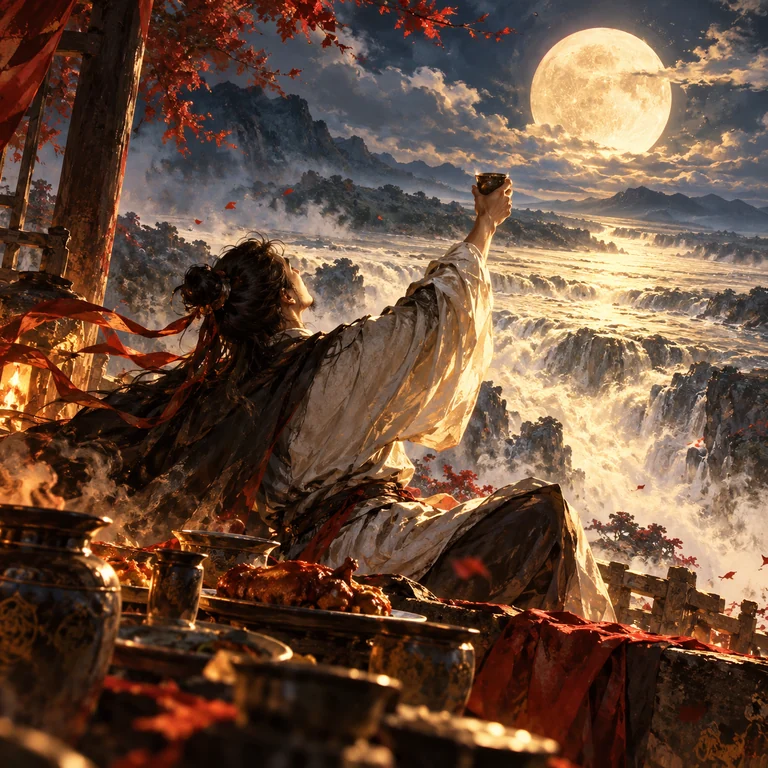
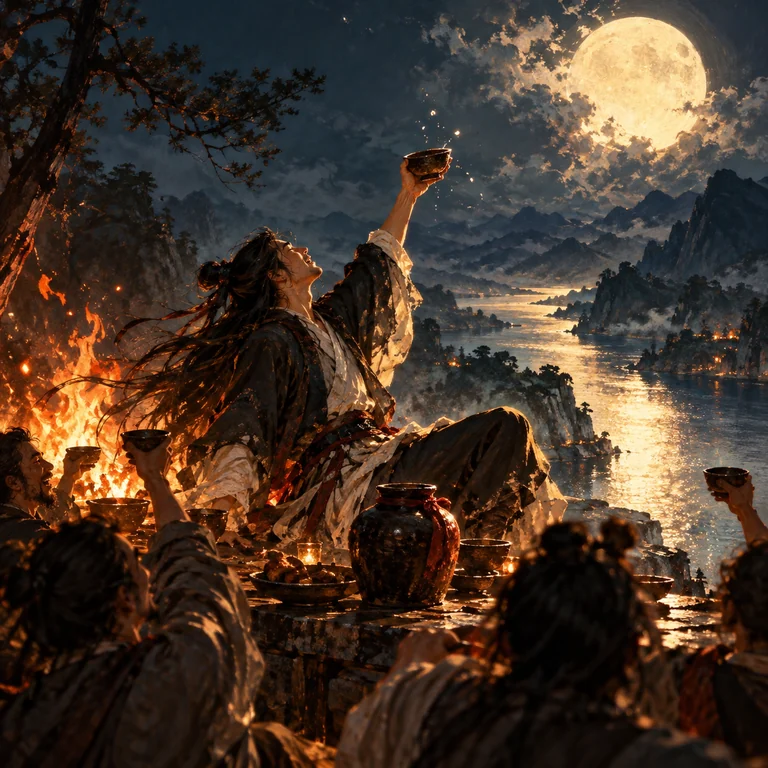
From a poem into a story
Du Fang pawns the old fur coat he bought for forty taels and receives only eight, intending to drink with an old friend through the night and bid farewell to his old dream of fame. Halfway into their drinking, the mute apprentice behind the stove raises a bamboo clapper and beats out a different rhythm for Crossing the Sands. The inn’s creditor also arrives that night. The wine is still warm, but the song he has sung for half his life can no longer be sung as before.
Start readingAI-assisted writing · Fictional characters and events
