
Two Poems for Minister Zhang of the Court of the Imperial Regalia, Lamenting the Rain at Princess Yuzhen’s Villa
Tang dynasty・Li Bai

Tang dynasty・Li Bai
秋坐金张馆,繁阴昼不开。— In autumn I sit in the halls of Jin and Zhang; dense shade does not lift even by day.
Mist in the air blurs the rain's hues, a bleak chill comes into view.
Dark and dim, the anguish of sinking in disaster; heavy and deep, sorrow and grief press on.
What can console me in clear autumn,white wine brimming in my cup.
As I chant, I think of Guan Zhong and Yue Yi; these men have long since turned to ash.
Drinking alone, I try to hearten myself,who values my talent for governing the world。
弹剑谢公子,无鱼良可哀。— Tapping my sword, I take leave of the young lord; to have no fish to eat is truly pitiful.
In relentless rain I long for sunlight,how can these drifting clouds be swept away.
Ji and Xie brought Heaven and humanity into harmony, yet yin and yang grew unruly.
Autumn rain pours as though wells were overturned, dark mist stretches across the towering peaks.
I wished to travel a mere few steps, yet the way became a barrier of mountains and rivers.
I hear the torrents rushing and roaring; vast, startling waves churn and roll.
Mud and sand block the road midway; cattle and horses cannot be told apart.
Hungry, I took food from a washerwoman; in idle hours, I pieced together the bamboo slips of Yuling.
In the gardener's plot I find autumn vegetables; even goosefoot and bean leaves are too sparse to fill the view.
The long-legged spider weaves secluded thoughts; the cricket grieves in cramped confinement.
No blue smoke rises from the kitchen stove; green moss grows on knife and chopping board.
I throw down my chopsticks and take off my rare bird-patterned robe, exchange it for wine and drink myself drunk in the northern hall.
That commoner from Dantu had a generous spirit beyond measure.
When shall a golden platter,offer a full hu of betel nuts.
With the deed accomplished, I shake out my robes and leave, wandering beside the blue-water isles.
The animation remains in its original Chinese.
The animation is ready.
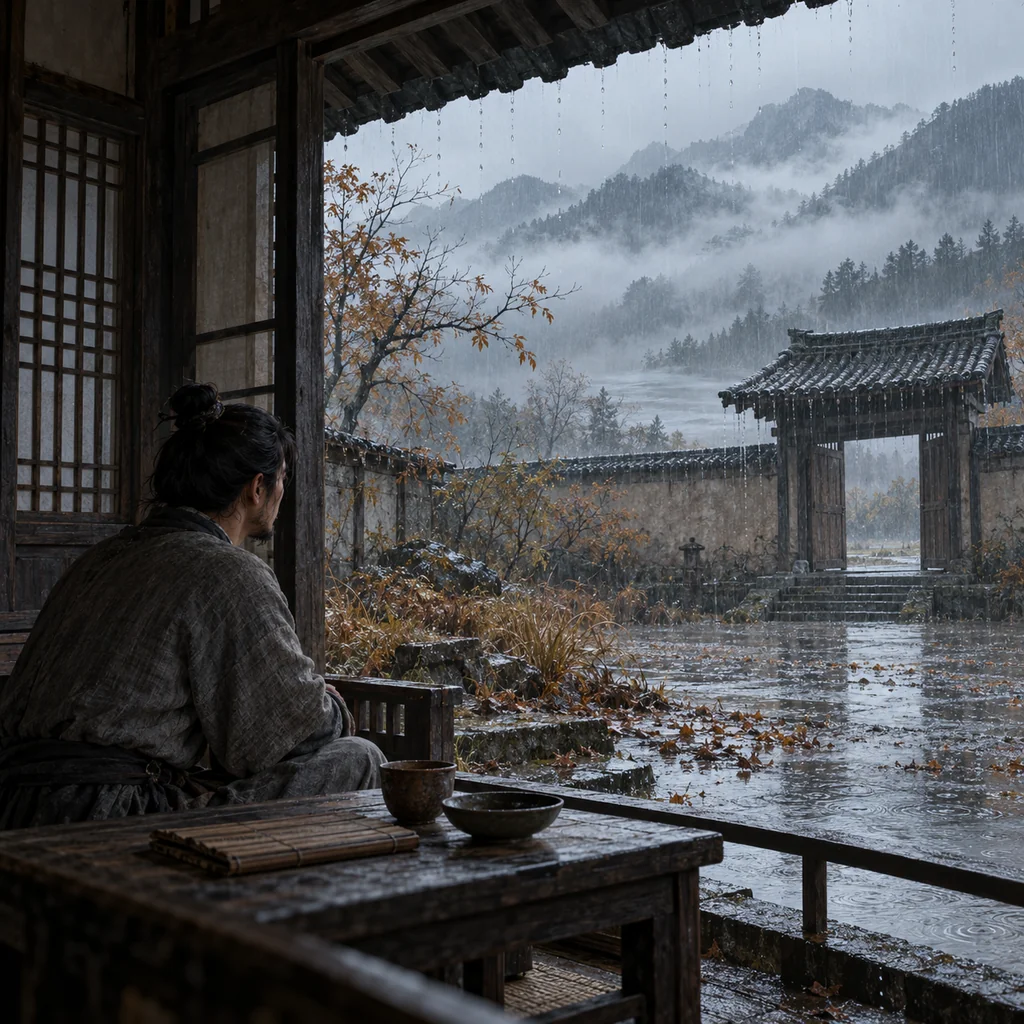
In autumn, I sit in the lodging of a family as eminent as the Jin and Zhang clans; layers of dark cloud cover the sky, and even by day no sunlight appears.
Mist in the air mingles with the rain’s gray hues, and chill wind and rain sweep toward me from the distance into which I gaze.
The dark distress of flooding brings anguish, while heavy grief and indignation press upon one in successive waves.
In this clear, chilly autumn, what can comfort me? I can only fill my cup with wine.
While chanting poetry, I think of Guan Zhong and Yue Yi, but these worthy predecessors have long since turned to dust and ash.
Drinking alone, I try for now to encourage myself: who values my ability to govern worldly affairs?
Like Feng Xuan tapping his sword and singing, I tell the noble young lord: I cannot even get fish to eat—what a lamentable plight.
Wearied by unceasing rain, I long only to see the bright sun; I do not know how to roll away the drifting clouds that cover the sky.
Those in power ought, like Ji and Xie, to harmonize Heaven’s order with human affairs, yet yin and yang remain so unrestrained and disordered.
The autumn rain pours fiercely, as though an entire well were being emptied; dark mist stretches across the towering peaks.
I had only wished to travel a short distance, close at hand, yet it was as though mountain after mountain and river after river blocked the way.
The sound of rushing torrents fills my ears; the vast waters raise startling waves that churn without end.
Mud and sand blocked the road entirely; amid the murk, even cattle and horses could scarcely be distinguished.
When hungry, I can only depend on a washing woman's gift of a meal, as Han Xin once did; when free, I arrange and study ancient books and bamboo slips.
I went to the vegetable grower to seek some autumn greens; even coarse vegetables such as goosefoot and bean leaves were too scant to fill the eye.
The spider spins its web, as though winding up deep, secluded sorrows; the cricket's chirping stirs a grief that feels cramped and unable to unfold.
No cooking smoke rises from the kitchen stove; the knife and chopping board, long unused, have grown green moss.
Putting down the chopsticks, I took off my shuāng-bird fur coat against the cold to exchange it for wine, then drank myself into a stupor in the northern hall.
Liu Muzhi of Dantu, who rose from commoner origins, possessed a spirit and strategic talent that were truly not to be lightly measured.
Who knows when I, too, might serve a hu of betel nuts on a golden platter, entertaining those who once looked down on me.
Once my great work is accomplished, I shall shake out my sleeves and depart, wandering freely beside quiet islets in the water.
Division of the sequence: This title comprises two poems. This page presents twenty-one couplets consecutively: the first seven form the first poem, and the remaining fourteen form the second, totaling fourteen and twenty-eight lines respectively. The second poem begins at 苦雨思白日 (tormented by rain, I long for the bright sun).
别馆 in the title: a residence separate from the main home. 卫尉 is an official title, and 张卿 is a respectful address to the official surnamed Zhang to whom the poem is presented. Scholars differ over the recipient's precise identity and the year of composition. This page addresses the recipient only as the title does, without adopting disputed identifications or dates. The central figure in the poem is someone staying away from home and confined by rain.
金张: The families of Jin Midi and Zhang Anshi of the Han dynasty, renowned for their prominence; later, the names often stood for powerful aristocratic households. 金张馆, their mansions, carries that metonymic meaning here. 繁阴: Dense dark clouds. 昼不开: The sky remains overcast even by day.
空烟: haze in the air. 萧飒: the bleak chill and stirring of wind and rain. 翳翳, pronounced yì yì: dark and dim. 昏垫: darkness and distress amid engulfing waters; it carries forward the sense of suffering from floods in ancient texts, rather than drowsiness.
清秋: a clear, chilly autumn season; it does not necessarily mean the weather is sunny. 白酒: an ancient alcoholic drink in the poem, not modern high-proof distilled baijiu. 盈: to fill.
管乐: Guan Zhong and Yue Yi. The former was a renowned minister of Qi during the Spring and Autumn period; the latter a celebrated general of Yan during the Warring States period. Both represent talent in governing and warfare. 此人已成灰: These worthy predecessors have long since died. 经纶: Originally the arranging of silk threads; here it means planning and managing the affairs of the state and world.
弹剑、无鱼: allusions to Feng Xuan, a retainer of Lord Mengchang who tapped his sword hilt and sang to complain about his treatment; in the Records of the Grand Historian, “Biography of Lord Mengchang,” his name is written 冯驩, Feng Huan. 铗 means sword. 谢 here can be understood as making a statement or appeal; 谢公子 means addressing one’s plea to the noble young lord.
稷契: Hou Ji and Xie, legendary worthy ministers under Shun. 契 is pronounced xiè. 和天人: to harmonize Heaven's way with human affairs. 阴阳 refers to the workings of nature; 骄蹇, pronounced jiāo jiǎn, means arrogant and unruly. The poem sets the harmony that should prevail against the continuing rain before the speaker, with a questioning tone.
霖: rain lasting many days. 剧: fierce or intense. 倒井: as though an entire well were poured out, an exaggeration of the rain's force. 绝巘: an extremely high peak; 巘 is pronounced yǎn. 咫尺: a very short distance. 山川限: to become a barrier like mountains and rivers.
潈潈: the rushing of many waters; the original text consulted also writes it as 潨潨. 奔溜: a rapidly plunging torrent. 惊波: surging, fearsome waves. 不可辨: difficult to distinguish clearly, describing the confusion caused by rain, mist, and muddy water.
漂母: an elderly woman who washed silk floss. The Records of the Grand Historian, “Biography of the Marquis of Huaiyin,” records that she gave Han Xin food when he was destitute. The poet invokes Han Xin’s hardship before recognition to describe his own dependence on others for meals. 漂 is pronounced piǎo.
羽陵简: an allusion to ancient books and written slips. Volume 53 of the Imperial Reader of the Taiping Era quotes the Account of King Mu’s Travels on airing worm-eaten books at Yuling; 缀 may be understood as arranging or compiling. Here the phrase describes tending books at leisure, and Yuling is a place-name in the old allusion.
园家: a household that grows vegetables. 藜藿, pronounced lí huò: coarse edible greens such as young goosefoot leaves and bean leaves, often used to evoke an impoverished diet. 不满眼: so few that even these humble vegetables are scarcely to be seen.
蟏蛸, pronounced xiāo shāo: a small, slender-bodied, long-legged spider, also written 蟰蛸 or 蠨蛸 in ancient texts and commonly called 喜子. 蟋蟀, pronounced xī shuài, also called 促织: a cricket, an insect that chirps. 褊浅: cramped and constricted; this couplet uses spiderwebs and insect sounds to convey hidden sorrow and confinement.
刀机: the knife, chopping board, and table used to prepare food. A smokeless stove and moss-covered utensils convey hunger, cold, and neglect after a long time without cooking; the blue smoke is not decorative incense.
箸, pronounced zhù: chopsticks. 鹔鹴, pronounced sù shuāng, was originally a bird’s name; here it abbreviates 鹔鹴裘, a fur robe worn against the cold. Miscellaneous Records of the Western Capital recounts how Sima Xiangru obtained wine on credit against the robe he was wearing; in the poem, 解鹔鹴 means taking off the fur robe, with 裘 omitted. 北堂: the northern hall, here the place where they drink.
丹徒布衣者: The commoner of Dantu, referring to Liu Muzhi. 布衣 denotes his status as an ordinary person who had not entered official service. 慷慨 here emphasizes spirit and ambition, rather than simply generosity with money. In his early years, Liu Muzhi once sought food from his wife's family and was treated disdainfully. After rising to prominence, he entertained his wife's brothers with a hu of betel nuts served on a gold platter. The account appears in the Biography of Liu Muzhi in the History of the Southern Dynasties.
金盘 (golden platter), 槟榔 (betel nuts): continuing from “丹徒布衣” (the commoner of Dantu) in the preceding couplet, both invoke the story of Liu Muzhi, who was slighted when seeking food but later rose to prominence. 斛, pronounced hú, is an ancient unit of capacity; no fixed modern weight is assigned here. 荐: to present or offer, here referring to serving betel nuts to guests. 何时 (when) shows that this imagines a future turn of fortune.
拂衣去: shaking out one's robes and leaving, without clinging to status or office. 摇曳: moving freely, wandering at ease. 沧洲: an islet or shoal beside the water, often associated in poetry with reclusion; it should not be equated directly with a modern administrative place name. The ending envisions life after achievement; the poem does not say that the speaker has already received a recommendation or left his lodging.
Textual variants: The source tradition records 秋坐 alternatively as 愁坐, 乃 as 仍, and 闻 as 泻, and also includes the forms 稷卨, 咫尺涂, 潨潨, and 鷫鸘. This page leaves variants and commonly used character forms in the notes; the main text retains 秋坐, 稷契, 乃, 途, 潈潈, 闻, and 鹔鹴 as given in the displayed poem.
Reading guide: These are two connected ancient-style poems in five-character lines. The first begins with autumn rain at a separate residence, then turns to solitary drinking and thoughts of Guan Zhong and Yue Yi, before invoking Feng Xuan tapping his sword to express frustration at being unrecognized. The second intensifies the storm until roads are blocked and the stove stands cold for lack of food, interweaving allusions to Han Xin, Liu Muzhi, and others before they rose to prominence. Attend both to the concrete images of hunger and cold and to the fluctuations of ambition: although the ending imagines retirement after success, the rain, hunger, and desire for recognition remain, with no benefactor suddenly arriving to resolve the predicament.
The first poem begins with daylight failing to break through. What is lost is not only sunlight but also the brightness and openness on which everyday movement depends. Mist and rain blur together, and a bleak chill comes head-on; the body is trapped first, then sorrow and resentment are stirred. A cup of wine does not settle the mood, but instead turns thought toward the talents of Guan Zhong and Yue Yi and the question of who might recognize such ability. The ending narrows to the modest dietary complaint of having no fish. Through the old story of Feng Xuan, it addresses both living conditions and expectations of personal recognition, placing great ambition beside straitened circumstances so that each illuminates the other.
The second poem depicts rain with a stronger sense of obstruction. The image of an overturned well magnifies its volume, while sheer peaks magnify the obscuring mist; a road close at hand suddenly seems separated by mountains and rivers. Torrents, startling waves, mud, and sand impede hearing and movement as well as sight. Set against such disorder between yin and yang, the claim that Ji and Xie should be able to harmonize heaven and humanity also charges the natural scene with questions about the existing order, allowing the impasse in nature and disorder in human affairs to reflect one another.
From the reference to hunger and the washerwoman onward, the scene returns to the basic questions of whether there is food to eat or a fire to cook over. Books and writings can still be put in order, but autumn vegetables are scarce; cobwebs grow ever thicker, while the unused knife and chopping block grow ever colder. The historical allusions do not lift the poet above daily life; they show precisely how even a useful talent may endure such deprivation. Exchanging a fur robe for wine may seem carefree, but following the absence of cooking smoke, it also reveals the cost of forcing some consolation. It cannot be read simply as a picture of exuberant drinking.
The ending invokes Liu Muzhi's rise from commoner to eminence, lifting confidence again after humiliation. “When” remains an unanswered question, and golden trays and betel nuts still belong only to an imagined future. The subsequent thought of shaking out his robes and leaving shows that the desire to exercise his abilities coexists with an unwillingness to endure prolonged constraint. The strength of the two poems lies in this movement back and forth: they conceal neither hunger nor cold, yet do not present lack of recognition as lack of ambition; they hope to be seen while preserving the wish to choose where to go once achievement is complete.
Let words find a melody
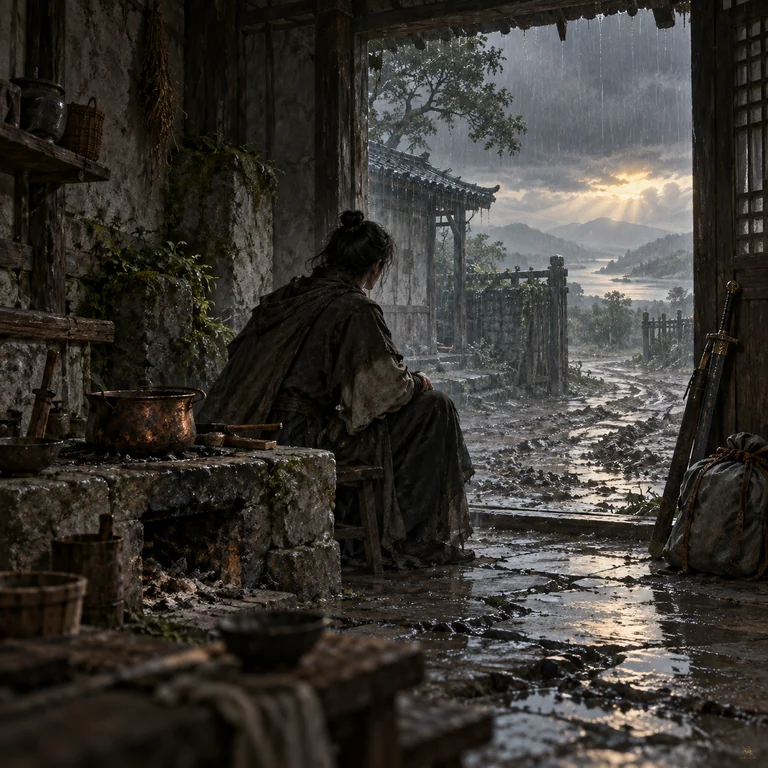

From a poem into a story
After years of calling bids for an antiques association, Lu Qing finally saves enough to buy an old chair from a mountain temple. He carries it upstairs at Rainwatch Tower, hoping to make his first major deal for himself. With every compliment from a guest, the chair legs sink a little deeper into the floorboards. He tries to rise, but the armrests tighten around him. Rainwater has flooded the lane below, while those at the table keep discussing the chair’s great value. First, he must make the smiling guests hear that he truly cannot get up.
Start readingAI-assisted writing · Fictional characters and events
