
Huanxisha · On the Road through a Riverside Village
Song dynasty・Fan Chengda

Song dynasty・Fan Chengda
十里西畴熟稻香,槿花篱落竹丝长,垂垂山果挂青黄。— For ten li, ripe rice scents the western fields; hibiscus blooms along the fences, slender bamboo stretches long, and mountain fruits hang heavy, green and yellow.
Thick mist heralds autumn, the morning air moist; thin clouds veil the sun, the noon shade cool. No flying canopy is needed to shelter my military dress.
The animation remains in its original Chinese.
The animation is ready.
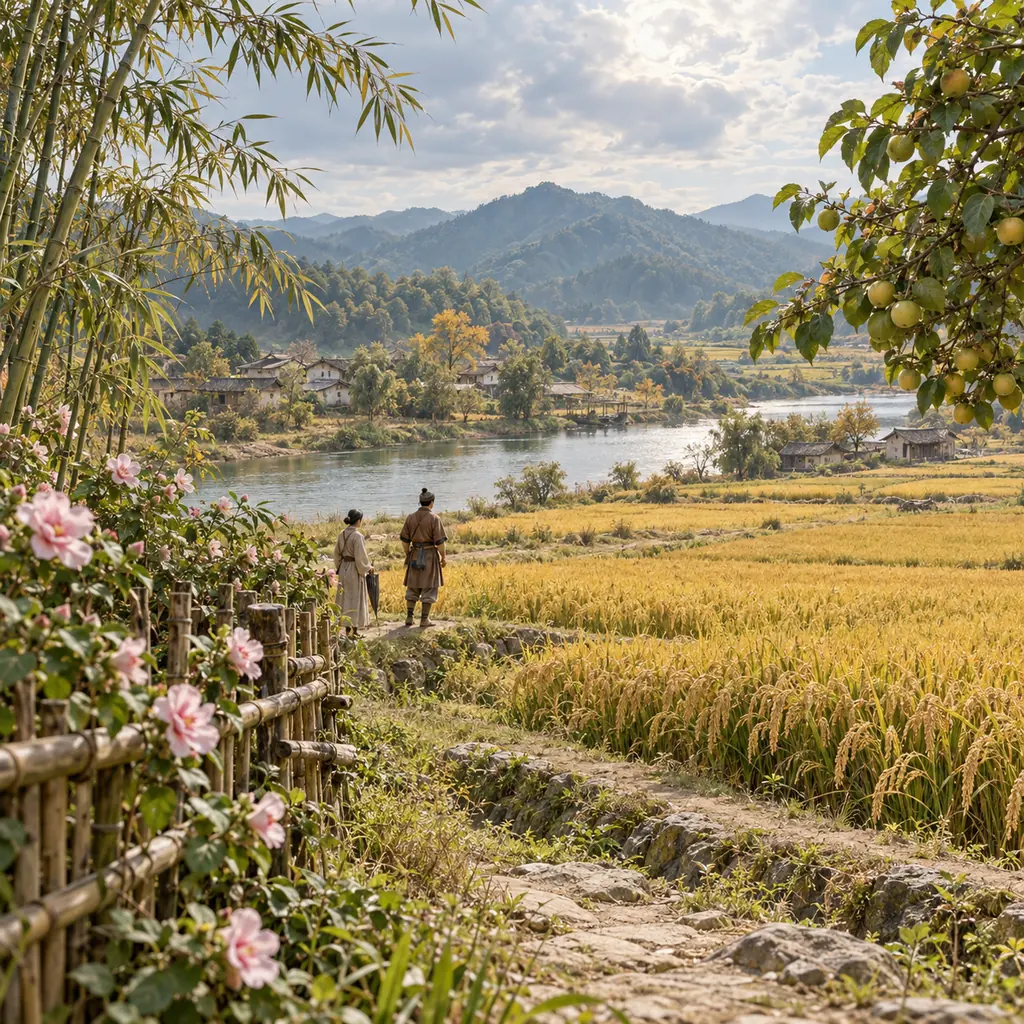
Looking along the way, I see broad fields to the west where ripe rice gives off its fragrance. Rose of Sharon blooms beside the fences, and slender bamboo branches stretch softly; on fruit trees in the hills, green and yellow fruits hang heavy.
At dawn, dense mist brings a damp chill that announces autumn's arrival; by noon, thin clouds veil the sunlight, and the air still feels cool. There is no need to raise another canopy to shield this military robe from the sun.
浣溪沙: a ci tune pattern. This lyric has two stanzas of three lines each, with seven characters per line. 江村道中: on the road through riverside villages; the title does not justify supplying an unverified specific village name.
西畴: the fields to the west. 畴 is pronounced chóu and means farmland; “ten li” describes the stretch of fields and need not be taken as an exact measurement. 熟稻香: the scent of ripe rice in the fields, rather than rice cooking in a pot.
槿花: flowers of the rose of Sharon. 槿 is pronounced jǐn. 篱落: a fence, or the village dwellings enclosed by fences; it does not mean petals are falling.
竹丝长: describes the slender, drooping branches and leaves of tall bamboo; some interpretations also find a delicate softness in gossamer threads among the bamboo. 长 is pronounced cháng here.
垂垂: Hanging heavily downward. 青黄: Some fruits are still green while others have turned yellow, indicating different stages of ripening, rather than that all are fully ripe.
浓雾知秋: sensing autumn in the morning mist and its cool moisture. 晨气润: the morning air is moist. 午阴凉: it is cool at noon because clouds obscure the sun; 阴 does not mean nighttime darkness.
飞盖: a parasol or canopy used for shade, here referring to a sunshade opened while traveling; 飞 does not mean that the object can fly by itself.
戎装: military attire. 戎 is pronounced róng. The lyric's author once served as military commissioner of Sichuan, overseeing related military and administrative affairs; common annotated editions infer from this that the lyric may have been written in Shu. It identifies no particular battle, so its military attire should not be reinterpreted as a modern army uniform, nor should a definite date of composition be devised from it.
Reading guide: On a walk through a riverside village, the fragrance of rice first draws the eye to the fields, then the gaze moves among hibiscus blossoms, bamboo fences, and fruit-bearing branches; only in the second stanza does the traveler describe the cool moisture felt by the body. Notice the spatial movement in the first stanza and the shift in time from dawn to noon in the second. A person in military dress appears at the end, giving the rural scenes a specific observer, without turning the peaceful fields into a battlefield.
Instead of first explaining where someone has come from or is going, the opening line lets the scent of ripe rice fill the stretching fields. Fragrance is smelled, while hibiscus flowers, bamboo fences, and green and yellow fruit are seen; the two senses complement one another, giving the riverside village an approachable texture of daily life. The supple slenderness of the second line also contrasts with the heavy hanging fruit of the third: bamboo has lines, fruit has weight, and a harvest is more than an undifferentiated expanse of gold.
After the stanza break, the landscape is no longer merely something in the distance. The mist's moisture and the coolness beneath the clouds touch the traveler; morning and noon also make readers feel that this comfort has lasted for part of the journey. The final “no need” is lightly spoken: thin clouds have already shaded him from the sun, making a ceremonial parasol unnecessary. His military dress indicates his identity and responsibilities, while the ease of the fields forms his actual experience at this moment. Together they suggest affection for village life and livelihoods, without requiring an account of military exploits absent from the poem. The ci closes with ordinary scenery, concrete sensations, and a brief judgment, clear in mood and lingering in effect.
Let words find a melody

From a poem into a story
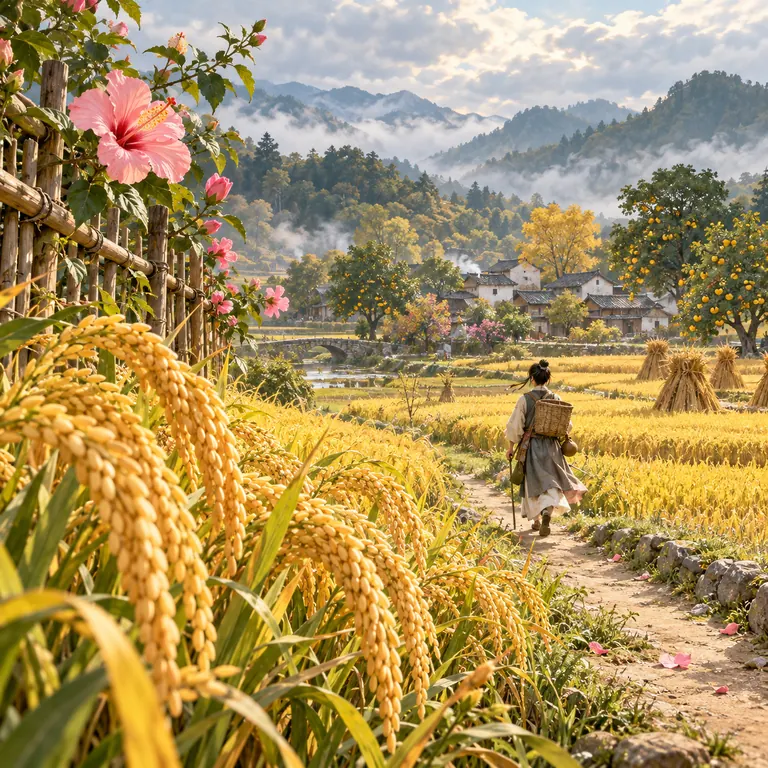
Returning from the frontier, Fang Ti saves the wedding-feast money to buy an ox, hoping to rent fields and make a life with Feng Sui. When he goes to fetch his bride, old friends dress him in his battle robe, raise a red umbrella, and call him general all along the road. At the narrow bridge, however, the docile ox plants all four hooves and refuses to move. As the gongs beat ever more urgently, his old injury makes his right leg buckle first. His bride steps out from behind the hibiscus hedge, lifting her skirt. The humiliations he fears most all unfold before her eyes.
Start readingAI-assisted writing · Fictional characters and events
