
Wuyi Lane
Tang dynasty・Liu Yuxi

Tang dynasty・Liu Yuxi
Wild grasses flower beside Vermilion Bird Bridge; the setting sun slants across the entrance to Wuyi Lane.
Swallows once before the halls of the Wang and Xie families now fly into ordinary people's homes.
The animation remains in its original Chinese.
The animation is ready.
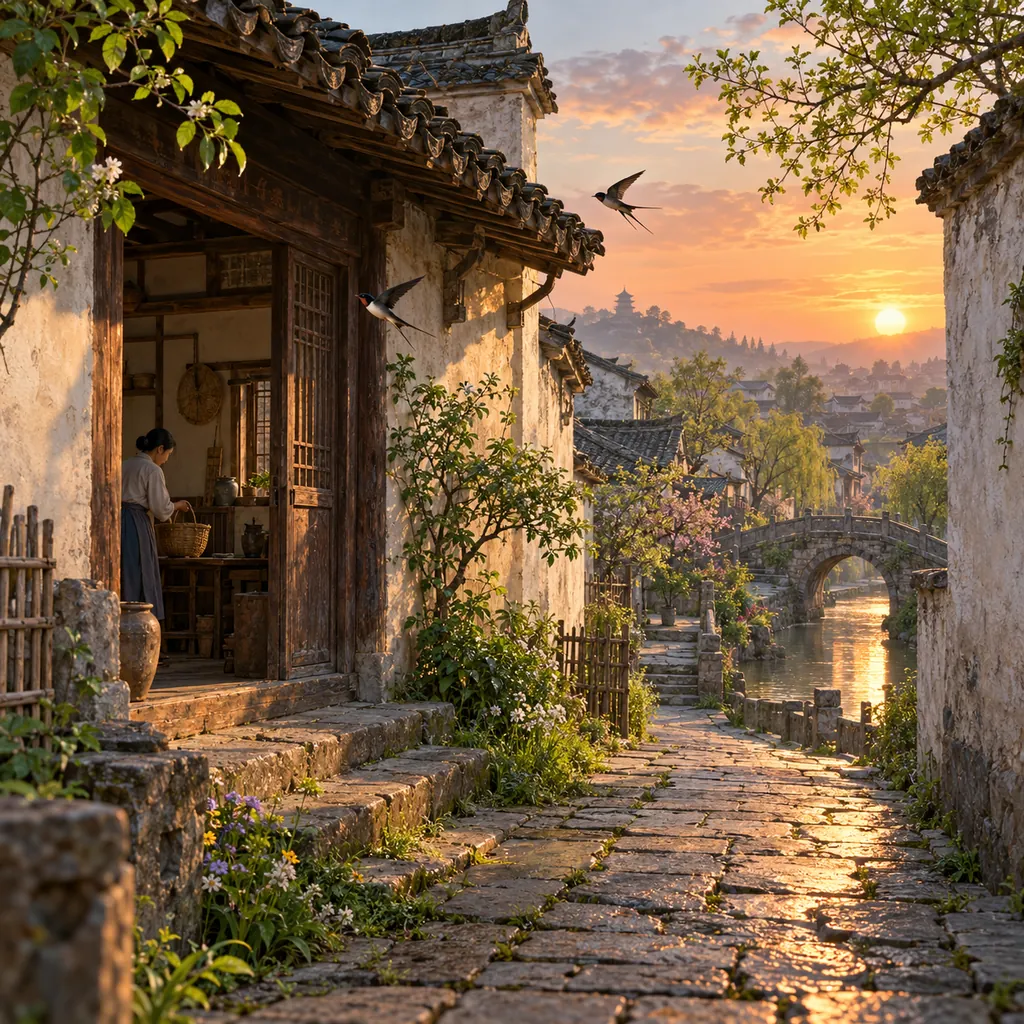
Wild grasses bloom beside Vermilion Bird Bridge; the evening sun slants across the entrance to Black Robe Lane.
Swallows like those that once came and went, nesting before the halls of the powerful Wang and Xie families, now fly into the homes of ordinary people.
乌衣巷: Wuyi Lane, an old place-name in Jinling, near the Qinhuai River in present-day Nanjing, associated with the residences of aristocratic families in the Eastern Jin. “Wuyi Lane” is one of the “Five Poems on Jinling.”
朱雀桥: the name of an old bridge in Jinling, near Wuyi Lane. Its name does not require imagining a bridge painted with a Vermilion Bird or entirely vermilion in color.
野草花: wild plants flowering; 花 can mean “to bloom.” 夕阳斜: the setting sun shines obliquely, depicting the light and shadow of dusk.
王谢: the Wang and Xie aristocratic clans of the Eastern Jin, represented by figures such as Wang Dao and Xie An. 堂: here, the halls of their residences.
旧时堂前燕: swallows beneath the eaves of once-powerful households connect past and present. This is a poetic association and contrast, not a claim that the same swallow lived from the Six Dynasties into the Tang.
寻常: everyday, ordinary. The homes of common people contrast with the halls of the Wang and Xie families to show changes in social standing; there is no need to assign an actual owner to every house in the poem.
Reading guide: This historical quatrain depicts no grand battle scene and offers no itemized account of the old capital's prosperity. It begins with wildflowers beside a bridge and slanting sunlight at a lane's entrance, then follows swallows in flight to connect the great households of the past with ordinary homes today. As you read, consider what has truly changed and what still returns each year; the sense of rise and fall lies between the two.
The first two lines place Zhuque Bridge and Wuyi Lane side by side. The place names themselves carry the historical weight of the old capital, yet the present scene contains only wildflowers and the setting sun. Grass grows as usual, and light still falls at the lane's entrance, but the grand human spectacle is absent, leaving a space for the imagination. The word “花” (“flowers,” here suggesting flowering) lends the wild grass a slight movement, while “斜” (“slanting”) lowers the light. These ordinary sights thus acquire a palpable sense of time passing.
The final two lines do not directly declare the decline of the Wang and Xie clans; instead, swallows make a light, graceful transition between scenes. The space before grand halls connects with ordinary homes, while former times stand against the everyday present. In language, a very short flight crosses a long span of human change. The swallows here are a recurring image of life, whose meaning cannot be calculated literally from an individual bird's lifespan. The restraint of the ending also deserves attention: ordinary people's homes remain places where life continues, so the poem contains more than abandonment and disappearance. Illustrious lineages recede, everyday habitation continues, and the poet conveys his feelings through this continuity and succession without spelling out the final implication for the reader.
Let words find a melody
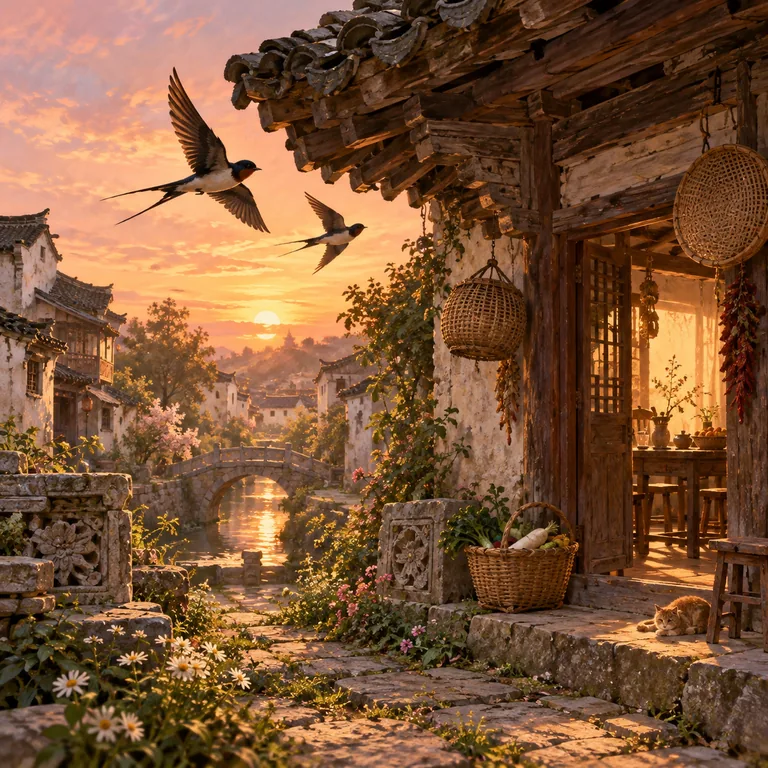
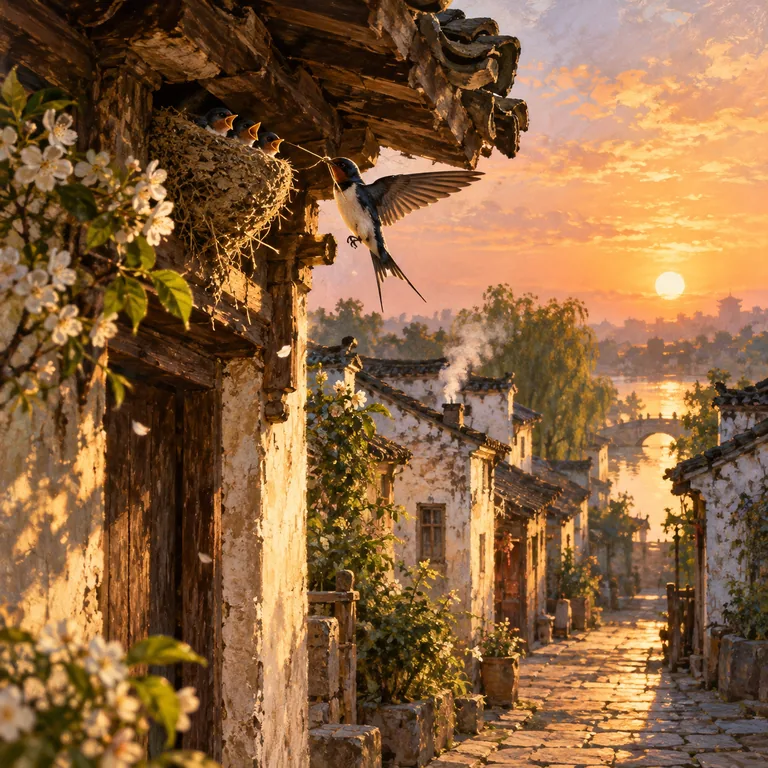
From a poem into a story
Han Zhun guarded the old residence’s gate for thirty-two years. Now he owns the property deed himself, yet still takes the side gate whenever he comes and goes. His daughter makes birthday noodles and asks him to sit in the place of honor, while the teahouse proprietor wants him back in his old livery to call out the grand formalities of former days for visitors from afar. He cannot let go of the old stories people gather round to hear, but he has promised his daughter to be home toward the end of the si hour, near eleven in the morning. In the courtyard, new swallows busily carry mud, none waiting for the former master to be announced.
Start readingAI-assisted writing · Fictional characters and events
