
The Four Seasons
Wei and Jin Dynasties・Tao Yuanming

Wei and Jin Dynasties・Tao Yuanming
Spring waters fill the marshes on all sides; summer clouds form many wondrous peaks.
The autumn moon casts brilliant light; on winter ridges, hardy pines stand fair.
The animation remains in its original Chinese.
The animation is ready.
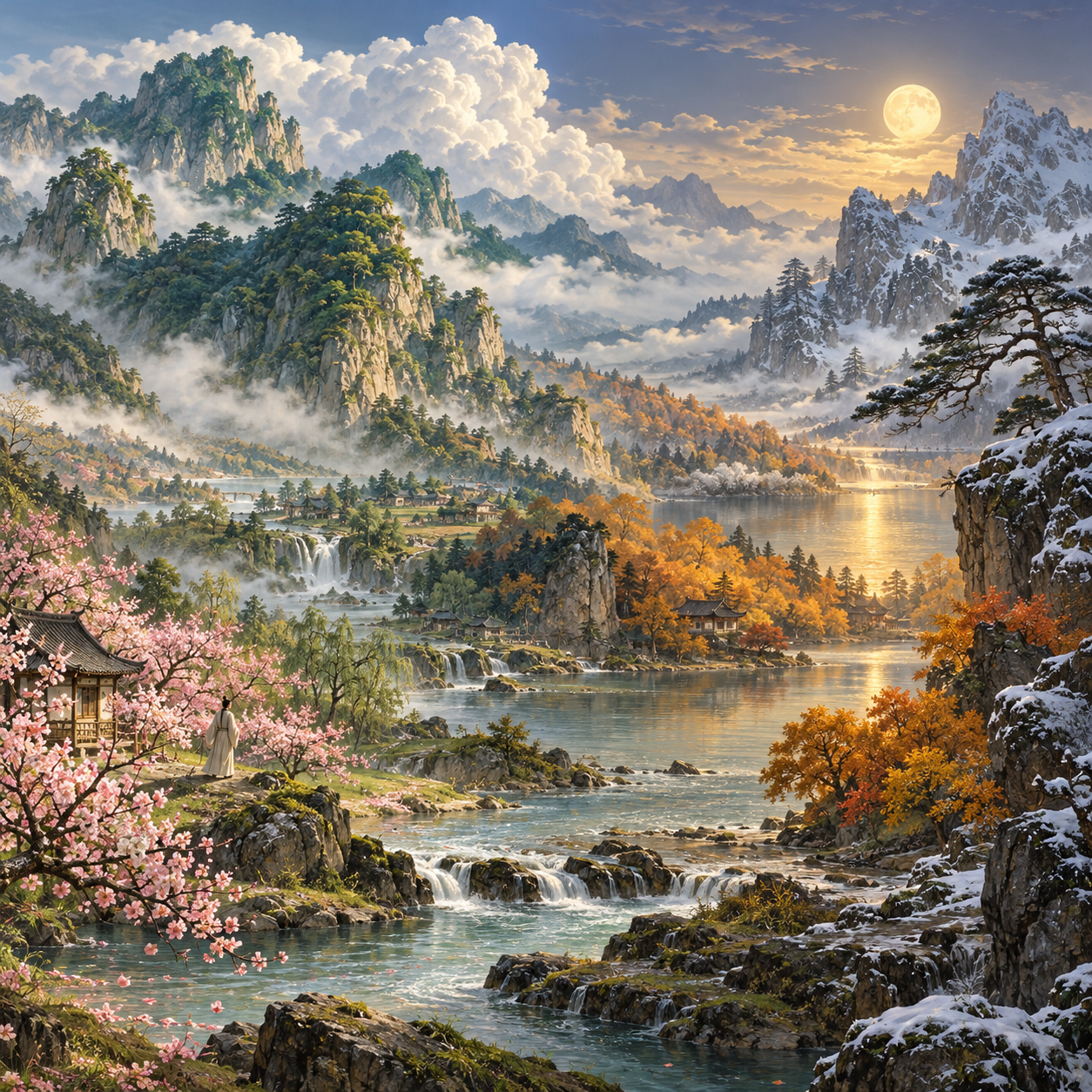
Spring waters fill ponds and marshes everywhere; summer clouds pile into many strange peaks. The autumn moon sheds its bright radiance, while green pines on winter ridges appear especially beautiful in the cold.
四时: the four seasons—spring, summer, autumn, and winter. 四泽: waters and marshes in all directions. 奇峰: unusual peaks, comparing the forms of summer clouds to mountain summits. 扬: to give forth. 晖: radiance.
秀: to stand gracefully or reveal beauty. 寒松: “pines in the cold,” the wording used on this page; other versions have “孤松” (a solitary pine).
The authorship is disputed: this poem was once included in Tao Yuanming’s collected works, but the Song writer Xu Yi, in Xu Yanzhou’s Remarks on Poetry, considered it a poem by Gu Changkang, namely Gu Kaizhi, mistakenly included in Tao’s collection. This page retains the original attribution while noting the attribution to Gu Kaizhi; inclusion in a collection alone cannot establish authorship.
Reading guide: This short five-character poem uses four lines to evoke the four seasons in turn. It has been attributed to both Tao Yuanming and Gu Kaizhi; appreciating its images does not require first deciding on a single author. The text here follows the page's “寒松” (pines in the cold) version.
Each line selects just one distinctive scene: the fullness of spring waters, the strange forms of summer clouds, the brightness of the autumn moon, and the grace of winter pines. The four seasons thus remain distinct while all retaining vitality and beauty.
Summer clouds resemble mountain peaks, and winter ridges answer them with actual mountains, creating a subtle correspondence between imagined and real forms. The poem offers no lyrical commentary, allowing four concise pictures to compose a complete cycle of the seasons on their own.
Let words find a melody
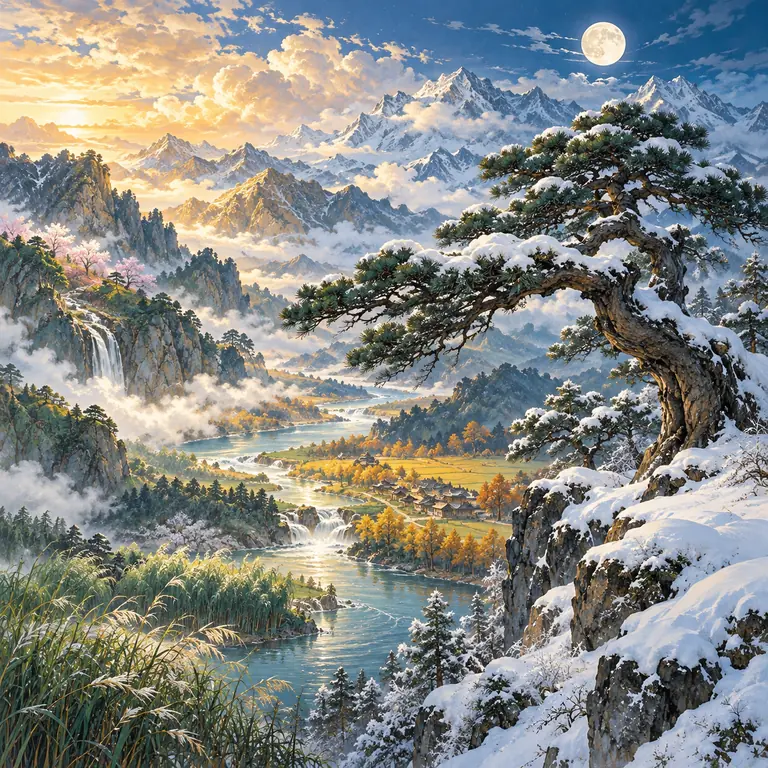
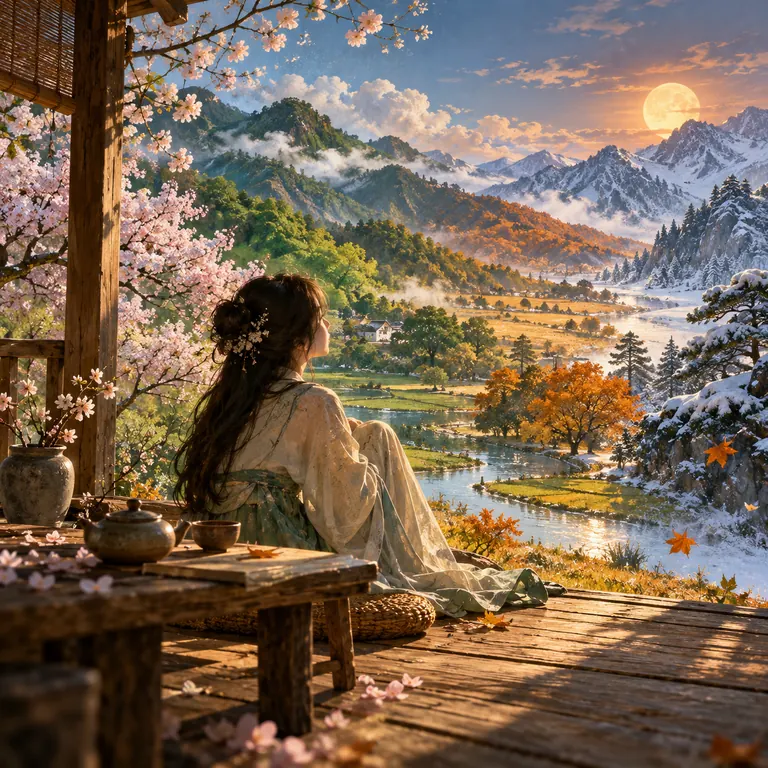
From a poem into a story
A Cen borrows a night of winter scenery from the mountain temple, wanting only to let his feverish mother sleep peacefully. After the rooster crows, he still asks for one more night; by the seventy-third day of autumn, the peach trees blossom again, but one strange thing after another happens to the fish and grain. The room remains cool, and the mountain temple is only ten li north of the village, yet he dares not tell his mother where the half-bowl of cool water delivered each day truly comes from.
Start readingAI-assisted writing · Fictional characters and events
