
In Praise of Jing Ke
Wei and Jin Dynasties・Tao Yuanming

Wei and Jin Dynasties・Tao Yuanming
Prince Dan of Yan excelled at nurturing worthy men, resolved to avenge himself upon the mighty house of Ying.
He gathered a hundred worthy men, and toward year's end found Master Jing.
A noble man dies for one who understands him,sword in hand, he leaves the capital of Yan。
素骥鸣广陌,慷慨送我行。— White steeds neigh on the broad road, sending me on my way with stirring spirit.
His bristling hair thrusts against his lofty cap; fierce resolve surges against its long ties.
We drank farewell beside the Yi River, heroes assembled all around.
Gao Jianli struck the mournful zhu; Song Yi sang in a ringing voice.
The mournful wind sweeps past with a sigh; cold waves rise in gentle swells.
The shang mode draws still more tears; the yu mode startles the brave warriors.
He knew in his heart he would go and never return, yet his name would live in later ages.
He mounts the carriage—when would he turn back? Its canopy speeds into the Qin court.
With fierce resolve he crosses ten thousand miles, winding past a thousand cities.
As the map unrolled to its end, the deed came to its crisis, the mighty ruler stood alarmed and shaken.
Alas, his swordsmanship was lacking, and the extraordinary deed came to nothing.
Though the man has long been gone, his passion still stirs hearts a thousand years later.
The animation remains in its original Chinese.
The animation is ready.
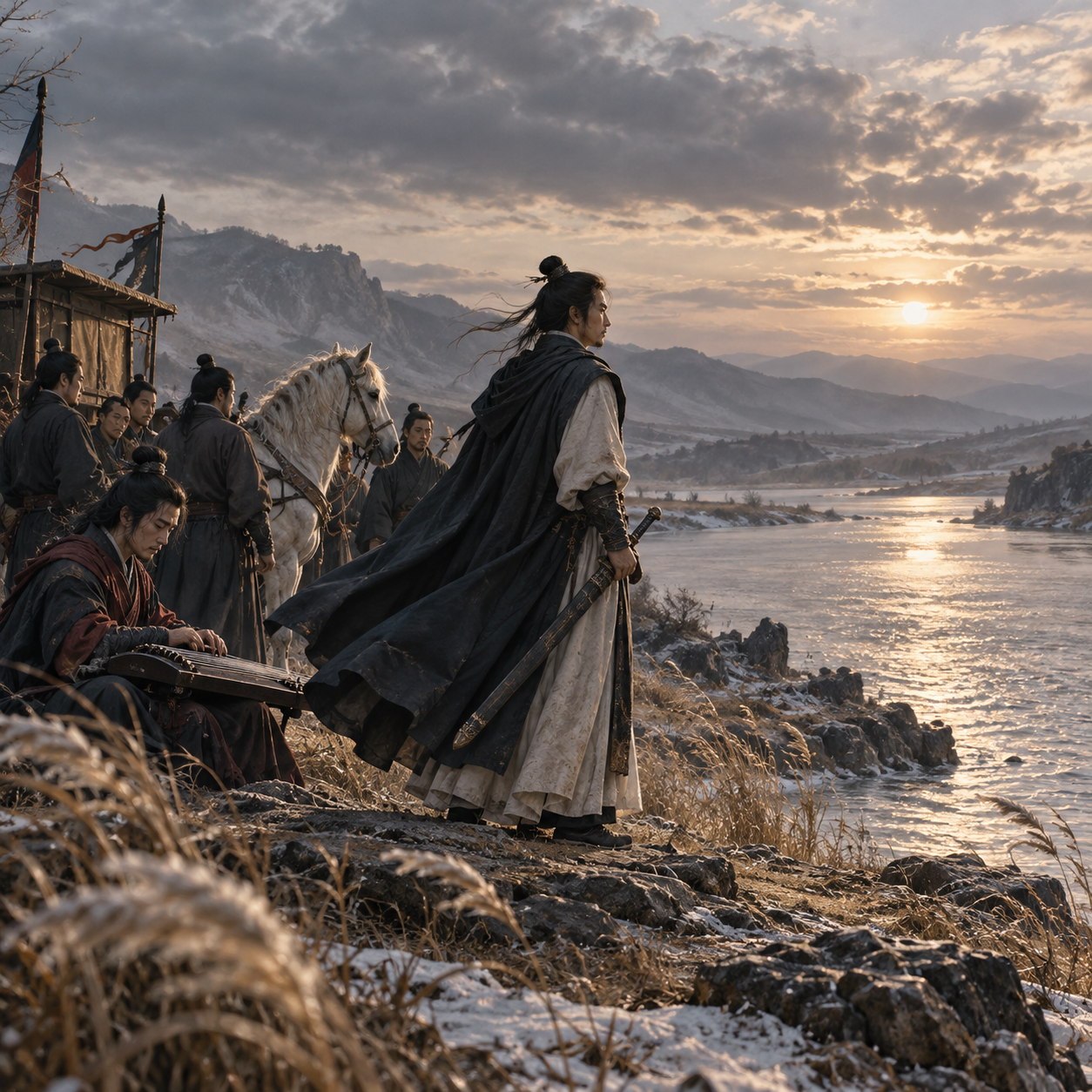
Crown Prince Dan of Yan knew how to honor brave men and was determined to take revenge on mighty Qin. He gathered many warriors and, as time pressed upon him, finally found Jing Ke. A noble man is willing to die for one who understands him; Jing Ke took up his sword and left the capital of Yan. A white horse neighed on the great road, and the farewell was charged with heroic passion.
His furious hair thrusts against his tall cap, and his heroic spirit shakes its tassels. At the farewell feast beside the Yi River, heroes gather; Gao Jianli strikes the mournful zhu, and Song Yi sings aloud. Wind sighs past, cold waves rise on the river; the sorrowful music brings tears, then its stirring change of tone rouses the warriors.
Jing Ke knew that he was unlikely to return, yet still wished to leave his name to posterity. He mounted the carriage and departed resolutely, its canopy speeding straight into the Qin court; with fierce determination he crossed distant roads and passed through many cities. When the map was unrolled to its end, the assassination attempt was finally revealed, and the overbearing King of Qin panicked. Alas, his swordsmanship proved ineffective, and the extraordinary undertaking ultimately failed. Though Jing Ke died, his heroic passion still moves people a thousand years later.
强嬴: mighty Qin, referred to through Ying, the royal family’s surname. 百夫良: an outstanding warrior. 荆卿: an honorific for Jing Ke.
素骥: a fine white horse. 危冠: a tall cap. 长缨: long cap ribbons. 饮饯: a farewell gathering with wine.
渐离: Gao Jianli, a friend of Jing Ke. 筑: an ancient stringed instrument. 宋意: Song Yi, a warrior of Yan who saw Jing Ke off. 商音、羽奏: ancient musical modes, emphasizing sorrow and stirring passion respectively in the poem.
飞盖: a swiftly moving carriage. 逶迤: a road winding into the distance. 图穷: the map is unrolled to its end, revealing the dagger. 豪主: the king of Qin. 怔营: frightened and uneasy.
The story is connected with Jing Ke's attempt to assassinate the King of Qin, recorded in “Biographies of Assassins” in the Records of the Grand Historian; this poem chiefly celebrates the man's spirit and elaborates the scenes poetically.
Reading guide: Through the story of Jing Ke’s attempt to assassinate the king of Qin, Tao Yuanming portrays a hero who honors his promise and goes to his death. It reveals the impassioned, forceful side of Tao’s poetry. Most of the poem concerns the departure and farewell at the Yi River, while the assassination attempt is quickly concluded; the focus in reading is how the poet judges a failed hero.
The farewell scene links sounds, gestures, and surroundings: the horse's neigh, the striking of the zhu, and impassioned singing echo the mournful wind and cold waves, giving the warrior's decision a palpable weight. “心知去不归” (knowing in his heart he would not return) keeps an awareness of tragedy within the heroic spirit.
The ending acknowledges the attempt's failure without allowing success or failure to erase its worth. The single word “惜” (alas) turns toward lament, while “千载有馀情” (feeling lingers even a thousand years later) extends the event from the Qin court into later generations' reading, answering the opening emphasis on loyalty to one who truly understands you.
Let words find a melody


From a poem into a story
As the northern army presses toward the border, A-Huai hurries to finish a zhu, a struck string instrument, for a farewell, hoping to do something important for the benefactor who took him in. A baby tooth suddenly rolls out of its wooden body, while the child going along keeps asking whether he may call someone Father on the day he becomes an apprentice. The song of the Yi River is about to begin, but a few whispers from the rear corridor make it impossible for A-Huai to keep his head down and simply tune the strings.
Start readingAI-assisted writing · Fictional characters and events
