
A Spring River on a Moonlit Night of Flowers
Tang dynasty・Zhang Ruoxu

Tang dynasty・Zhang Ruoxu
The spring river’s tide reaches level with the sea,over the sea, the bright moon rises with the tide。
Its shimmer follows the waves for thousands upon thousands of miles; where along the spring river is there no bright moon?
The river winds around fragrant meadows; moonlight makes the flowering woods look dusted with sleet.
Frost seems to stream through the air, its flight unseen,the white sand on the islet cannot be distinguished。
River and sky are one color, without a speck of dust, bright in the empty heavens hangs the lone moon's wheel.
Who first saw the moon beside this river? In what year did the river moon first shine on humankind?
Human generations follow one another without end; year after year, the river moon looks much the same.
不知江月待何人,但见长江送流水。— I do not know whom the river moon awaits; I see only the long river sending its waters onward.
A single white cloud drifts slowly away; at Green Maple Landing, sorrow is more than one can bear.
Whose traveler rides a little boat tonight? In what tower does someone long beneath the bright moon?
Lovely, the moon lingering above her tower must be shining on the dressing mirror of one parted from her beloved.
Within the jade doorway's curtains, it cannot be rolled away; from the clothes-beating stone, it returns when brushed aside.
At this moment we gaze toward each other, yet cannot hear one another; I wish to follow the flowing moonlight and shine upon you.
Wild geese fly far, yet cannot pass beyond the moonlight,fish and dragons leap beneath the water, tracing ripples.
Last night, by a quiet pool, I dreamed of falling flowers,alas, spring is half gone and I have not returned home。
The river flows, carrying spring almost to its end; above the river pool, the sinking moon slants west once more.
The slanting moon sinks deep into sea mist, between Jieshi and Xiaoxiang lie endless roads.
Who knows how many ride the moonlight home? The sinking moon stirs feelings through the trees along the river.
The animation remains in its original Chinese.
The animation is ready.
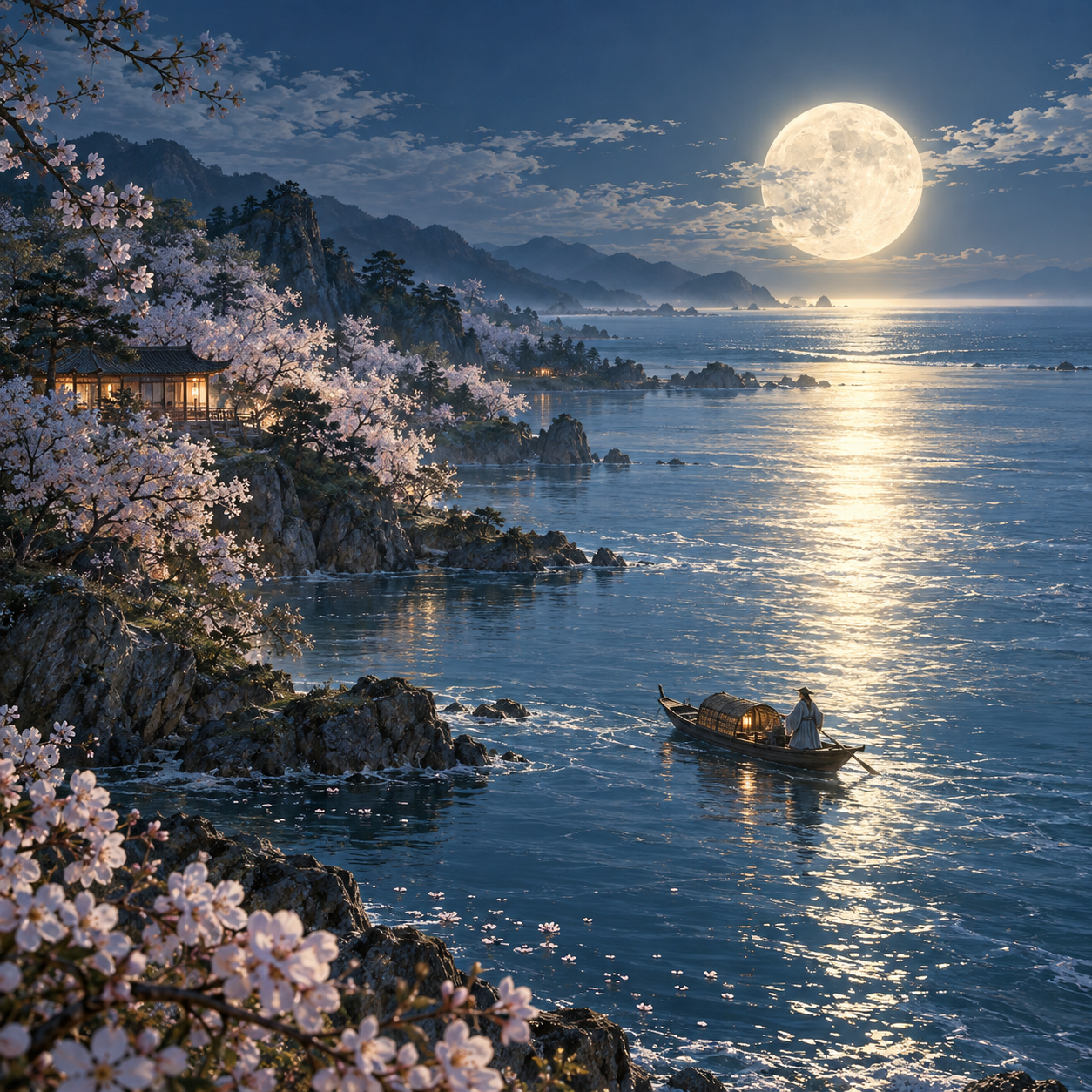
The spring river's surging tide seems to merge with the sea, and the bright moon over the sea rises with it. Moonlight shimmers along the waves, spreading for countless miles: what part of the spring river lacks its radiant glow? The winding river circles fields of fragrant grasses and abundant flowers; moonlight falls on the flowering woods as though fine white ice pellets covered them. White frost seems to drift through the air, yet none can be seen falling; the pale sand on the shoal blends with the moonlight until they are hard to distinguish.
River and sky share one color, without a trace of dust; in the clear heavens there is only a solitary moon. Who first saw this moon beside the river, and in what year did the river moon first shine upon people? Human generations follow one another without end, while the moon over the river looks much the same year after year. I do not know whom the river moon awaits; I see only the Yangtze endlessly sending its waters away.
A white cloud drifts slowly away; at Qingfeng Riverbank, sorrow is beyond telling. Whose traveler rides a little boat tonight, and where is someone in a tower longing beneath the moon? How poignant, the moonlight lingering over that tower—it must be shining on the parted one's dressing table. Rolling up the curtain cannot roll it away; brushing it from the washing stone only lets it shine there again.
At this moment we gaze at the same bright moon, yet cannot exchange messages; if only I could flow with its light and shine beside you. However far wild geese fly, they cannot escape this boundless moonlight; fish and dragons leaping beneath the water can only stir successive ripples. Last night I dreamed of falling flowers beside a quiet pool; alas, spring is already half gone, and I still cannot return home. The river carries spring away, and spring will soon be spent; the setting moon above the pool tilts westward again.
The slanting moon slowly sinks into sea mist; from Jieshi in the north to Xiaoxiang in the south stretch endless roads. Who knows how many can return by moonlight; the setting moon stirs the feelings of parting, scattering them through the riverside woods.
滟滟 (yàn): the shimmer of light on rippling water. 芳甸 (diàn): open country covered with fragrant grasses, flowers, and trees. 霰 (xiàn): tiny ice pellets, here used to liken the appearance of flowers under moonlight. 汀: flat ground or a small islet beside the water.
纤尘: the finest specks of dust. 月轮: the full moon. 穷已: to come to an end. 青枫浦: a shore where green maples grow, also carrying the traditional associations of a place of parting.
扁舟子: someone traveling far in a small boat. 可怜: lovely or deserving of tenderness, with sympathy implied according to context. 玉户: a splendid doorway. 砧 (zhēn): a stone used for pounding clothes.
月华: moonlight. 水成文: ripples form on the water; 文 is used for “纹” (“patterns” or “ripples”). 闲潭: a secluded, tranquil pool.
碣石: a mountain in the north. 潇湘: the region of the Xiao and Xiang rivers in Hunan. Mentioning the two together emphasizes immense separation; they need not be understood as a confirmed itinerary for the figures in the poem.
Reading guide: Using an old Music Bureau title, Zhang Ruoxu takes a moonlit spring river as the shared setting for natural beauty, the continuation of life, and the mutual longing of travelers and the women awaiting them. The poem has thirty-six lines, linked throughout by the moon's rising, lingering, westward descent, and setting, which form a clear progression through time.
The opening unfolds with the rising tide of river and sea, then moves to flowering groves, white sand, and a solitary moon. The view shifts from broad to fine detail, its tones growing purer. Within this clarity, the poet asks “何人初见月,” who first saw the moon, and appreciation of nature turns toward reflection on humanity and time.
The second half moves beyond life in general to place the sorrow of separation at two ends: a little boat and a dressing chamber in a tower. Moonlight lets those far apart share the same scene while repeatedly reminding them that they cannot meet. “卷不去” (cannot be rolled away) and “拂还来” (returns when brushed aside) especially make intangible longing into an inescapable presence nearby.
The final section deepens the melancholy of an uncertain return through spring's approaching end and the setting moon. The ending offers no answer of reunion; instead, it disperses longing among tree shadows filling the river, letting personal sorrow merge again with the vast world of the opening.
Let words find a melody
From a poem into a story
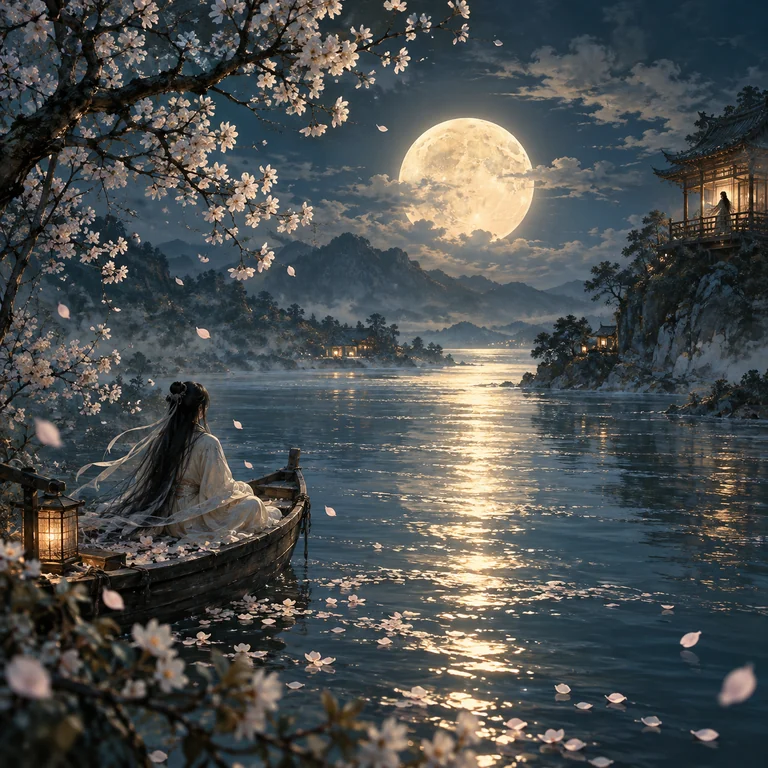
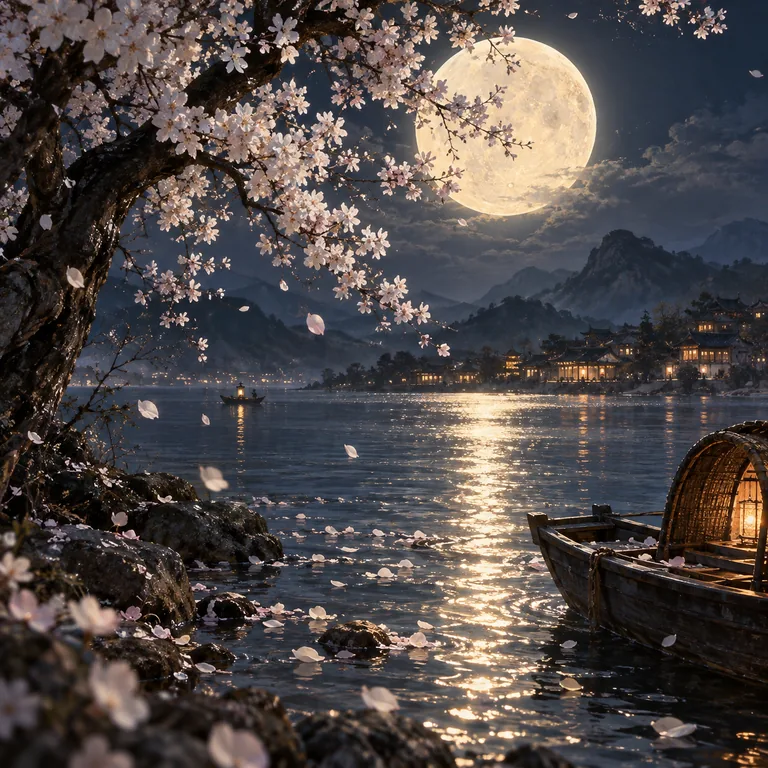
The spring tide rises to the old ferry landing, and A Zhao still has not sold the boat her father left behind. She packs her sewing things to leave for the city, only to discover an unnamed lantern debt on the ledger’s final page. Following an old lantern along the riverbank, she encounters a daughter who has not returned for sixteen years and a mother who borrows a lantern every year; the departure she has already carefully arranged gradually falls under the spell of opera singing from the opposite shore.
Start readingAI-assisted writing · Fictional characters and events
