
After the Upheaval and Separation, Exiled to Yelang by Imperial Grace: Recalling Former Travels and Expressing My Feelings, Presented to Wei Liangzai, Prefect of Jiangxia
Tang dynasty・Li Bai

Tang dynasty・Li Bai
In heaven stands the White Jade Capital, with twelve towers and five cities. Immortals stroke the crown of my head; with my hair bound, I receive everlasting life.
Mistakenly I pursued the world's pleasures, yet deeply explored the workings of order and disorder. Ninety-six sage rulers—empty names hung like floating clouds.
I wagered heaven and earth on a single throw, unable to put warfare from my mind. I tried my hand at the arts of kings and hegemons, hoping for the glory of high office.
My fate went gravely against me; I abandoned it all and roamed the seas. Learning the sword only made me laugh at myself; what, after all, did my writing achieve?
My sword cannot withstand ten thousand men, my writing has undeservedly won renown across the seas. Such child's play is hardly worth mention, with five sighs I leave the western capital.
As the moment of departure draws near, impassioned tears wet my cap strings. I marvel at your bold, untrammeled talent; your lofty bearing surpasses all the gifted.
You spread a farewell feast beneath the parting canopy, consoling me as I set out on this distant journey. Saddled horses gather like floating clouds, escorting me to Piaoqi Pavilion.
Songs and bells cannot exhaust my feelings; the sun sets over Kunming. In the tenth month I reach Youzhou, where spears and lances crowd like stars.
The sovereign abandoned the northern sea, yielding it wholly to the great whale. Its breath sets a hundred rivers rushing; even Mount Yanran could be toppled.
Knowing in my heart I cannot speak, I long instead to dwell on Penglai and Yingzhou. I bend my bow, fearing the Heavenly Wolf; holding an arrow, I dare not draw.
I wipe away tears at the Golden Terrace,crying to heaven as I mourn King Zhao。No one prizes the bones of a noble steed,Lü’er prances and gallops in vain。
Were Yue Yi born again, he too would flee in these times. Years wasted, ambitions thwarted, I drive my horse back to your hometown.
逢君听弦歌,肃穆坐华堂。百里独太古,陶然卧羲皇。— Meeting you, I hear strings and song, and sit solemnly in your splendid hall. Your hundred-li domain alone preserves the ancient ways; contentedly I rest as in the age of Fuxi.
We summoned music at Changle Hall,spread the feast and set out wine jugs and cups。Worthy men and heroes mingled with lovely women,seated in solemn rows before the candles。
Drunken dancers swirl among splendid banquet mats; clear songs circle the soaring beams. The revels have not lasted a full morning before my term is over and I return to Xianyang.
Ten thousand crowd the road to see him off,banquet tents stretch into the distance, facing one another。Once parted, a thousand miles divide us,our fortunes rise and fall through differing warmth and cold。
Heat and cold have changed several times; the nine lands collapse in turmoil. Han armor meets the northern troops; sand and dust darken the sea of clouds.
Grass and trees tremble with murderous force; stars lose their radiance. White bones pile into hills—what crime have the common people committed?
Hangu Pass fortifies the imperial dwelling; the nation's fate hangs upon Geshu. Three hundred thousand long halberds open the gates to admit the rebel chief.
Ministers and nobles were treated like dogs and sheep; the loyal and outspoken were minced and pickled. The two sovereigns went forth on their royal travels, and both capitals became ruins.
The imperial prince is granted authority to wage campaigns; bearing the commander's banner, he holds mighty Chu in check. His discipline is unlike that of Huan and Wen; his army teems with men fierce as bears and tigers.
People lost their sense of whom to follow; rebel power rose like wind and rain. You alone held Fangling firm, your loyalty and integrity unsurpassed through all ages.
I lie atop Incense Burner Peak, feeding on rosy clouds and rinsing my mouth with jade-clear springs. Beyond my open door the Nine Rivers turn; beneath my pillow the Five Lakes join.
At midnight the naval forces came; Xunyang filled with banners. An empty reputation brought me harm; I was coerced aboard a towered warship.
徒赐五百金,弃之若浮烟。辞官不受赏,翻谪夜郎天。— In vain they bestowed five hundred in gold; I cast it aside like drifting smoke. I resigned my office and refused rewards, only to be banished instead to distant Yelang.
The road to Yelang stretches ten thousand miles; traveling west makes one old. Though all under heaven has been swept clear, I remain a blade of grass burdened with frost.
日月无偏照,何由诉苍昊。良牧称神明,深仁恤交道。— Sun and moon shine without partiality; how can I plead with the blue heavens? A good governor is praised for godlike wisdom; his deep benevolence shows compassion for the bonds of friendship.
Once admitted, undeservingly, among those of lofty standing, I have climbed Yellow Crane Tower three times. Ashamed before the recluse Mi Heng, I gaze in vain upon Parrot Islet.
At Mount Fan, the aura of dominion is spent; heaven and earth lie desolate in autumn. The river carries snow from Emei, its waters stretching across the flow of the Three Gorges.
Ten thousand boats come through here, sails following one another past Yangzhou. Sending my gaze across these countless miles, I feel my sorrow scatter in the vastness.
Gauze-screened windows open against the sky; trees beside the water are green as tresses. Watching the sun, I fear its sinking into the hills; urging on the wine, I rejoice to welcome the moon.
Girls of Wu and beauties of Yue, slender and graceful, flaunt their powder and rouge. Summoned, they climb the cloud-high stair, smiling as they emerge through curtained windows.
Before the guests she dances with hands gently lowered, her silken robes moving in the spring breeze. A guest kneels to ask that she rest, but the host’s delight is not yet spent.
Reading your work from Jing Mountain, even Jiang Yan and Bao Zhao would be visibly moved. A lotus rises from clear water, naturally free of carved embellishment.
Untrammeled delight fills my simple heart; at all times he invites me to seek it with him. Tiger-like guards crowd his vermilion gates; how imposing the ranks of halberds!
Bamboo is trimmed and rock hewn to open the grounds,winding waters swell, clear and deep. We climb the terrace and sit in the waterside pavilion,our discourse full of fine and noble words.
A few words are prized above white jade; beside one promise, gold weighs little. Say that I have not failed you; let the bluebird reveal my faithful heart.
A magpie from among five-colored clouds comes flying and calling from the sky. Word arrives that a decree of pardon has come, releasing me to return from Yelang.
Warm air transforms the frozen valley; fiery smoke rises from dead ashes. You ascend to Phoenix Pool, then suddenly cast aside a talent like Jia Yi's.
Jie's dog still barks at Yao; the Xiongnu laugh through a thousand autumns. At midnight I sigh four or five times, forever anxious for the great realm.
Banners flank the two mountains; the Yellow River flows between. Like chickens tied together, the armies cannot advance; they water their horses and linger in vain.
Where can I find Yi, that master archer, to bring down the Hairy Head star with a single arrow?
The animation remains in its original Chinese.
The animation is ready.
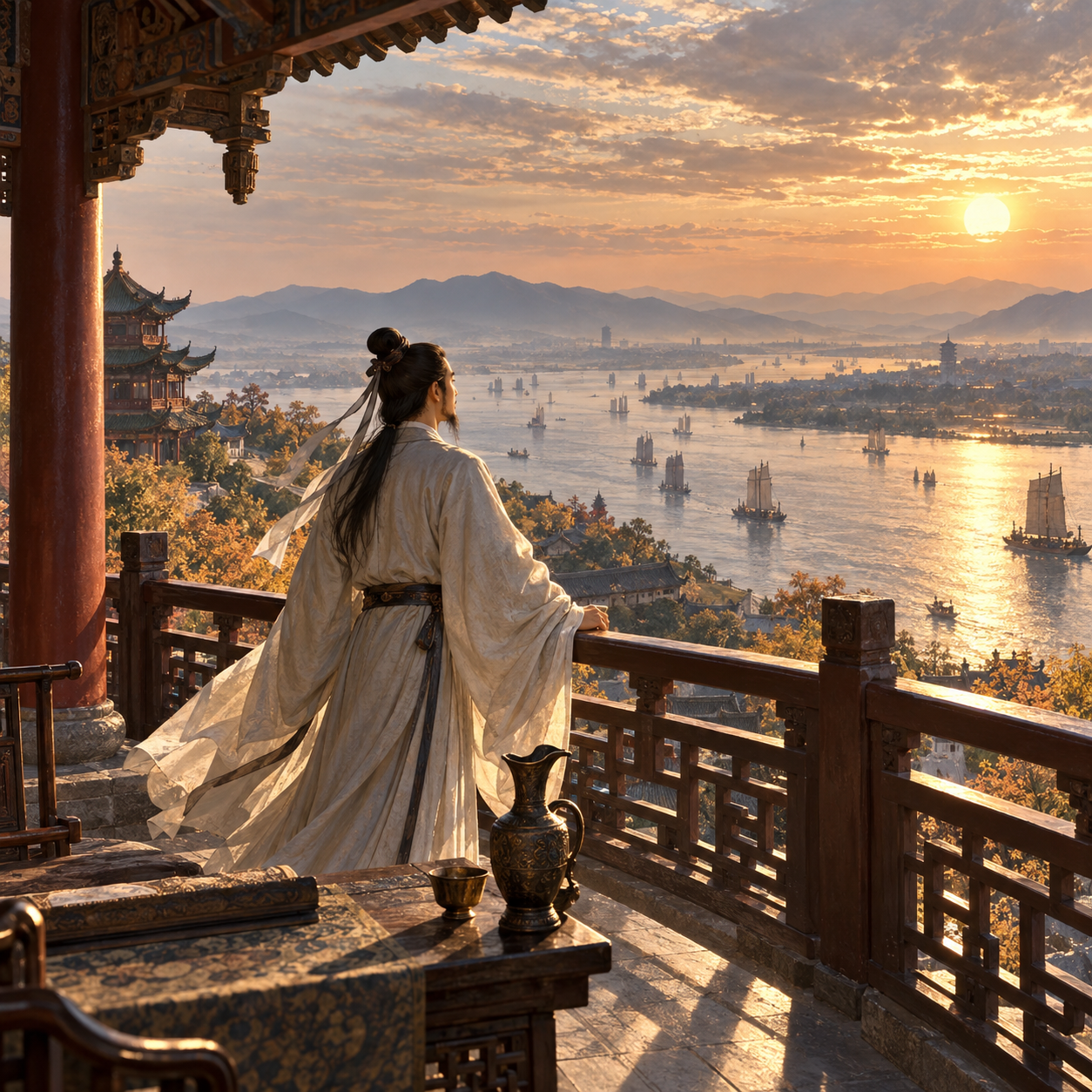
In heaven stands an immortal capital built of white jade, with twelve towers and five cities. Immortals stroked my head, and in youth I already longed for eternal life. Later I strayed into the worldly pleasures of fame and achievement, studying deeply the successes and failures of order and disorder; many kings called sages through the ages left behind only names as insubstantial as drifting clouds. They treated the realm as a great gamble and never escaped warfare. I once tried to study the strategies of kingship and hegemony, hoping to attain distinction; but fate opposed my wishes, so I set these things aside and wandered the seas.
Learning swordsmanship now seems laughable to me; what, in the end, has writing accomplished? My swordsmanship cannot withstand ten thousand soldiers, yet my writings have, by good fortune, spread my name across the land. These meager skills are hardly worth mentioning; like Liang Hong, I leave the capital chanting my discontent. As I depart, my feelings surge, and tears wet my cap and sash. I admire your free, exceptional talent, standing high among so many gifted men. You hold a farewell feast to encourage me on my distant journey; carriages and horses gather like clouds and escort me as far as Piaoqi Pavilion. Before the bells, drums, and songs have exhausted our delight, the sun is already setting toward Kunming Lake.
I reached Youzhou in the tenth month and saw weapons massed as thickly as stars. The court had entrusted vast northern lands to a powerful general; his might could drive a hundred rivers and topple Mount Yanran. I knew the danger but could not speak openly, wishing only to retire to the immortal mountains at sea. I wanted to draw my bow against the baleful star, yet held the arrow without daring to release it. I wept on the Golden Terrace and called to King Zhao of Yan, who sought worthy men: today no one values the bones of a fine horse, and noble steeds leap in vain. Even if Yue Yi were reborn, he would be forced into exile in such times.
After years wasted in disappointment, I rode back to Guixiang and found you governing there, educating the people through rites and music, seated with dignity in your hall. The hundred-li district under your rule seemed restored to ancient simplicity, its people peaceful and content, as though living in the age of Fuxi. At Changle Lodge, music accompanied a banquet, with wine vessels arrayed; worthy scholars, gallant guests, and singing women sat interspersed in orderly rows by candlelight. Drunken dancing stirred the splendid mats, and clear singing circled the high beams. Our happy gathering had scarcely begun when your term ended and you had to return to Xianyang. Well-wishers crowded around, and farewell tents along the road stretched into the distance. After parting, we were a thousand li apart, each experiencing different turns of fortune and hardship.
After several turns of cold and heat, the realm suddenly plunged into chaos. Imperial troops fought the rebels, and dust and sand darkened heaven and earth; plants and trees were filled with murderous menace, and even the stars lost their light. White bones piled up like mountains—what crime had the common people committed? The passes guarded the capital, and the nation's fate rested with Geshu Han; despite the many long halberds and armored soldiers, the gates still opened to the savage enemy. Dukes and ministers were slaughtered like livestock, and loyal, upright men were harmed. Two emperors left the capital region, and Chang'an and Luoyang became ruins.
The prince was ordered to lead troops and commanded a powerful army in Chu, yet lacked the restraint of Duke Huan of Qi and Duke Wen of Jin. Though brave officers and soldiers served him, people no longer knew whom to follow, and rebellion surged like wind and rain. You alone held firm at Fangling, outstanding in loyalty and integrity. At that time I lived in seclusion on Incense Burner Peak at Mount Lu, drinking clear springs and feeding on clouds and sunset glow; the Nine Rivers wound before my door, and the Five Lakes seemed connected beneath my pillow. At midnight the navy arrived, filling Xunyang with banners. Burdened by an empty reputation, I was forced aboard a warship. The five hundred gold pieces bestowed on me seemed no more than drifting smoke; I declined office and reward, yet was instead sentenced to exile in Yelang.
The road to Yelang is long; traveling west makes one grow old. Though peace is gradually returning to the realm, I remain like frost-stricken grass. The sun and moon should shine impartially; how can I appeal to heaven? You, a wise prefect, show consideration for an old friend. I have been fortunate to be your honored guest and have climbed Yellow Crane Tower several times; facing Parrot Islet, I feel ashamed that I fall short of Mi Heng. Fanshan’s former air of dominance has faded, and heaven and earth are filled with desolate autumn. The river brings snowmelt from Mount Emei, and the waters of the Three Gorges surge past; countless boats sail from here toward Yangzhou. Gazing as far as I can, the broad river view briefly eases my sorrow.
The gauze windows of the high tower seem to open against the sky, and waterside trees grow thick and green as hair. Seeing the sun about to be caught in the mountains, we fear the feast will end too soon; while urging more wine, we rejoice to see the moon rise. Beautiful singing girls from Wu and Yue, their makeup radiant, climb the stairs and emerge smiling from the curtains. Before the guests, they dance lightly with lowered hands, their silk robes moving as though in a spring breeze. The guests kneel to request a brief rest, but the host’s enthusiasm is still unspent.
Reading your poem about Mount Jing, even Jiang Yan and Bao Zhao would be moved. It is like a lotus emerging from clear water, naturally fresh, needing no ornament. Your spirit often rises beyond worldly concerns, and you frequently invite me to join you. Warriors crowd before your residence, their halberds arrayed in imposing ranks; in the garden, tended bamboo and rocks surround a clear, deep stream that winds around them. We climb terraces and sit in waterside pavilions, where your conversation often reveals outstanding insight. A word is more precious than white jade; beside a promise, gold seems light. You say I have not failed your trust; may the messenger convey this sincere heart.
As though a magpie had flown down from the five-colored clouds of heaven, news of a pardon arrived, allowing me to turn back from the road of exile to Yelang. Warmth revives a frozen valley, and dead ashes begin to glow again. You will enter court to assume an important office, while I, like Jia Yi, remain cast aside. Even Jie's dog barked at Yao, and the Xiongnu once mocked the Han for appointing Tian Qianqiu; the world's censure does not prove a worthy person guilty. Again and again I sigh at midnight, often anxious for the country.
Banners line the space between two mountains, with the Yellow River flowing through the middle. The armies, like chickens tied together, hinder one another and cannot advance; they can only linger by the river, watering their horses. How can we obtain a divine archer like Hou Yi, who could shoot down Maotou, the star symbolizing the enemy threat, with one arrow and truly end the warfare?
Yelang: a Tang place name, referring in the poem to the destination of exile; Li Bai was pardoned on his way there. Jiangxia: the area of present-day Wuhan, Hubei. Wei Liangzai: an old friend of Li Bai, then serving as prefect of Jiangxia. The experiences recorded in the title should not be simplified to “written in Yelang.”
白玉京、十二楼五城: the White Jade Capital, twelve towers, and five cities, images of the Daoist immortal realm. 结发: the early years when one bound up one's hair on coming of age. 九十六圣君: an inherited traditional count of ancient sovereigns, rather than a historical list individually verified by this poem.
轩冕: the carriages and robes of high officials, standing for the splendor of an official career. 五噫: an allusion to Liang Hong’s “Song of Five Sighs” of the Eastern Han and his departure from the capital to withdraw from worldly affairs, expressing indignation. 祖帐、祖道: farewell banquets and ceremonies.
戈鋋 (chán): weapons. 长鲸: a great whale, used as a metaphor for a powerful calamity or an ambitious force. 蓬瀛: Penglai and Yingzhou, legendary mountains of immortals. 天狼、旄头: the stars Tianlang and Maotou, used in the poem as symbols of warfare and enemy threats.
黄金台、骏骨: the Golden Terrace and the bones of a fine horse, allusions to King Zhao of Yan’s search for worthy men. 騄耳: a legendary swift horse. 乐毅: a famed general of Yan who later fled after falling under suspicion. 贵乡: a Tang county in the area of present-day Daming, Hebei. 弦歌: governing a locality through rites and music. 羲皇: Fuxi.
九土、六合: the whole realm. 哥舒: Geshu Han, a Tang general whose command was connected with the loss of Tong Pass during the An Lushan–Shi Siming Rebellion. 醢、菹: minced meat paste and pickled vegetables; here metaphors for brutal slaughter. 二圣: Xuanzong and Suzong. 两京: Chang'an and Luoyang.
帝子: Li Lin, Prince of Yong. 桓文: Duke Huan of Qi and Duke Wen of Jin, ancient hegemons. 房陵: the area of present-day Fang County, Hubei. 香炉: Incense Burner Peak on Mount Lu. 浔阳: the area of present-day Jiujiang, Jiangxi. 旌旃: banners.
Lines such as “迫胁上楼船” (“Coerced aboard the towered warship”): The poet's account of his service on Prince Yong's staff carries a tone of self-defense; this wording should not be treated as an uncontested historical conclusion.
负霜草: grass damaged by frost, a metaphor for those who suffer. 良牧: a wise local governor. 祢处士: the recluse Mi Heng, renowned for his literary talent; Parrot Islet is associated with his “Rhapsody on the Parrot.” 樊山: Mount Fan, near present-day Ezhou, Hubei.
小垂手: an ancient dance movement. 江鲍: Jiang Yan and Bao Zhao, writers of the Southern Dynasties. “清水出芙蓉,” “a lotus emerging from clear water,” praises Wei Liangzai's poetry in this poem.
青鸟: the messenger bird of mythology. 凤池: the Phoenix Pool, referring figuratively to the central imperial government. 贾生: Jia Yi, invoked as an image of a talented person held back. 桀犬吠尧: “Jie’s dog barking at Yao,” a metaphor for each serving their own master, or for judgments that invert good and evil. 千秋: Tian Qianqiu, an official of the Han dynasty.
连鸡: an allusion to the ancient image of chickens tied together and thereby hindering one another, used here for armies failing to coordinate. 夷犹: to hesitate or linger. 羿: Yi, the legendary master archer.
Reading guide: This long poem in five-character lines combines recollection, a verse gift, self-defense, and concern for the times. After experiencing the An Lushan Rebellion, the Prince of Yong affair, and exile, Li Bai associated with Wei Liangzai during his return following a pardon, using this gift poem to look back on his political aspirations and life's reversals. Readers should distinguish accounts of the past, present-day feasting and excursions, and symbolic scenes drawn from allusions; the poet's account of himself is not an undisputed chronology.
The poem's rises and falls arise from the repeated pull between two desires: seeking immortality and serving the world. The opening seems already to transcend earthly life, but soon turns to the achievements of kings and hegemons, and to rulers seeking worthy men and finding them. The middle places personal frustration amid warfare and the common people's bones, so its grief and indignation extend beyond failure to obtain office.
Wei Liangzai runs through every section as the person to whom the poet can recount his past and from whom he can regain respect. Farewells, local governance, feasting and outings in Jiangxia, and judgments of poetry and prose give the friendship concrete substance. “清水出芙蓉” (a lotus emerges from clear water) occurs within this exchange between friends and should not be understood apart from its context.
A pardon and return bring a change of fortune, yet the ending does not rest in the joy of personal deliverance. Banners, the Yellow River, and a stalled army come back into view; the final question to a skilled archer returns the whole poem to the hope of quelling rebellion and bringing peace to the people. Numerous allusions connect the poet’s own circumstances with the ordeals of worthy men in antiquity.
Let words find a melody
From a poem into a story
The pardon removes Shen Yan’s wooden cangue, but gives him not a coin for the journey home. He takes on thirty-seven crates of damp books, hoping to seek out an old friend in Jiangzhou. An old military treatise still holds his youthful boasts of bringing peace to the realm, but the girl at the ferry asks only whether the wave patterns on the book spines can help her find her father. As place names gradually emerge along the way, this job taken for a living becomes harder and harder to finish along its planned route.
Start readingAI-assisted writing · Fictional characters and events
