
Xie Xin En · Autumn's Slowly Fading Light Cannot Be Held
Five Dynasties・Li Yu

Five Dynasties・Li Yu
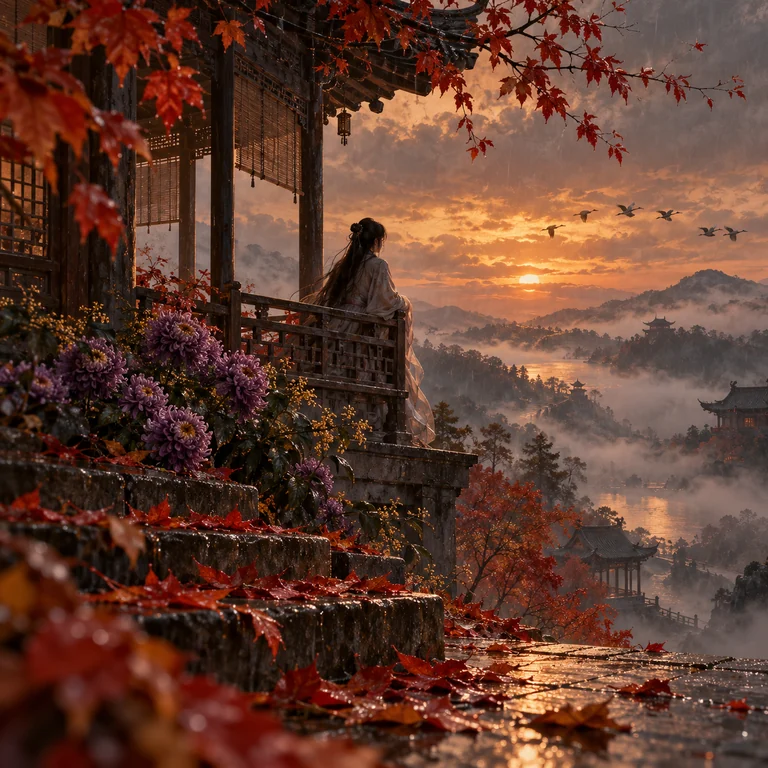
冉冉秋光留不住,满阶红叶暮。— Slowly passing autumn light cannot be held; red leaves fill the steps at dusk.
Once again the Double Ninth Festival passes; where I climb the towers and terraces, the fragrance of cornel drifts down.
The scent of purple chrysanthemums drifts through courtyard and doorway; evening mist veils the fine rain.
Newly arrived geese call in harmony, their cold cries choking; year after year, sorrow and regret remain much the same.
The animation remains in its original Chinese.
The animation is ready.

The slowly fading autumn light cannot be held; at evening, red leaves cover the steps. The Double Ninth Festival has passed again, and among the towers and terraces once climbed, the scent of cornel is gradually dispersing. The fragrance of purple chrysanthemums drifts into the courtyard, while evening mist veils the fine rain. Newly arrived geese give low, choking cries in the cold; the sorrow that returns each year rises again with this autumn scene.
冉冉: slowly passing. 重阳: the ninth day of the ninth lunar month, traditionally marked by climbing heights and wearing cornel sprigs. 榭: a structure beside water or built on a terrace.
茱萸: an aromatic plant associated with the Double Ninth Festival. 香坠: its fragrance fades. 雍雍: harmonious bird calls; here, together with “咽寒声” (“choked, chilly cries”), it describes the calls of geese. 长: always or often.
Surviving versions of this lyric differ in wording and punctuation; this page follows the text presented here. No definite date or setting is imposed.
Reading guide: Li Yu expresses sorrow through autumn scenes around the Double Ninth Festival. Steps, courtyards, doorways, towers, and pavilions form spaces close at hand; red leaves, chrysanthemum fragrance, fine rain, and the cries of geese enter them layer by layer, revealing the relationship between recurring seasons and unresolved feelings.
The opening declares “留不住” (“cannot hold it back”), and every autumnal detail that follows seems to prove the statement. Falling leaves are seen, chrysanthemum fragrance is smelled, and fine rain and geese’s cries add a chill, steadily deepening the sensory layers.
“又是” (once again) and “年年” (year after year) echo each other: each return of the season can neither renew sorrow nor make it disappear. The final “相似” (alike) seems plain, yet precisely conveys a familiar, enduring pain.
Let words find a melody

From a poem into a story
Xiaoman buys a pair of wooden clogs in a neighboring city. The fish missing its whiskers on their soles is a design her eldest brother carved incorrectly as a boy. Yet the man behind the shop calls himself Yusheng and says he has no younger sister. In seven days it will be the Double Ninth Festival, when the family will, as always, leave a place for the son who vanished fifteen years ago. Xiaoman returns with the news. Her mother bends to retrieve a red fruit that has rolled beneath the cupboard, then finally asks: Is he dressed warmly enough?
Start readingAI-assisted writing · Fictional characters and events
