
A Novel of Trade Routes and Reunions in an Ancient Setting
An Ink Spot Beside the Bamboo Hobbyhorse
Ku Wuji · AI Writing · 10555 characters · about 12 min
When Lu Yan found his own name in the ledger, the first thing he did was press his thumbnail against it. He’d already seen the entry for the green plums yesterday and thought the rest would be little more than the small expenses their mothers had incurred going back and forth. He hadn’t expected to turn two pages and find a crooked ‘砚’ beneath a string of numbers for borrowed tables and chairs. Someone had drawn a slash through the character without quite crossing it out, and an even smaller ‘葭’ was squeezed in beside it.
Yao Jia was in the back courtyard telling Carpenter He which jars to move first, her sentences coming through the window in pieces. He didn't call her over just yet. He looked at the date first. He had been nine, and Yao Jia eight, still too young to need to get away from other people to talk. Someone in the lane was celebrating, and the two families had lent out their benches. He'd sat at the table writing down names, insisting that whoever lent something should have their name entered, and that his own low stool had to count too.
He had forgotten whose wedding it was. He remembered only the two great pots set up in the courtyard and how anyone who passed them carried the steam of glutinous rice on their clothes. He had carried a basket of empty bowls for Ruan Xin, and halfway there two strips in the bottom had broken. None of the bowls shattered, but each had a stripe of mud on the bottom. Afraid of being scolded, he crouched by the well to wash them. The well rope was thicker than his wrist back then. When Ruan Xin came over, she left him free of the carrying and gave him a piece of very hot rice cake.
He suddenly wanted to know when she had finally got to eat, so he turned the pages until he found the wedding feast. The rice and vegetables were all listed. The counts for the tables and chairs each had a mark to say they had been returned, and there was even a circle beside the two earthenware basins his mother had lent. Farther down, in Ruan Xin’s hand, were the words 已做、已送, made and delivered. The last line recorded a sack of stove ash used. Lu Yan stared at it for a moment and reached for his own fresh sheet to add an entry, then stopped.
That ledger was harder to reckon than a boatload of cargo. It held rice taken on credit, cloth sold for others, tables and chairs lent for a wedding feast, and a great many small things that could hardly be priced. Who had looked after whose sick relative, who had minded whose child for a few days. Even the bamboo hobbyhorse Yao Jia used to run around the well with as a child was entered in the corner of a page. It said the bamboo was left over from a neighbor’s basket repairs, and no money had been taken.
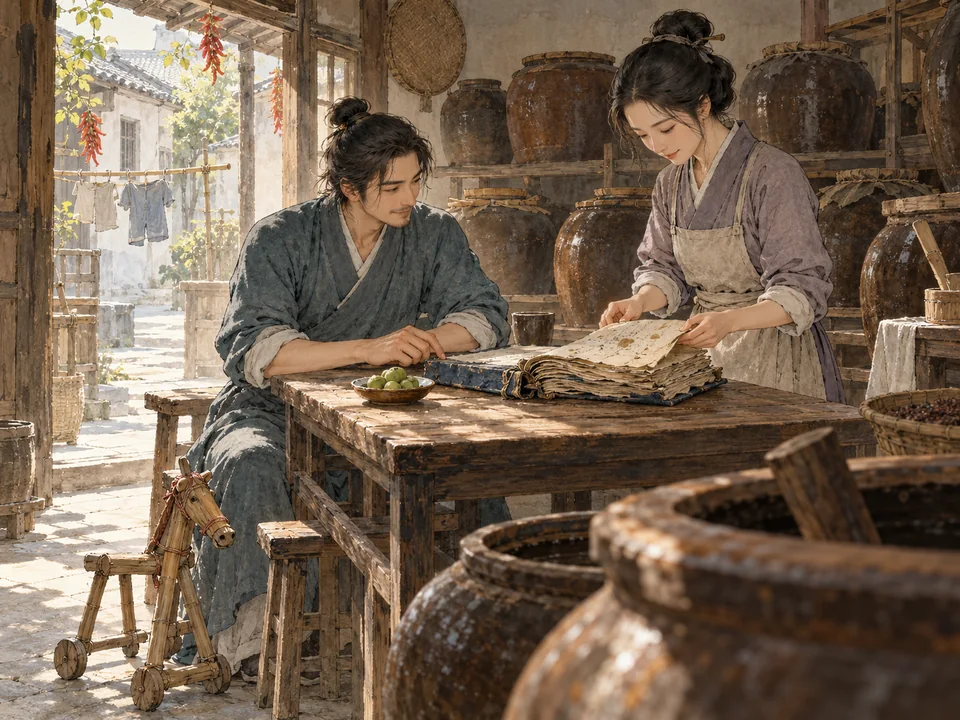
The corner of the page had long since softened from turning. When Lu Yan saw the words 竹马, ‘bamboo hobbyhorse,’ he laughed aloud. Yao Jia poked her head through the rear window and asked what it was. He held up the ledger for her. She didn't understand at first, but when he pointed to 料, ‘materials,’ she said it was bamboo left over from the Han family's basket repairs. Had he really thought all these years that he had brought it down from the bamboo hills himself? He answered instinctively that he had at least supplied the cord for the horse's head. Yao Jia laughed and said that cord had been cut from a length by her own stove.
Lu Yan’s fingers curled in as though the bit of cord really had caught them. Carpenter He heard them from outside the window, laughed along, and asked if they meant that broken frame behind the door. Yesterday, while looking for a sliver of bamboo to wedge the window, he had nearly split it up, but Yao Jia had stopped him. He picked it up and brought it over. Half the horse’s head had already come loose, and at some point two mismatched cords had been added to the bamboo body. When it swung, it looked less like it was running than like it could hardly stop nodding.
Yao Jia said it had turned up this year when she cleared out the loft. Her aunt had meant to save it for Xiao Geng to play with, but when he took it and shook it, a whole bellyful of broken leaves fell out. So it had been propped by the door for her to take apart. Lu Yan took it without daring to grip it hard. His fingertips still found the place he'd held it long ago. The bamboo skin was no longer smooth, but the grip was a little paler than the rest. In that pale patch, his nine-year-old hand suddenly had a size he could hold again.
“You said it was for me, too,” Yao Jia said.
He laughed and admitted it. Back then he had held the horse high and refused to lower it until she called him ‘Brother Lu.’ She refused. They made a circuit of the well and both ended up stepping into the muddy overflow. Ruan Xin took hold of them, one in each hand, and told them to look at the treasures they’d picked up on their feet. What he always remembered afterward was that Yao Jia had accepted the horse. He had forgotten that before taking it, she had carried his muddy shoes home for him.
The carpenter went back under the rear eaves to continue looking at the timber. Yao Jia put the broken bamboo hobbyhorse by the wall and said they had better keep Xiao Geng from actually riding it and coming away with a bad leg. Lu Yan looked at the crooked, drooping head without saying that it could be put right with a little repair. He picked a fresh chicken feather out of the bamboo hoop and laid it beside the counter. It struck him that he had come back with so many things that other people had already taken apart, mended, or found new uses for, and all along he had imagined they were still waiting for him.
In the afternoon they came to the accounts for the households Ruan Xin had later made pickled vegetables with. The Qin shop, the Yu household, the Chens at the east end. Their names appeared in turn. At first they pooled a few jars at a time, then the quantities grew until a page could no longer hold them. Yao Jia took out a more recent slip, left by her mother when she had asked for a share in the partnership. The paper was so small it looked as though it had been cut for some passing use. On the back you could still see half the name of an apothecary.
Lu Yan read the beginning and looked up to ask when it was from. Yao Jia said six years ago, when she was twenty-three. Her mother had said her daughter had learned the work alongside her and couldn't go on depending on how many vegetables other people were willing to bring. She said nothing more about what her mother had thought at the time. She laid the slip flat by his hand and turned away to bring in the jar cloths drying outside the window. Lu Yan saw entries for the rice, salt, and vessels several households had put into the venture. The last item read ‘Xin-niang supplies the labor.’ The space after it was blank.
He thought of Qin Shouyi passing the door that morning. The shopkeeper had put on a little weight, but still wore the same sort of brown jacket with a stiff, upright collar. He had asked Lu Yan first about Lu Zai, patted his arm on hearing his father was doing well enough, and then praised the Yao girl for being capable. Qin Shouyi said that if someone like her made a home in Changgan, life would surely go well for her. At the time Lu Yan had been too busy trying to keep from smiling too openly to ask what, exactly, it would take to keep such a capable woman’s life going.
“So the talks fell through?” he asked.
Yao Jia was folding the pieces of cloth one by one. She said her mother had told her she had brought it up. Shopkeeper Qin and the others had all said neighbors had always looked after one another, and that keeping too close a tally would cool things between them. Later someone brought her mother a little basket of chestnuts, and someone else said they would take two more jars to sell and make sure she didn’t lose out. Her mother didn’t argue with them again in person. At this, Yao Jia gave a softer laugh than she had over the bamboo horse. Her mother had come home and shelled the chestnuts, she said, picking out the best ones for her.
She had never heard her mother say how much that share ought to be. How many years they had worked, how much each person had done, even who had carried an extra load on a shoulder pole, none of it had been set down separately in the accounts. She knew only that after that little slip of paper, her mother had worked for three more years. The later entries marked “done” were more crowded. Once, when her mother was ill and couldn’t keep her writing steady, she still had Yao Jia fill in the date the jars had gone out. Back then Yao Jia still hoped that if this batch sold well, it would be a little easier to ask next time.
Lu Yan had already dipped his brush in ink. It hung above the page. This was the moment he hated most at the shipping firm, when the facts were clear but there was no figure to put down. If water spoiled a few baskets of beans, the beans could be counted. If a jar broke, the pieces could be swept up and shown to the owner. Here was an empty line, and there was no telling even how many people they'd need to ask before they could begin. He was about to say he could go and see Shopkeeper Qin, but when he looked up, Yao Jia was watching the brush too.
“First write down what we still haven’t established,” she said. “I asked you to look through it, not to go coax someone into saying something nice for me.”
He nodded, wrote ‘labor unlisted’ on the sheet beside him, then asked whether her mother had ever taken money or rice from any of those households, beyond what she’d advanced when she made their vegetables. He saw Yao Jia’s eyes tighten as soon as the question was out, and nearly swallowed the last part of it. She didn’t answer at once. She went to the back courtyard, unfolded a cloth she’d just folded, shook it out, and hung it on the bamboo pole, as if it had suddenly turned out to be damp.
Lu Yan lowered his head and waited. After a while she came back and said that the year her father fell ill, the Qin family really had lent them rice, and the Yu family had brought them charcoal. Some of it had been repaid, and some had gone unmentioned. He made a separate column for it, leaving the earlier note, ‘Labor unaccounted for,’ in place. She stood watching beside him and slowly edged the stool a little closer. She said it was fair to ask about these things. It was just that whenever people asked, they made it sound as though that one sack of rice meant there was no need to mention all the years her mother had worked.
The tofu seller’s carrying pole rattled outside again. Lu Yan heard the faint clack of wood against wood and remembered the extra little corner the seller had cut off yesterday. He drew no conclusions on behalf of Ruan Xin or the Qin family, simply putting what was known on one side and what still needed asking on the other, as Yao Jia told him. There was gradually more to write, and still plenty of blank space. Yao Jia suddenly pointed to one entry. Her aunt had been the one who was ill that year. Her mother had gone to stay three nights, and her aunt had later come to look after her in turn. Just because the words ran together didn’t mean the Yao family had done all the helping.
He said all right and corrected it. She went to lift the little pot off the fire. Perhaps she was too quick, because the lid struck the side of the stove with a clink. She hissed under her breath. Lu Yan was already on his feet, but she raised the hand she hadn’t burned and said it was nothing, she’d only brushed against it. He stood in the doorway watching her rinse the side of her finger in cool water. Remembering how easily he had said yesterday that he knew what hard times her family had been through, he realized how much of what he thought he knew came down to a sentence he’d heard.
Before setting down his brush at dusk, he read through the names they’d marked to ask that day. At Yao Lan’s, Yao Jia said not to go straight over tomorrow. Her aunt still had to exchange her new shoes. If Yao Jia went to see her today, she might not hear even half a sentence before her aunt was off. Lu Yan laughed and made a note in the corner. He actually wrote 先换鞋, ‘shoes first.’ Yao Jia leaned in to see. At first she wanted him to cross it out, but then she laughed too and said they wouldn’t forget that way, so he might as well leave it.
He weighed down the paper. Outside the window the wind turned the bamboo hobbyhorse gently halfway around. The loop of red thread still on its head had faded past recognition. Lu Yan suddenly wanted to ask what else she'd kept all these years, then thought the question would make him sound as though he'd only just learned to recognize things and was already in a hurry to claim a whole roomful. In the end he only asked if he should come at the same time tomorrow morning. She said half a ke later. She was going to buy bamboo shoots first. This time he remembered the half ke and left it to her to decide how many to buy.
· End of chapter ·
This original work was written with AI assistance, expanding on Li Bai’s “长干行二首” (Two Songs of Changgan) and this site’s original short story “青梅旧账” (Old Accounts from Green-Plum Days). The characters, trading firms, prices, geography, and chronology are all imagined; it preserves the original work’s core of settling old debts, recognizing craft and labor anew, and renegotiating a relationship in adulthood. It is not a biography of the poet.


Comments
Loading comments…
Have something to say?Sign in to comment →