


AI can answer questions, but can it truly “think”?
Frequent users of AI search products will notice that these products often “drop the ball” when faced with complex questions—they can imitate Shakespeare's style and solve math problems, yet may be at a loss when tackling difficulties in everyday life.
This is like an erudite but inflexible bookworm, rich in knowledge but lacking flexible thinking. Clearly, simply turning AI search into a “talking search engine” is far from enough.
So how can we get a large language model with greater intelligence, stronger reasoning and the ability to think deeply to solve ordinary users' real problems, instead of just tackling Olympiad problems?
Moonshot AI recently offered an attempt of its own: it has just launched Kimi Explorer, which aims to tackle searches involving complex questions. Interestingly, Kimi Explorer does not emphasize pursuing cutting-edge scientific research capabilities. Instead, it focuses on improving the experience in everyday use, trying to find a balance between ordinary users and “advanced” AI.
Reportedly, Kimi Explorer Edition has learned to break down complex problems like a human. By independently planning an approach and carrying it out step by step, conducting massive, exhaustive searches on its own, and immediately reflecting on search results, it ultimately helps users find more comprehensive and accurate answers.
To see how it actually performs in use, Silicon Star also tried it out right away.

When Large Language Models Begin to Think Like Humans

Kimi Explorer Edition is now available to all users. It is easy to use: there is no need to switch models. The toggle is at the bottom of Kimi’s chat box; simply turn on “Explorer Edition” to start using it.
Compare Investment Returns
The recent roller-coaster ride in the A-share market has given investors a taste of heart-racing excitement—cheering a surge yesterday, only to beat their chests in dismay over a plunge today. Let us first ask Kimi Explorer to compare the returns of two investment options: if I bought BYD shares at the opening of the first trading day after this year’s Spring Festival, how would that compare with investing in gold on the Shanghai Gold Exchange over the same period, through the close of the last trading day of month 9? Which option would have yielded a higher return? Put it in a table
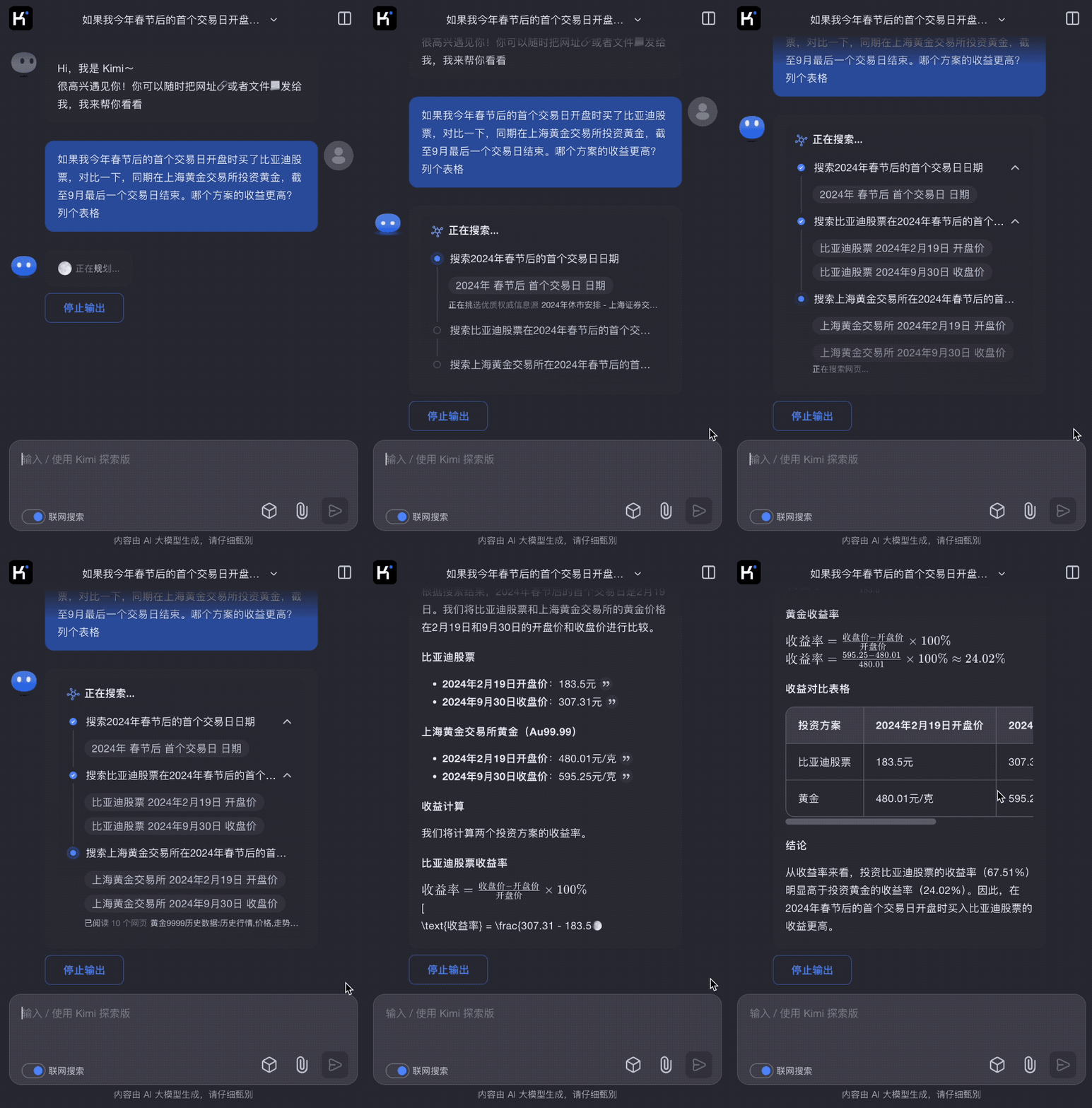
The question above actually contains at least three subquestions and would require multiple manual searches and operations using traditional methods. We can see Kimi’s thinking process: it answers by separately looking up BYD’s share price and the price of gold, then generating a table to compare them.
Classic McKinsey Interview Question
Since Kimi Explorer emphasizes search capabilities with reasoning, let's try a consulting interview question that requires more demanding logical deduction.
Problems like these usually require highly structured thinking, such as breaking down the problem and building logic trees. They also often require reasoning and testing hypotheses in real time based on the information provided. Traditional LLMs rely primarily on pretraining data and struggle to perform immediate analysis as flexibly as humans.
Question: Assuming all pianos are tuned regularly, estimate how many full-time piano tuners Beijing needs
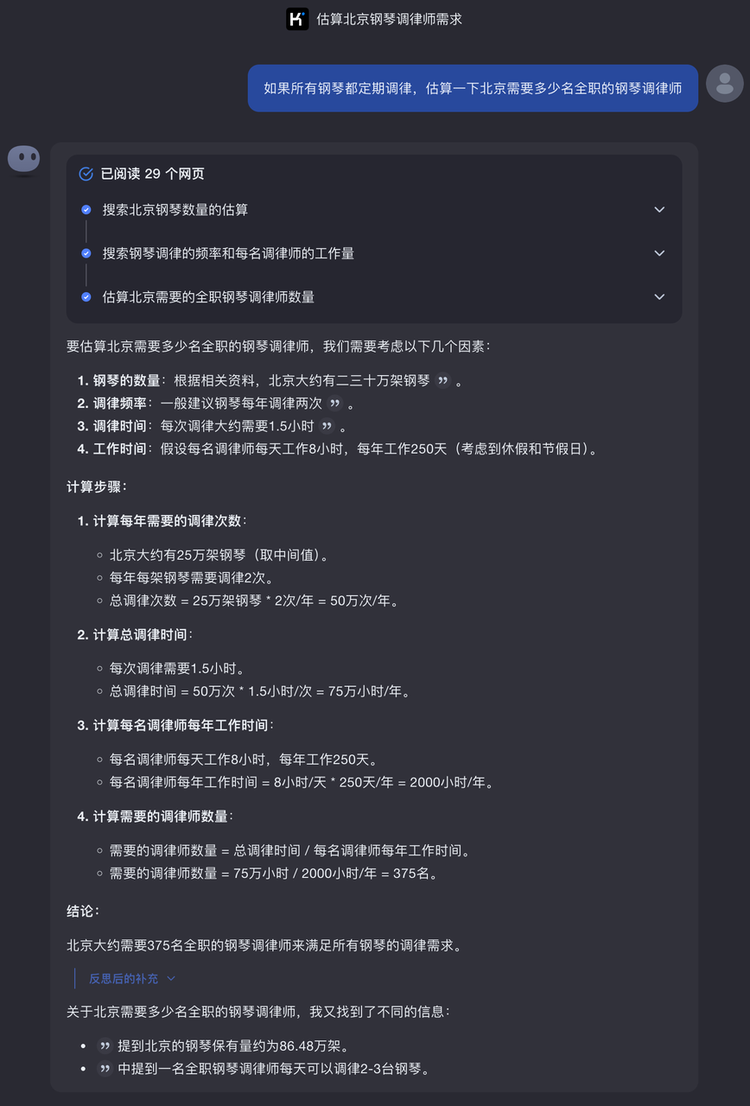
We can see that Kimi can handle logical reasoning problems involving multiple variables and assumptions, analyzing them step by step and making estimates through Fermi estimation (breaking down the problem, assessing the reasonableness of assumptions, and estimating the order of magnitude of the result). The breakdown follows this logic: number of pianos * tunings per year * time per tuning = total annual tuning time. After reaching its conclusion, Kimi also provides two related pieces of information as supplements.
During the process, Kimi combined data from different sources through search and then performed a comprehensive analysis, resembling a process of multistep thinking and reflection after a user enters a question.
The question above may be too common, so here is one that is not in the “question bank”: How many wind turbines would need to be built to completely replace China's coal-fired electricity generation in 2023? How many Shanghai-sized areas would these wind turbines occupy?
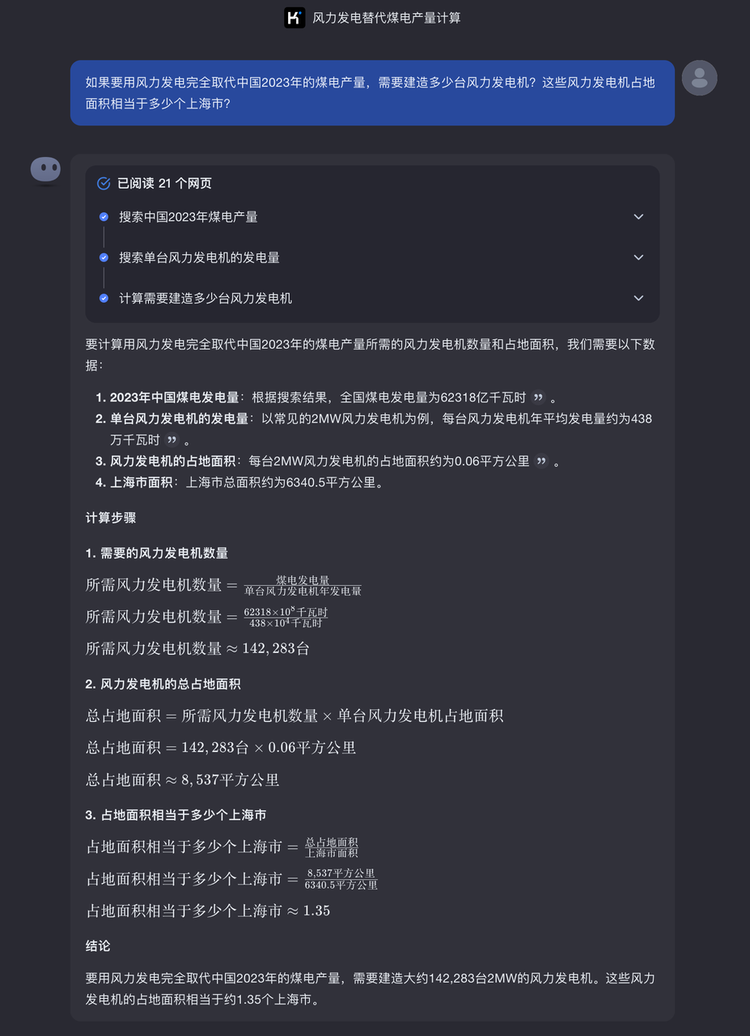
After extracting the key information, calculating step by step, and reasoning clearly, Kimi delivered the answer very efficiently.
For comparison, I used Perplexity's paid Pro mode. After some calculations, Perplexity produced a rather implausible answer. On checking it, I found clear problems in its estimates of the number of wind turbines and the land area required.

Let’s imagine a possibility
Now for an even more imaginative question: estimate how much material would be needed to rebuild the entire Roman Colosseum using 3D printing technology. How long would it take? Approximately how much would it cost? What advantages and disadvantages would it have compared with the original construction methods?
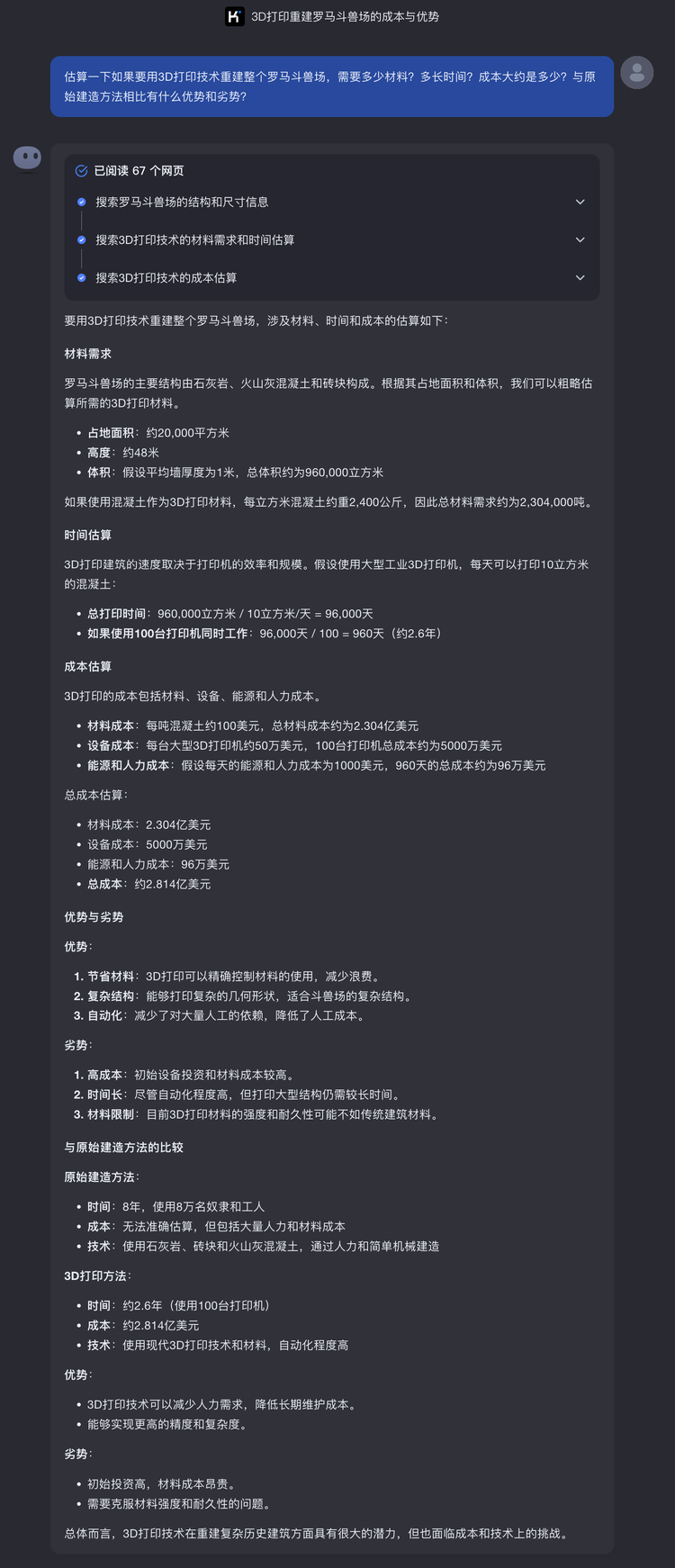
Kimi first retrieves relevant data and breaks down the problem, for example by calculating the materials, time, and cost needed to 3D-print the Roman Colosseum. It then uses these data to make estimates and conduct analysis, answers each question step by step, and compares the advantages and disadvantages of 3D printing and traditional construction methods, ultimately providing a complete and clear solution. We can see the entire thought process, from information retrieval and data processing to logical reasoning and recommendations.
Looks like next time I run out of creative ideas, I can ask Kimi for help.
We continue testing the limits of Kimi Explorer Edition's abilities in information gathering, data processing, and handling complex tasks.
First, a task involving substantial data processing. Question: In month 9 of 2024, which A-share listed companies hit their daily upper price limits? List them in a table in chronological order and analyze the reasons.
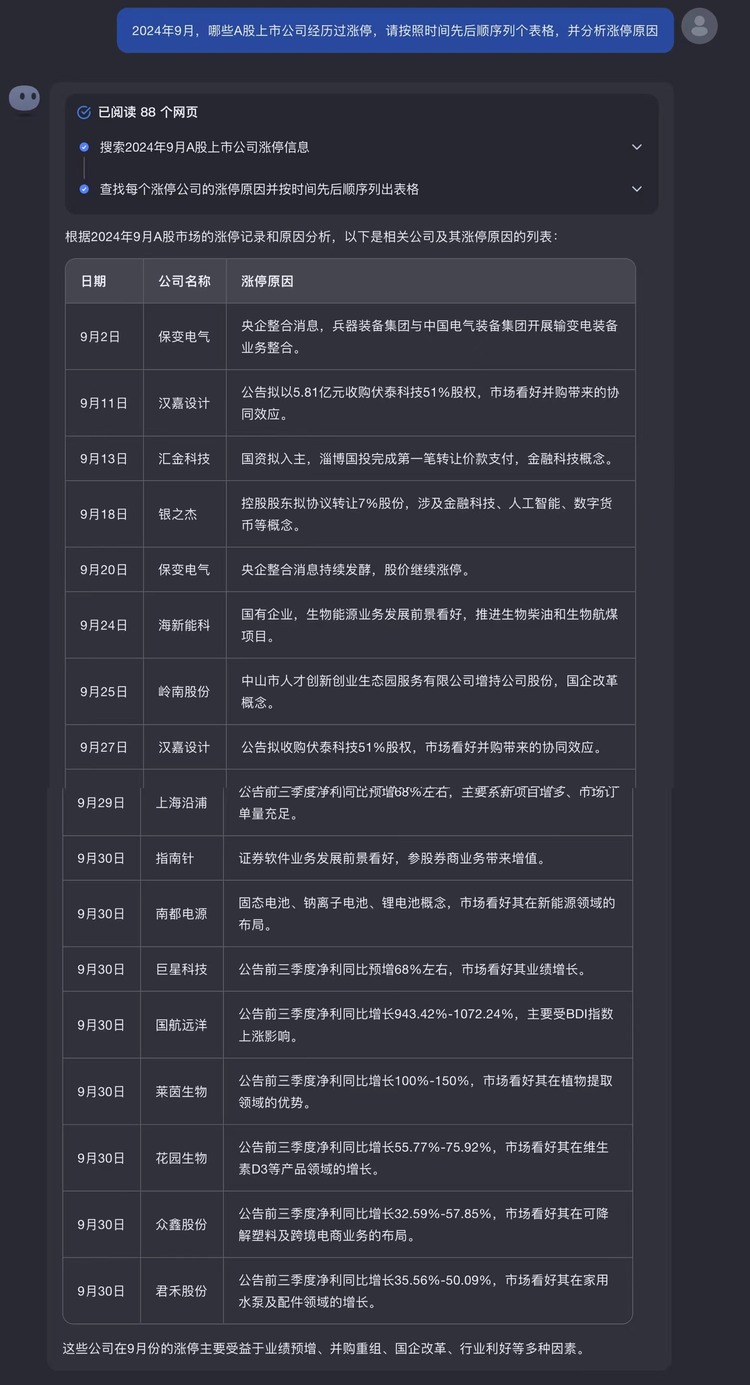
To answer this stock-market question correctly, Kimi Explorer needs the ability to access and process real-time data, integrate and organize information, and understand financial domain knowledge.
Especially because this question involves information about numerous companies and the reasons their stocks hit the daily upper price limit, we saw Kimi Explorer's capabilities in batch information processing and automation: it can read many webpages at once, quickly collect, filter, and organize the reasons multiple companies' stocks hit the upper limit, and generate a systematic report.
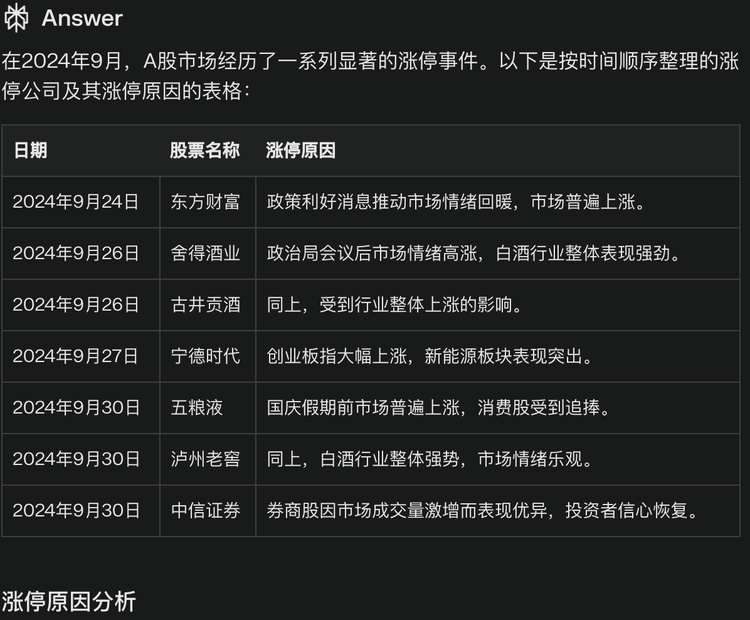
Faced with the same question, Perplexity encountered a problem with incomplete information in its very first step.
Here is another complex task involving the latest corporate and geographic information: Among the companies on Fortune’s 2024 China Tech Top 50 list, which have their headquarters in Beijing?

After the question was asked, Kimi quickly retrieved relevant information from 232 web pages, including the 2024 Fortune China Tech 50 company list mentioned in the question and information about their headquarters. It then categorized and organized the retrieved headquarters locations of the companies and presented them clearly to the user.
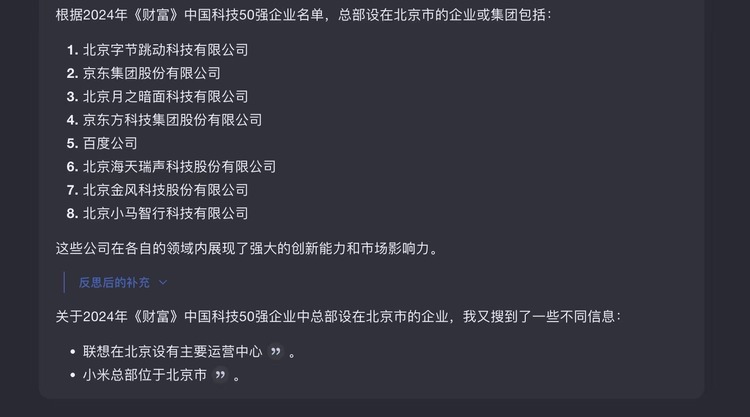
One point worth mentioning is that after giving its answer, Kimi also provided “additions after reflection.” In this particular question, we can see that Kimi checked its own answer for omissions and added Lenovo and Xiaomi.
This is another feature of Kimi Explorer: after providing an answer, KImi further guides users to think or supplies additional information through “supplementary reflections,” leading to more complete and in-depth answers. However, this reflection is not triggered by every question, perhaps to avoid unnecessary elaboration.
Beyond finance and history, let us see whether Kimi Explorer can understand the complexity of technological evolution: trace the development of three key technologies used in the iPhone: capacitive touchscreens, lithium-polymer batteries, and mobile phone CPUs. How far back do these technologies originate? What key technological breakthroughs did each undergo before ultimately making the iPhone possible?
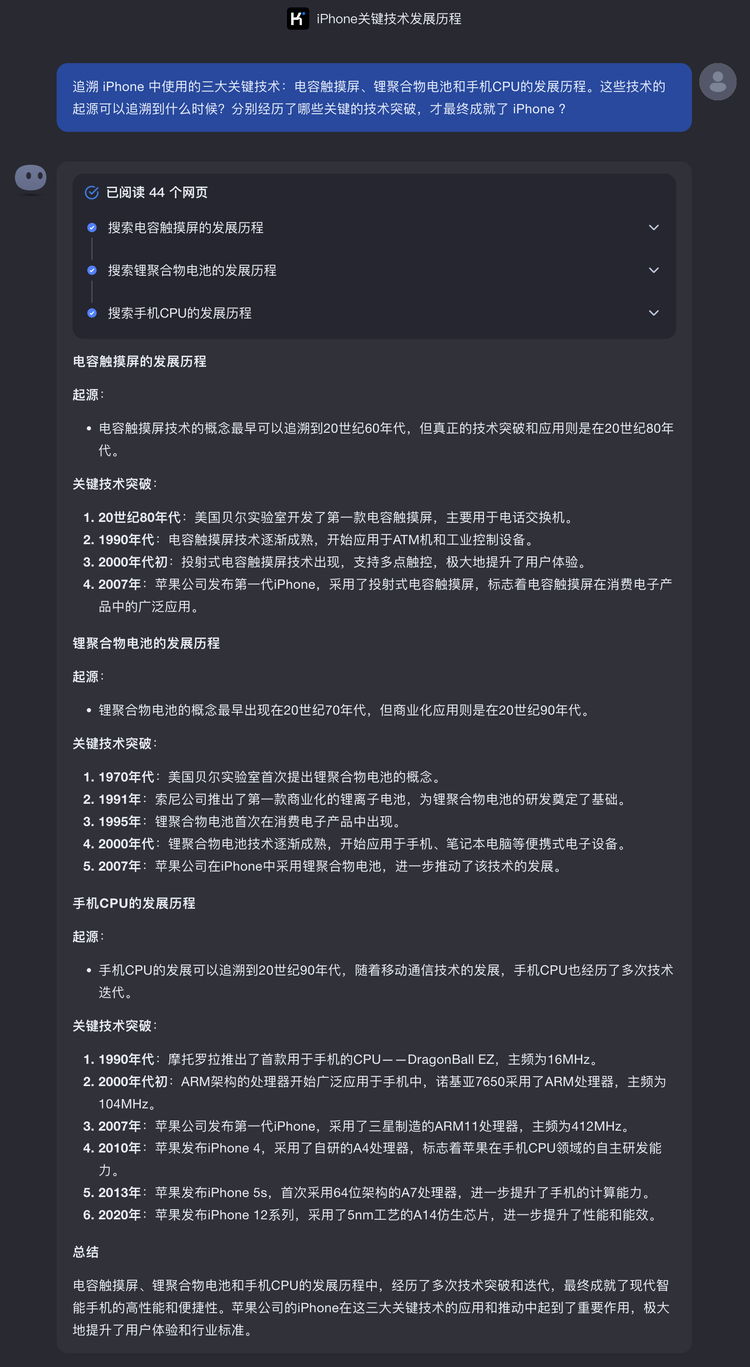
Kimi Exploration Edition still breaks things down step by step in a clear, logical sequence, covering the entire process from the technology's origins and key breakthroughs to modern applications, providing fairly comprehensive, comprehensive background and reasoning. It feels as though asking Kimi to expand and continue it a little would produce a complete analytical article.
More creative uses
Kimi Explorer has enhanced its ability to handle complex problems, enabling Kimi to understand users' questions and perform analysis and reasoning on multiple levels, while also opening up more ways to use Kimi in everyday life.
Have Kimi help you find a movie:There is a Japanese animated film about a high school girl who lives in a seaside town. She has a hearing impairment and wears hearing aids. The film contains many scenes involving sign language. The male lead is her classmate, and he begins learning sign language to communicate with her. The film has a warm, delicate style, with many themes about youth and growing up. What film is this?

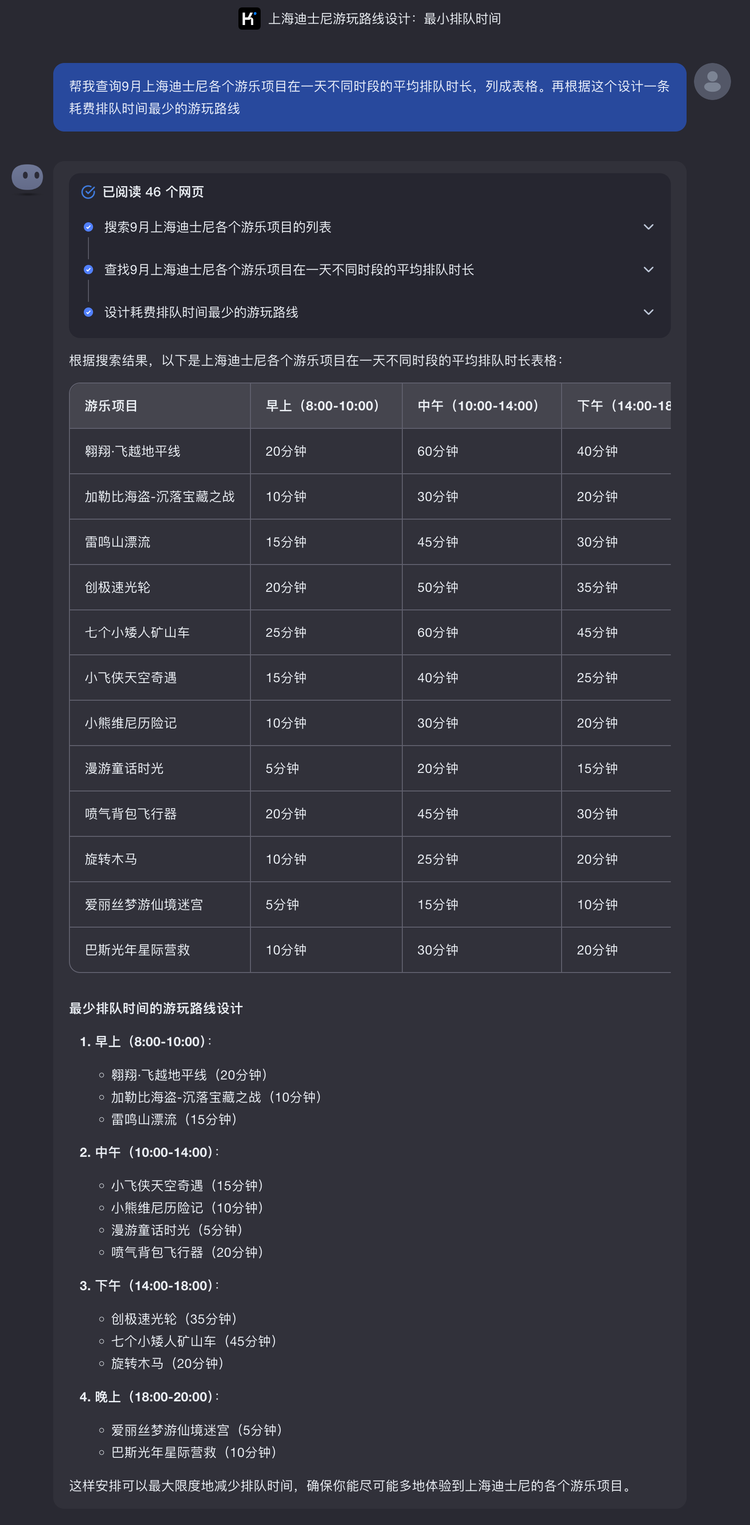
Let Kimi help you plan your travel itinerary:Find the average wait times for each attraction at Shanghai Disney Resort at different times of day in month 10, and organize them into a table. Then use this to design an itinerary that minimizes time spent queuing.
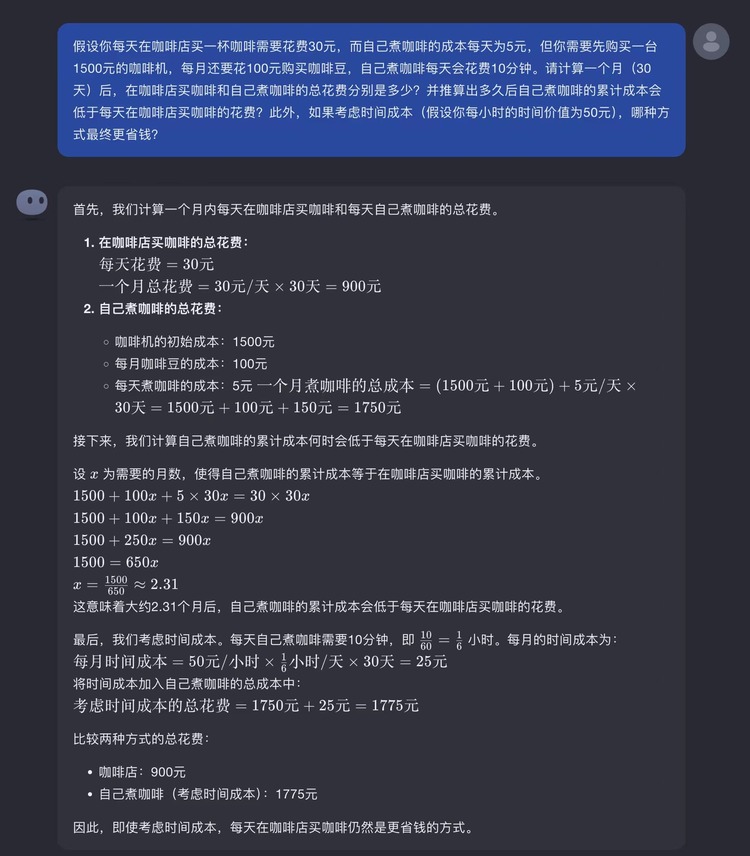
Ask Kimi to compare buying coffee at a coffee shop VS brewing it yourself:Suppose buying a cup of coffee at a café every day costs you 30 yuan, while brewing your own costs 5 yuan per day, but you first need to buy a coffee machine costing 1500 yuan and spend another 100 yuan each month on coffee beans. Brewing your own coffee takes 10 minutes each day. Calculate the total costs of buying coffee at a café and brewing your own after one month (30 days). Then work out how long it will take for the cumulative cost of brewing your own coffee to fall below the cost of buying coffee at a café every day. Also, if you account for the cost of your time (assuming your time is worth 50 yuan per hour), which option ultimately saves more money?
Conclusion
If long-text processing gives Kimi a better “memory,” then its “reasoning” capability clearly increases its intelligence. By simulating human reasoning and thought, Kimi breaks down complex problems and solves them step by step. During execution, it can also call tools such as code execution and search, and finally reflect on and correct itself as a human would.
Clearly, Kimi Explorer is not trying to create an o1 this time. Their underlying thinking may be similar, but at the user level, Kimi Explorer is still primarily targeting its broad user base: knowledge workers and university students. It uses search to solve problems in users’ everyday situations that were previously difficult for large language models to handle.

If o1 is a specialized model for scientific research and advanced users, the current Kimi Exploration Edition is more like a search and research tool for a broader audience.
Technological innovations that truly change the world often begin with solving everyday problems. Simulating human reasoning and thought, combined with massive exhaustive searches and continuous reflection and iteration on search results, has indeed given Kimi a kind of “superpower.” Users experience unprecedented efficiency and accuracy when using Kimi to find answers.
In addition, “deep search” is reportedly only the first step, and Kimi Explorer will add other new capabilities in future updates.
While looking forward to what comes next, everyone can start using Kimi Explorer now.
