
Waiting for a Guest
Song dynasty・Zhao Shixiu

Song dynasty・Zhao Shixiu
When the yellow plums ripen, rain falls on every home,
青草池塘处处蛙。— Around the grassy pond, frogs call everywhere.
My invited guest has not arrived, and midnight has passed,
Idly I tap a game piece, shaking down the lampwick's charred blossom.
The animation remains in its original Chinese.
The animation is ready.
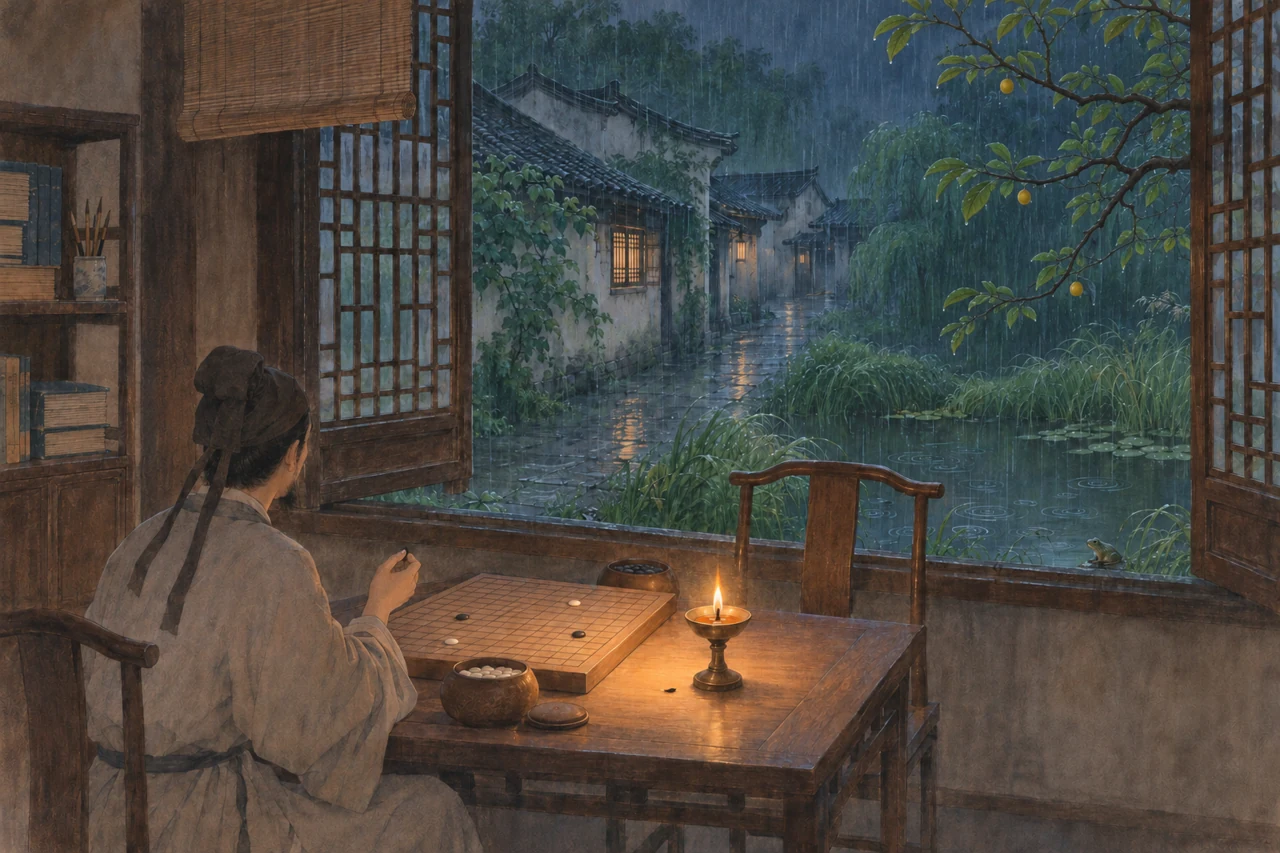
In the rainy season when plums ripen yellow, every household is enveloped in unending rain; around the grass-lined ponds, frogs call without cease.
I arranged to meet someone, but it is past midnight and they still have not come. Absentmindedly, I tap the chess pieces gently, and the charred bloom on the lampwick falls.
约客: to invite a guest to meet. The title also appears as 《有约》, “An Appointment.”
黄梅时节: Early summer in Jiangnan, when plums turn yellow and ripen amid prolonged rain, rather than autumn. 家家雨: Every household is enveloped in rain, emphasizing how widely it falls.
青草池塘: a pond and its banks where green grass grows. 处处蛙: frogs are heard calling everywhere; the line uses the frogs themselves to stand for their calls.
有约: a meeting has been arranged in advance. 不来: the expected person has still not arrived. 过夜半: midnight has already passed, emphasizing the long wait.
闲敲棋子: idly, absentmindedly tapping a game piece, an action carrying the mood of waiting; “闲” does not necessarily mean being free of all concern.
灯花: the flowerlike formation that develops on the wick of an oil lamp as it burns. 落灯花: this formation falls away; the tiny change conveys the late hour and the long wait. It does not mean fresh flowers beside the lamp.
Waiting for a Guest is a seven-character quatrain by the Southern Song poet Zhao Shixiu, capturing a moment of waiting for a visitor on a plum-rain night in Jiangnan. The first two lines describe rain and croaking frogs; only in the last two does the poem reveal that the expected guest has not arrived, drawing attention to the gesture of lightly tapping a game piece beneath the lamp. Though brief, the poem makes season, sound, human presence, and the felt duration of waiting echo one another.
This is the website’s reading guide, not the author’s own preface. This edition uses the commonly circulated four-line text; it does not infer a precise year, residence, or guest’s identity from the scene, nor treat the reason for the guest’s absence as established historical fact.
The poem begins with surroundings larger than the individual. “家家” (every household) answers “处处” (everywhere): steady rain enfolds the homes, while frogs call along the ponds. Early summer's life fills both sight and hearing. The rain and frogs are more than a simple backdrop of stillness: their sounds continue and fluctuate, yet never become the sound at the door that the waiting host most longs to hear.
Only with “有约不来” (“the invited guest has not come”) does the preceding scenery turn toward the person within it. At this point, the rainy night ceases to be merely a leisurely landscape; “过夜半” (“past midnight”) gives waiting a tangible duration. The poem never explains why the guest has not arrived. This omission leaves room for expectation, conjecture, and disappointment to coexist; readers need not invent a definite reason.
The final line does not directly express anxiety or disappointment, nor does it have the figure rise and gaze into the distance; it simply describes “闲敲,” idly tapping. Chess is ordinarily played by two people sitting opposite each other, but now its pieces have become a way to pass time alone. This slight tapping gesture suggests both the looseness of having nothing to do and an inability to settle, with the mind still caught on the appointment. The tension between “闲,” idleness, and the long wait keeps the emotion from becoming an outright complaint.
“落灯花” (the lamp's charred wick falls) compresses time into a small, visible change beside the lamp. From rain reaching every household, to frogs calling in the pond, to the chess pieces and wick close at hand, the poem's gaze steadily draws inward, while its sounds shift from the wider surroundings to a faint noise beside one person. The ending pauses at the moment before the guest arrives, without supplying an outcome to the wait; that lamplit room thus continues beyond the four lines.
Let words find a melody
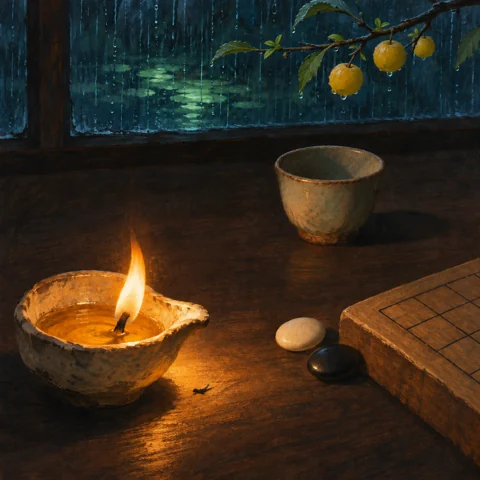
From a poem into a story
Shen Jianwei returns to Linpu to close the Go club her father has run for twenty-seven years. On a night of plum-season rain, her old friend Liang Xu, with whom she has not had a long conversation in years, fails to arrive as agreed; instead, her recorder captures an elderly man borrowing an umbrella. During the ninety-day relocation period, an old house about to disappear brings together people who left home, a boy without talent, a recording engineer who cannot hear clearly, and a Go player unwilling to admit to growing old. They must decide what to keep, and learn to let others leave.
Start readingAI-assisted writing · Fictional characters and events
