
A Novel of Craft and Society in a Historical Setting
Scissors in the Moonlight
Ku Wuji · AI Writing · 11015 characters · about 12 min
Early that morning, Gu Qing found a narrow-necked vase, rinsed it with warm water, and turned it upside down by the window. It was an old vase her grandmother had kept, with a small chip in the rim that went unnoticed with silk flowers in it. It could only be filled halfway with water. Gu Qing found several damp cloths in a bamboo basket as well. If she cut just one branch and kept its buds supplied with water, she thought, there would be something left to keep when they moved the tree.
Shen Su saw her and asked what she meant to wash. Gu Qing said yesterday's fallen blossoms had got muddy and she wanted to rinse them again. Her grandmother glanced at the mouth of the bottle and let the story pass, telling her only to keep the damp cloth away from the underside of the white silk. The whitest piece in the room was still uncut. Gu Qing had winced at what it cost her and washed her hands before touching it, as if fine material could tell how poor its owner was.
She took the bottle out with her, meaning to ask a flower seller how to keep a cut branch fresh. There were more vegetable sellers than flower sellers in the West Market. The leaves on the winter vegetables curled at the edges, but the radishes still had mud clinging to them. She found Granny Qi, who often sold pine boughs. The woman lifted a branch out of the water and said customers wanted something pretty for a day or two. If they expected it to look as fresh after the New Year as it had on the tree, that was beyond her powers.
Gu Qing asked what if the branch had lots of buds. Granny Qi asked her back whether more buds meant she had got more for her money. A single branch could only take up so much water. Her tone was brusque, but her hands were quick. She pulled a short piece of broken bamboo tube out of her vegetable basket and gave it to Gu Qing, telling her to use it if she got a branch, so she wouldn't break a good vase. Gu Qing took it and only then realized how tightly she had been clutching the narrow-necked vase. Her palm had warmed against its base.
Before going back to the lane, she went around the east end of the market. Ding Fengquan was writing out prices for an oil seller. Beside his table lay a wooden sign with a cracked corner. She recognized one of the two characters on it. She went over and asked whether the other was “换” (exchange) or “借” (borrow). Master Ding told her it was “还” (return), then glanced up at the bottle in her hand and asked whether Shen Su was giving flowers away again. As a child Gu Qing had run errands for her grandmother and brought cut plum branches to his house. Now she blushed and said no.
She stood and waited for him to finish writing. The oil seller kept reaching out to point to a number that needed to go up or down, and Ding would lift his brush out of the man's way. Gu Qing watched for some time before she understood that writing a notice took more than sitting down and getting it written. Even the few words everyone thought were plain had to be asked about again and again. After the oil seller left, she ventured that she wanted to read a paper for the sale of a house and was afraid she wouldn't know all the characters. Could she ask him to come with her?
Ding Fengquan gave no immediate answer. He first asked whose paper it was and whether the person who held it would let an outsider see it. If they refused, he would only end up standing outside their door. Gu Qing said she hadn't asked yet. He wiped his brush against the rim of a dish and said she should ask first. If they agreed, he would go. He could read the words, but he couldn't give orders to the buyer on her behalf. He named a fee of five cash for the half day, including the time getting there and back, with a separate arrangement if she wanted anything written out.
Gu Qing had expected a long lecture and was reassured instead by the mention of five copper coins. She tucked the bamboo tube against the outside of the bottle and said she would ask tomorrow. After two steps she turned back and asked whether the words “the courtyard wall marks the boundary” meant that everything on this side of the wall belonged to this side. Ding Fengquan moved the wooden sign back to the middle of the table and said that depended on what the paper actually said and what kind of wall was actually there. Gu Qing looked at his brush and finally left without asking whether she could win.
That afternoon, Shen Su divided the fallen blossoms into three little bundles, one for Auntie Chen to scent her clothes chest when she washed cloth, one for her own bedside, and the last tied very loosely with thread. Gu Qing said the blossoms had already fallen and would only hold their scent a few more days. Wasn't it a waste of thread to make so many bundles? Her grandmother trimmed the end of the thread and said the Chen family's daughter had loved the scent the last time she visited. A few days of liking it were still a few days.
Gu Qing knew that way of tying the bundles, two turns of thread without a tight knot. As a child she had often opened the flower sachets the neighbors brought back. The petals inside had already gone brown, but the cloth had been washed clean, and her grandmother used it to patch the next sachet. At the time she had thought there was nothing her grandmother wouldn't give away, yet once when a flower seller offered more than the market price to cut a basketful of branches in bloom, her grandmother wouldn't even let him set his basket down in the courtyard.
“Can't we really keep even one branch?” she finally asked, after holding it in half the day.
Shen Su paid no attention to the vase in her hand and asked first what she wanted to keep a branch for. Gu Qing said that if the tree was dug up, surely they could keep at least its scent in the house. Her grandmother nodded as though she understood where the sadness came from. She said she had cut off the dead branches a few days ago, everything that could be cut. If Gu Qing wanted another branch now, it would have to be a healthy one, and taking it would be more than tidying up.
Gu Qing let the matter drop. She spread the damp cloth out to dry, added half a bowl of water to the vase, and set it beneath the window beside the first silk plum blossom. She had carried the imitation branch out with her over the last few days and touched it up several times. The petal edges had frayed a little, though you had to look very closely to see it. She took out a fine needle to smooth the fraying, but suddenly caught the scent of blossoms from beyond the wall again. Her hand slipped, and the needle pricked the pad of her finger. She pressed the cloth to the speck of red, even less willing now to look at the single imitation petal she had got right after a whole day’s work.
After nightfall, Shen Su was still slow to go to bed. She sat beside the brazier, turning the old pattern paper Sister Ji wanted to ask about between her fingers. Its corner had been cut into a very shallow crescent. Gu Qing recognized the shape. Her grandmother had said it could be rolled into the best-fitting petal. Casually she asked whether that batch of flowers years ago had been made together with Sister Ji. Shen Su turned the paper over. First she said the Ji family always liked keeping track of who had started something, then added that the buyer back then had recognized only her. Without her taking responsibility, they might not even have been able to obtain the materials.
Gu Qing heard that there was more to be said, but just then her grandmother picked up her cup and complained that the tea was cold. She went to add hot water. By the time she returned, the old pattern paper had been put at the bottom of the chest, with only a yellow edge showing. Gu Qing did not press her. She herself often spoke outside of the Gu family's flowers, without explaining one by one who had dyed the silk or from whom she had learned to secure the bases. Those indistinguishable hands seemed, after enough years of work, to merge naturally into a single household.
Once her grandmother was asleep, the house finally went quiet. The moon was coming out from behind the broken eaves of the old house, lighting the well rim half white and half gray. Afraid the night wind would blow out the embers by the stove, Gu Qing drew the fire door shut before opening the courtyard door. The scissors were in her sleeve. The narrow-necked bottle sat under the window, a trace of lamplight reflected in its half measure of clear water. She had thought she'd be as brisk as when she went to get a roll of silk, but as she reached the branch, the first thing she heard was thin frost breaking under her shoe.
Gu Qing had meant to cut the plum branch in secret. When night came, she raised the scissors halfway, then lowered them. It was a healthy branch, with a dozen or more unopened buds at the tip. She suddenly understood why, all these years, her grandmother had always shared the branches she cut with the neighbors but had never been willing to cut an extra handful for money.
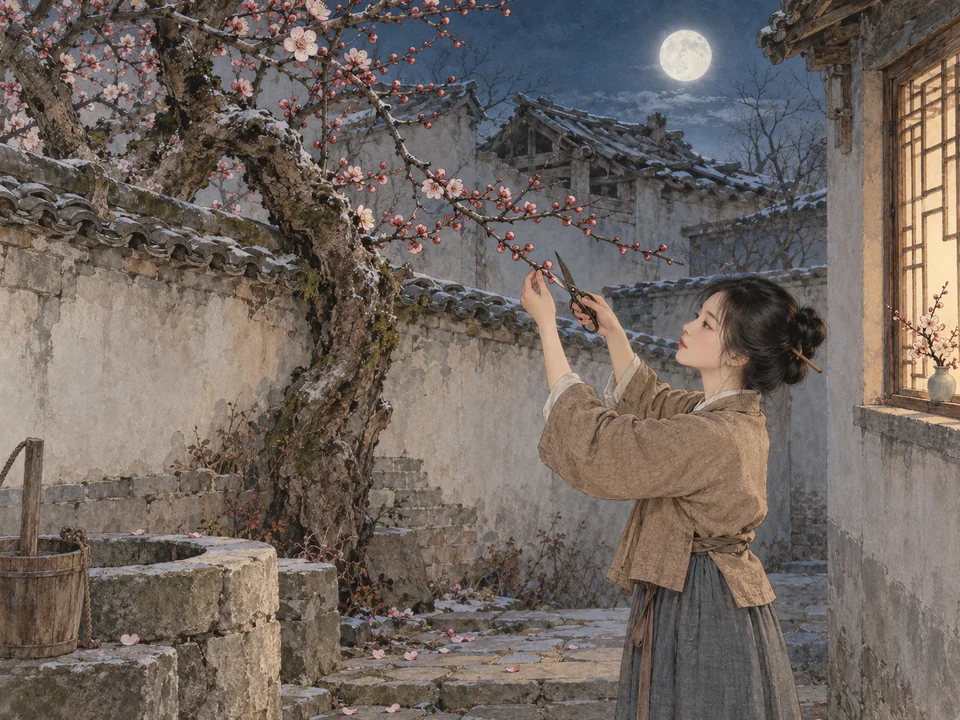
She stayed outside a while longer. Her left hand still supported the tip of the branch. It felt harder than a silk stem, and there was a damp chill where her thumb came near a bud. If she cut it, the flowers would open in her own vase. The owner next door, at least, couldn't take that branch away. But the tip might still grow farther if she left it there. Whether it would still be here at this time next year was beyond anything half a bowl of water in a vase could promise. She moved her supporting hand away. The branch sprang gently upward, its buds touched the moonlight, and it was still again.
The scissors never came down, but her hand ached with cold. Gu Qing crouched by the well and laid the scissors flat on her knees. All at once she felt like a customer who had already paid and walked away empty-handed, still waiting for someone to make up the difference. She disliked the thought and raised her head to look at the window. Grandmother’s bed was just inside. The wick was turned low, and no shadow showed on the blind.
She thought that in a little while she might go tell Grandmother she hadn’t cut it. As if saying so aloud would put Grandmother at ease and make her leave the business of keeping the tree in Gu Qing’s hands again. But she sat until her feet went numb, and in the end all she did was take the damp cloth indoors and pour the water from the vase back into the basin she used for watering flowers. The little chip in the rim scraped the back of her hand. She felt it with her fingers and did not look for another flower to hide it.
Shen Su hadn't been sound asleep. Hearing the water, she asked if it was cold outside. Gu Qing said it was. Her grandmother told her to wipe the scissors dry or the blades would rust. Gu Qing stood at the table, startled for a moment. Her grandmother had already turned over as though that was all she had to say. Gu Qing wiped the scissors and put them back in the sewing pouch they shared. Her fingers were still cold when she pressed them against the stitching on one side, leaving a faint mark.
The moon stayed bright late into the night of the fifteenth. The broken door panel cleared out next door cast a shadow on the wall. Even after lying down, Gu Qing could still make out the plum branch. She had left it where it was, and it seemed scarcely any safer for that. She remembered Mr. Ding saying he could read the words but couldn't tell people what to do. She remembered Wen Jichang saying the cart had trouble turning, and Auntie Chen's knitted brow as she rubbed mud spots out of other people's washing. What Gu Qing had done best all these years was cut cloth to the shape she wanted. No pair of scissors could cut the needs of the living people before her to a single line.
Before it was fully light, she got up to heat water. Shen Su was still sitting under the quilt. Gu Qing moved the shoes her grandmother usually wore over to the brazier first, without asking her to stay in that day. She picked up the three little bundles of fallen blossoms from the night before and put them in her basket, planning to drop them off at Auntie Chen's on her way and then go around to find the Wens. The bundles were so light she hardly felt she was carrying them. She left the narrow-necked bottle on the shelf.
As Gu Qing was leaving, Shen Su called her back and told her to put the outermost silk plum spray at the bottom of the basket so the blossoms wouldn't bump against the wall all the way. Gu Qing moved it and said she was only going to ask about the papers today. If they agreed to lend them, she would ask Mr. Ding to read them. If they refused, she would first hear them out. Grandmother nodded, folded the old pattern paper Sister Ji wanted into a little square, and set it by the edge of the basket. If she passed the silk shop, she said, she should return that first, so nobody would think she couldn't bear to part with a scrap of old paper.
Gu Qing took the template and found the paper thicker than she had expected. On the back she could still see faint traces of other patterns that had once been laid over it. She kept to herself what she had considered doing the night before, and whether she thought her grandmother ought to return the paper. She kept the two things separate, the fallen blossoms in the basket and the template in her sleeve. On the other side of the wall someone pushed open the newly swept courtyard gate. Its wooden pivot creaked, and she followed the sound next door.
· End of chapter ·
Written with AI assistance, this original book expands on Wang Anshi’s “Plum Blossoms” and this site’s original short story “Spring Breezes Are Not for Sale.” The characters, commercial affairs, geography, and chronology are fictional; this is not a biography of the poet. It preserves the original story’s central choices concerning saving the tree, the scentlessness of silk flowers, and a grandparent and grandchild viewing lotuses.
Comments
Loading comments…
Have something to say?Sign in to comment →