
A Novel of Craft and Society in a Historical Setting
Inside the Circle of White Lime
Ku Wuji · AI Writing · 10735 characters · about 12 min
The white lime fell first beside the Gu family's well. Just a little powder drifted in on the wind, leaving a pale spot barely visible on the wet bricks. Shen Su was pulling up the well rope, and as Gu Qing took the bucket from her, she heard someone beyond the wall say to measure another foot west. Without even setting the water down properly, she stepped onto the wooden bench they used for airing quilts and peered over the wall.
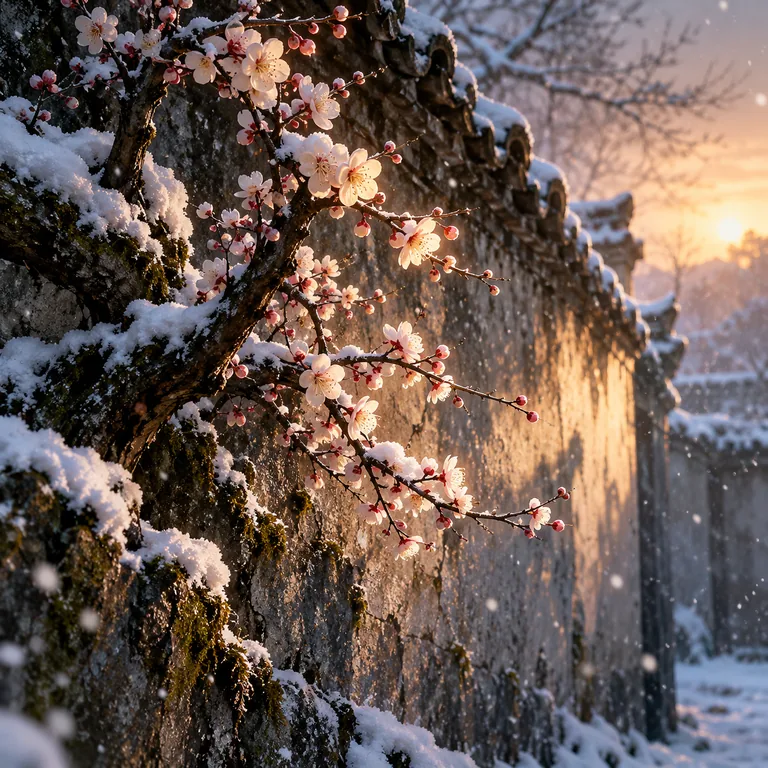
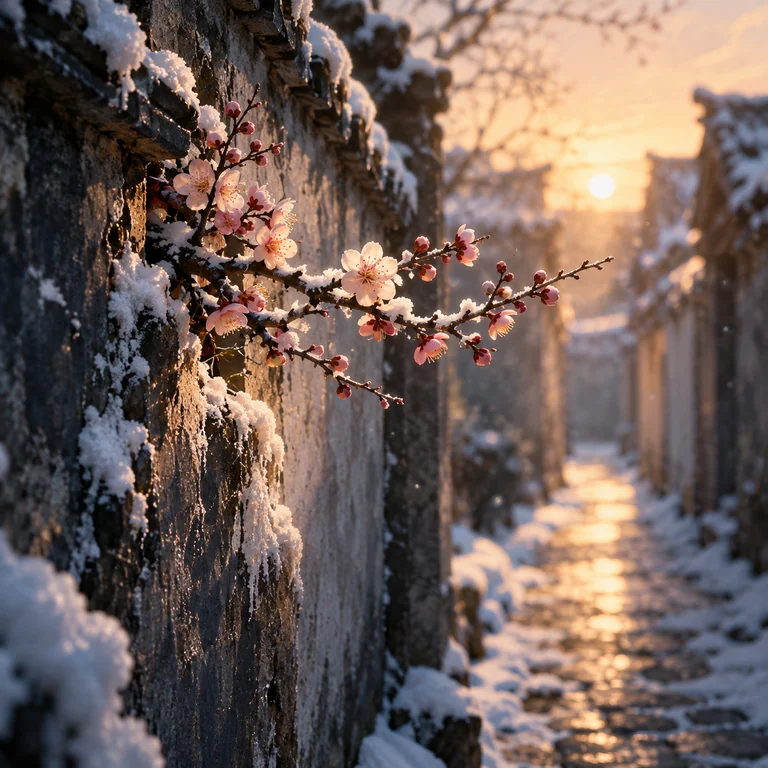
Three people stood around the plum tree. The man in the short tunic who'd measured the door yesterday was drawing a ring in lime slurry. The line ran along the foot of the old wall, and a thick hemp rope was tied high on the trunk. It was a small tree, but its branches knew how to reach. One stretched over the wall, another slanted into the old passage, as though it had kept a place for each of the two households to talk. Once the lime ring took it in, those scattered branches suddenly looked very lonely.
“What are you doing?” Gu Qing asked.
The man carrying the lime bucket looked up and said they were moving the tree. Another told her to come down; the plaster had already come loose underneath, and who would be responsible if she broke it by stepping there? Gu Qing was standing only on her own wooden stool. She had meant to argue, but heard her grandmother call from behind and climbed down first. Carrying half a bucket of water, she went out of her own gate and around to the abandoned house’s open entrance. The direct way was really only across a wall, but going around through East Stone Alley added a fair little distance, and along the way she had to yield to a cart of empty baskets.
They were clearing old things out of the courtyard. Two broken door panels lay stacked by the north wall, and the ash from the old stove had been swept into a small pile. As a child Gu Qing had thought the place enormous. Now, standing among the freshly snapped chalk lines, she saw that a cart set crosswise would take up most of the courtyard. The stone lane outside the east gate was narrow too, and once a cart came in, it was hard to turn it around. The man delivering timber was waiting outside and had already called out three times for people to make way.
A man in his forties came out of the main house with an empty drinking bowl and asked if she was the neighbor to the west. He wore an ordinary brown robe and the edges of his shoes were caked in mud. Gu Qing had imagined that once a man bought a house, he could have other people keep him clear of all the dirt. Before she could answer, he introduced himself as Wen Jichang and asked to borrow a bucket of clean water. His family would arrive later, the tea things and cooking gear weren't all in place yet, and the workers had already put in half a day.
Gu Qing glanced toward the well and said they had water, but the tree couldn't be moved just because someone said so. Wen Jichang followed her gaze to the plum tree. After a moment he said it was going outside the city and would be spared the woodpile. There was room at the country house to leave a ring of open ground around it. Here the roots were cramped against the wall and a cart couldn't get through. He said it evenly, as though this had already laid their worries to rest.
“Where will it be moved?” Gu Qing asked.
“Ten li outside the city to the southeast, straight along the main road.”
“Who will look after it?”
“We'll hire someone who knows how to care for trees, of course.”
Gu Qing asked again what would happen if that person said they could tend the tree, but it died after being moved. Wen Jichang pressed his lips together. She knew her question was unwelcome, yet could not help asking. Looking along the white lime circle, she saw the thickest root disappear beneath the wall. On the other side was the patch where Grandmother loosened the soil each year with a little spade. If the person who knew how to tend trees looked only inside the circle, how would they know all this lay beyond the wall?
Wen Jichang handed his empty bowl to a worker and said he would go over himself. Gu Qing thought he was coming to identify the roots and quickly stepped aside. When they reached the Gu courtyard, he greeted Shen Su first and asked if she was the elder who had been tending the plum all these years. Shen Su sat under the veranda, spreading a handful of fallen blossoms on a piece of old blue cloth. The petals were wet and a little translucent at the edges. She didn’t say she’d always tended it. She said she went over when there was a dead branch, and in dry weather she gave it a ladleful of water when she was passing.
“You've gone to a great deal of trouble over the years,” Wen Jichang said. He pulled twenty copper coins from his sleeve and set them on the corner of the table. “Things are being moved around now, so you won't have to carry that burden anymore. We ought to acknowledge what you've done. We can't simply take it for granted.”
Gu Qing heard the twenty coins strike together with a sharp clink. She knew better than anyone how much charcoal or silk that amount would buy. Yet looking at them now, she found how little there was almost painful to see. Shen Su folded the two corners of the old cloth together without touching the money. Having a tree by their well meant a cool place to sit in summer, she said. She hardly counted that as doing anyone a favor. Wen Jichang drew his hand back and left the coins on the table.
Someone outside the courtyard called for Shopkeeper Wen again. It was a woman in a somewhat worn dark blue-green cloak, with a cloth sleeve full of papers tucked under one arm and two coarse earthenware cups in her other hand. As soon as she came in, she asked if she might have some water, and Gu Qing hurried to say yes. The woman thanked her and set the empty cups by the well before turning to tell her husband that the cart at the door could no longer stay there. It was blocking the laundresses’ way back into the lane.
She let the remark pass without urging Shen Su to take the money. When she lifted her cloak, Gu Qing noticed a fresh patch at the cuff. The stitches were fine, though the colors did not quite match. Wen Jichang seemed a little put out by how abruptly she had arrived and told her to have the driver unload the wood first. She asked where it was to go. They had to decide on a spot before making people carry it in only to carry it out again. Shouting a few words would hardly save on wages. At that, Wen Jichang followed her out, leaving a sentence about the courtyard wall half finished.
Gu Qing brought the water to the door and heard that the woman’s surname was Xu. People called her Madam Xu. Gu Qing spilled a little as she poured, and Madam Xu reached out and cupped a palm underneath, catching the drops before they could fall on the papers under her arm. She did it with the ease of someone who found a safe place every day for things other people had yet to get a firm hold on. Gu Qing had meant to ask her to put in a word for the tree. When she opened her mouth, she asked instead when they planned to move it.
“We haven't settled on the work yet,” Madam Xu replied. “First we have to clear the place out. The trading house has to open on the sixteenth of the first month. Our old warehouse lease on the east side is up, and we can hardly put it off a single day.”
The sixteenth of the first month. Gu Qing counted it out in her head. It wasn’t far off. She remembered how she’d still been sulking that morning over a little stall, while these two had a whole property to put in order before the New Year. She couldn’t tell just then whether such a tight schedule was good or bad: they might be too pressed to listen to the two of them talk about flowers, or they might be pressed enough to leave other things in place if it saved them time.
After the Wens left, Shen Su pushed the money from the corner of the table toward the door. Gu Qing said she would return it when he came back. Grandmother said there was no need to hold him up over it. He had come to borrow water and could do without being questioned over it. Gu Qing felt her face grow hot and asked if that meant they could just take the tree. Shen Su left the question unanswered and got up to clear the empty bowls. As her knee bent, her hand went to the edge of the table for support.
Gu Qing hurried over to help, but her grandmother gently turned her arm away. She steadied the bowl and said her leg hurt, but she still had strength in it. Standing beside her, Gu Qing felt that all day people had been cutting her off. She went to straighten the worktable in a sulk and gathered up several long bamboo strips used for tying flowers that were leaning against the wall. A plum bud, fallen who knew when, was caught on one of them.
“What they bought was the house,” Shen Su said at last. “Just because I water the tree doesn't mean it has to do as I say.”
“I never said it had to listen to me.”
“What do you plan to do tomorrow, then?”
Gu Qing said she would ask the broker, look into what they had bought, and find someone with authority over such matters. At the third point she herself hesitated. She had never been to the government office, much less knew who was responsible for a plum tree leaning against a wall. Shen Su glanced at her without laughing and simply handed her the little scissors, saying that if she really meant to ask, she should first tuck in the loose thread at her cuff so people would see something besides that small worn spot.
Scissors in hand, Gu Qing wanted to tell her to stop finding fault with her. She looked down at her cuff and saw that the thread really had broken and the old cloth showed through underneath. In her flower-making days, Grandmother had always liked to change into her best outer garment when customers came. If someone called her an old sewing woman, her expression never changed, though after they left she could go about stony-faced for the rest of the afternoon. Gu Qing had never understood as a child. She understood a little now, but with the tree about to be dug up, she had no wish to spend another thought on that inch of thread.
At dusk, the workman who had measured the doorway brought back the bucket and took the twenty cash with him. Worried the Gus might misunderstand, he said the shopkeeper had meant it kindly and hadn't been trying to buy those few petals. Gu Qing heard him trying to preserve his employer's dignity, said she understood, and asked whether it was a gardener who had marked the circle around the tree in lime that day. The man shook his head. He was a carpenter, he said. If the tree really was to be dug up, they would have to call in Master Qiu. He wouldn't presume to judge how thick the roots were or where to cut.
Auntie Chen came back from the mouth of the lane with cloth still damp over her arm, flicking water onto the ground as she walked. She stopped the worker and asked whether they'd be blocking the lane again tomorrow. He said there'd be more deliveries, of course, until everything was unloaded. Auntie Chen held the outermost piece of cloth up to him to show him the mud a wheel had left on it. She had to wash that cloth clean for a customer, and now there was no getting out of another trip to the well that night.
Gu Qing said the new owners meant to open a warehouse and there would probably be carts coming and going all the time. Auntie Chen turned to look at her. “You knew there’d be carts all the time, and all you asked about was the tree?”
Auntie Chen spoke mildly, but Gu Qing had no answer. Their families had been neighbors for years. Auntie Chen often brought salt home for Grandmother, and Gu Qing had mended a hair flower for her daughter. Today she had been so taken up with the plum tree that she had failed to notice the whole rack of wet cloth from the mouth of the lane had been moved to the ground. She got Auntie Chen a basin, mixed some warm water for her, and helped rub out the mud spots. The longer she rubbed, the clearer it became that other lives besides hers and Grandmother’s were lived beneath that tree.
Gu Qing’s anxiety eased a little. The ring of white lime did not mean a shovel would come down tomorrow after all. She told her grandmother, who only gave a quiet murmur and went on adding flowers to the old cloth. Gu Qing suddenly reached out, clasped that hand with its prominent knuckles, and said she was sure she could think of a way. Shen Su looked at her. She neither agreed nor discouraged her. After a long while, she withdrew her hand and said the water was still on the stove. Gu Qing shouldn’t just sit there looking at her.
At night the wind came through the cracks in the wall between the two houses, carrying the acrid smell of fresh mortar. Gu Qing adjusted the wick and put a few stitches into her cuff by lamplight, much coarser than the ones she used on her flowers. Halfway through, she pushed open the window to look at the plum tree again. Thick hemp ropes hung among the branches, and the white lime made a faint circle in the dark. It occurred to her that if she cut a branch first, there would be at least one thing that wouldn't all be carried away by other people. Once she had the thought, it clung to her palm along with the scissors and wouldn't let go.
· End of chapter ·
Written with AI assistance, this original book expands on Wang Anshi’s “Plum Blossoms” and this site’s original short story “Spring Breezes Are Not for Sale.” The characters, commercial affairs, geography, and chronology are fictional; this is not a biography of the poet. It preserves the original story’s central choices concerning saving the tree, the scentlessness of silk flowers, and a grandparent and grandchild viewing lotuses.
Comments
Loading comments…
Have something to say?Sign in to comment →