
A Novel of Craft and Society in a Historical Setting
The Flowers Left on the Table
Ku Wuji · AI Writing · 10190 characters · about 11 min
The final forty flowers reached Yao's shop before the sun had cleared the eastern wall. Gu Qing set the box in its old place in the rear courtyard without following it to the inspection table. She kept looking from the window to her newly empty hands. This time she had delivered a day earlier than before, leaving time to remake a few pieces, yet she still feared hearing the box lid close inside.
Madam Han came out to call her. She picked up the slip inside the box, checked both lines of names, then showed her the four rows of flowers already laid out. Twenty stems had flat petals and twenty had curled ones. None showed white marks after being bent to test them. On just one stem the thread left after fastening was a little too long, and she could shorten it then and there. Gu Qing took out her needle and sat down to do it. She drew out the short length of thread, and only when the flower base held firm did the sweat on her palms begin to dry.
Yao Liao paid two hundred and forty cash, without a gratuity beyond what they'd agreed. As Gu Qing threaded the coins onto a string, Yao Liao told her to wait and fetched the original paper for the two hundred stems. She drew a line beneath the figures for the forty-four accepted from the first batch and the forty from each of the next two. The advance of a hundred and sixty had been fully deducted from the first batch. There was no outstanding debt, and the spoiled flowers were still Gu Qing's responsibility. Each kept a copy. Gu Qing saw the names of two other flower suppliers beside hers and let herself pass over the question of whether she'd have come first if she'd made all two hundred.
On the way back she went around to the hat-trim shop and told Xiaoman all twenty stems had been accepted. Xiaoman was replacing a hidden clasp on a black hat. Without stopping, she said she'd known that spot wouldn't split. What she'd worried about was Gu Qing being unable to resist adding another layer. Gu Qing glared. Xiaoman looked up and smiled, then asked her to fetch a scrap of cloth and help support the other side. She sat on the little stool and held it for a while, keeping no tally of who owed whom for this small favor and taking nothing off the wages she'd owe later.
From the twenty-sixth to the twenty-eighth of the third month, the three days of the Spring Flower Fair, Gu Qing took her everyday flowers to the West Market and passed up the extra table at the guildhall. All sorts came through the market, and smoke from the griddle stall drifted over, drawing customers before the colors on her tray could. She put up a thin board against the wind and laid out only the small flowers at eight cash apiece. For the more intricate sash flowers, she kept samples without making up stock. A woman who'd bought mustard greens looked through the flowers twice and said white wouldn't stay clean. Gu Qing asked what it was for. Hearing it was to be sewn onto a child's hat, she took out an old red one for the woman to press and see how it held.
The girl the woman had brought refused to wear red and wanted yellow. Gu Qing showed her the yellow one, and the girl took a fancy to the green beside it. Her mother urged her on from behind. Gu Qing was tempted to save them the trouble and choose one for her. She lifted her hand, then stopped herself. In the end the girl chose the faded red stem she had seen first, as though she had forgotten saying she didn't want it. Gu Qing laughed with a sigh and charged the usual eight cash, with nothing extra for all the talk it had taken to come full circle.
Over three days she sold ten stems for eighty cash. Short-term rent was eighteen and materials about twenty, leaving forty-two, with her own three days of walking back and forth still to account for. It was a modest success, enough to buy rice and thread and to show her that people still wanted what her hands made away from the fair's display tables. At the end of the month she took in a separate two hundred for Luo Yi's first ten boxed flowers, and after deducting the materials, labor, and design for the batch, she was left with just over half. Gu Qing laid out all the money once before dividing it among three little pouches for household expenses, working capital, and travel.
She didn't count every cash in the remaining pouches as profit. On a separate scrap of paper she reckoned up the spoiled flowers, wasted materials, purchases on credit, and the credit for supplies she'd got in exchange for giving up half a table. Retail sales were more erratic. Sometimes she'd go out twice without selling a flower, sometimes neighbors bought on someone's behalf and three flowers went out in one day. From the end of the second month, she recorded just one total coming in and one going out each evening. The reckoning was rough, but she stopped comforting herself with the full value of orders she hadn't been paid for. At that point the household had about four hundred cash on hand. By the end of the month, payments for new small batches had begun to come in, and the travel pouch was finally filling.
On the evening of the twenty-eighth of the third month, she returned to find that her grandmother had just washed her hair. Half-dried white strands hung over her shoulders. Shen Su’s hair had been thick when she was young, and she had always refused to cut it short afterward. Washing it took water, and Gu Qing had usually chosen an evening after finishing her work to do it for her. This time the old woman had washed it in the afternoon and let it dry slowly by the window, wrapping a pale cloth around the damp part. Half a basin of warm water used for soaking stood at her feet.
Gu Qing put away the last empty box and left the next bundle of material unopened. She took three flowers from the cabinet for her grandmother to choose from, a white one, a pale brown one, and the lopsided light blue one her grandmother had picked out a few days earlier. Shen Su said her hair was still wet and the flowers could wait. Gu Qing sat down beside her, separated a lock of the loose white hair, and asked whether she should comb it gently now or wait until it dried.
The bronze mirror was only the size of a palm. They crowded around it, and neither could see her whole face. Gu Qing wanted to polish it, and Shen Su said polishing wouldn't turn it into a window. Gu Qing took a soft cloth to it anyway. She rubbed for a good while, yet their faces stayed dim and yellow in the mirror. The little ink-like smudge on her own forehead, though, showed up clearly. Her grandmother asked if she had been to the Zhous’, then laughed and asked why, of all the habits she could pick up, she had to copy the way people there got soot on their faces.
Gu Qing snatched up the blue flower and made to press it onto Grandmother's head. Shen Su dodged, and instead of being pinned in place the flower caught by Gu Qing's own ear. They looked in the mirror together. The flower was too big and covered half of Gu Qing's face, like that spring greens hat at the sample showing. They laughed until they could barely hold the mirror steady. Shen Su's knee still hurt, and when they finished laughing she still had to move her leg slowly. Gu Qing took the foot basin away first so she wouldn't step in it.
In the end the old woman chose pale brown over pale blue. The brown was close to the color of her hair, with a thin line of warm yellow hidden in it. From any distance it looked like she had nothing on. Gu Qing was about to say the blue looked livelier, but when she saw her grandmother turn her head in the mirror, she threaded the needle and gently pinned the flower behind her ear. Shen Su was pleased, then suddenly objected that the pin was too bright and would show from behind. Gu Qing had to take it off and put in a dark thread loop instead. Holding back a laugh, she said this customer really was hard to please.
“Did I pay for it?” Shen Su asked.
“This one's mine to give. If you wear it out, you have to tell people Gu Qing made it.”
Her grandmother agreed with great solemnity, then added, “The design isn't Xiaoman's, so I can do that.” Caught out, Gu Qing raised a cloth to cover the mirror. Shen Su shielded it and said she didn't owe anybody a mention by name just now. In the end Gu Qing left the mirror uncovered. She leaned against the bed with the cloth in her hand, and when the laughter passed, she relaxed so suddenly that even her shoulders sank.
When the comb fell into the bronze basin, Gu Qing brought up the guild hall again. Someone had worn a flower at the back of her hat, she said, and from where Gu Qing stood in front, she couldn't see it. She had assumed the customer had bought it for nothing. Shen Su said people used to wear flowers like that too. They might look as though they were walking all alone out in front, but whoever followed saw the flower first. As she spoke, she lifted her hand to show the spot, her fingers so deft they hardly seemed to belong to the person who had needed a different thread loop a moment ago. Gu Qing asked how she had worn flowers in her youth. The old woman said she had made them all for customers. She had been far too busy herself.
“Then how do you know exactly where it goes?” Gu Qing asked.
Shen Su's hand paused. She laughed first and admitted there had been one time when she wore a new design to a relative's dinner. She'd had no mirror then and had dragged Sister Ji half a street asking if it was straight at the back until her friend wanted to pull the flower off her. At Sister Ji's name, Gu Qing let the question of who had made the design first go. She simply moved Grandmother's flower a little farther back to give her a chance to try it that way too. The old woman couldn't see it in the mirror, so she told Gu Qing to stand behind her and look, then asked three times in a row if it was straight. By the third answer Gu Qing was already a little impatient. Shen Su turned and caught her eye, and both of them burst out laughing.
That evening they ate tofu with the edges fried a little dark and a bowl of scallion soup. Gu Qing was halfway across the plate with her chopsticks when she saw the largest piece was still there. She instinctively went to give it to her grandmother, who picked up a small piece first and said the large one was too much for her. So Gu Qing split the large piece and they each took half, without pushing it back and forth to see who would yield. After eating, they left the sample flowers where they were, washed the dishes, and sat in the courtyard listening to the Wens close their gate.
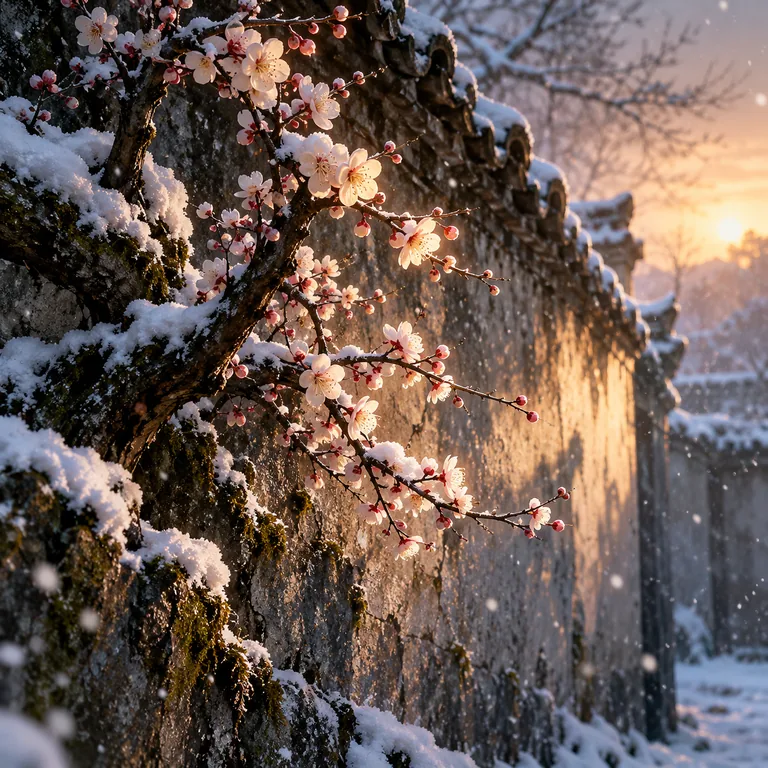
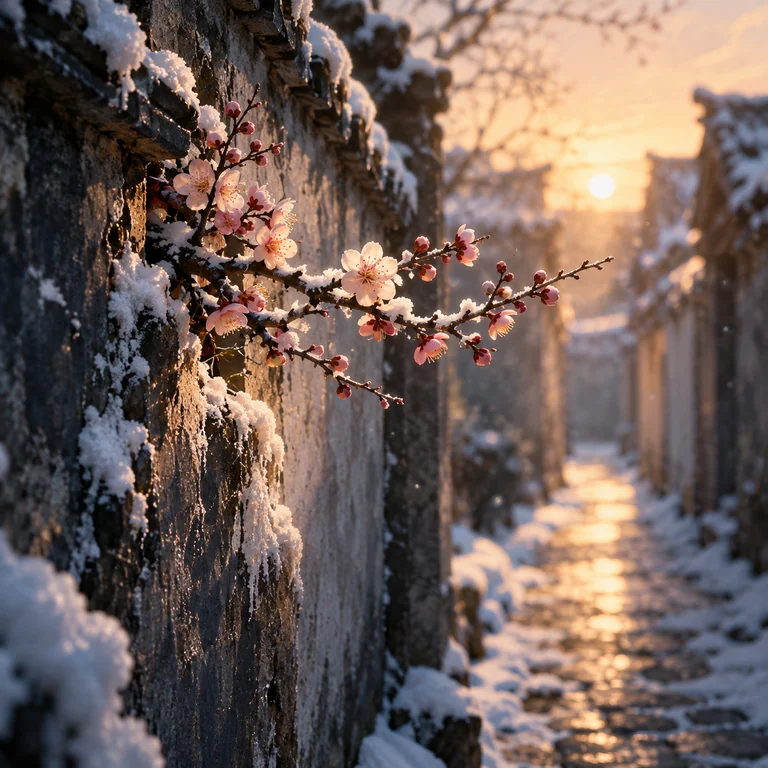
The warehouse had settled into a sequence of sounds. First the carts stopped, then the gate was barred, and finally came Xu Tan’s footsteps heading to the back courtyard after she lit the lamps. The plum branches had leafed out, casting fine shadows one after another across the curved wall. Gu Qing still looked up sometimes and wondered what the place would be like if the tree had been moved, though she no longer had to think about it every night. The tree could go a night without her watching it and still be there, and she could go a night without working and still have food to eat.
Late that night, Shen Su took off the flower. Afraid it would get crushed, she found a shallow saucer for it on the dining table. Gu Qing wanted to put it in the cabinet where she kept her sample flowers, but her grandmother waved her off. She meant to wear it again tomorrow, so there was no need to put it somewhere unfamiliar. Gu Qing left it there. The brown flower rested against a ring of white porcelain. Beside it were two upturned water bowls. It had no paper tag and no price. On her way to blow out the lamp she looked back once more, and just before the light went out, the flower seemed to turn a little toward her.
On the morning of the twenty-ninth, Luo Yi took away the last incense box in the batch and arranged to come for the next batch on the seventh day of the fourth month. After seeing her out, Gu Qing took out the fare she had asked about at the boat landing. The slip had been tucked among her flower patterns and had a little paste on one edge. She peeled away the dried paste and put the slip by itself in her traveling bag. Her grandmother saw her and made no effort to hurry her, staying at the table to straighten the thread loops on her own flower. Gu Qing asked whether, if it was fine tomorrow, she might like to try a cart ride out to the outskirts first. The old woman put down her needle, thought carefully, and said she would take the hat they had just mended.
· End of chapter ·
Written with AI assistance, this original book expands on Wang Anshi’s “Plum Blossoms” and this site’s original short story “Spring Breezes Are Not for Sale.” The characters, commercial affairs, geography, and chronology are fictional; this is not a biography of the poet. It preserves the original story’s central choices concerning saving the tree, the scentlessness of silk flowers, and a grandparent and grandchild viewing lotuses.
Comments
Loading comments…
Have something to say?Sign in to comment →