


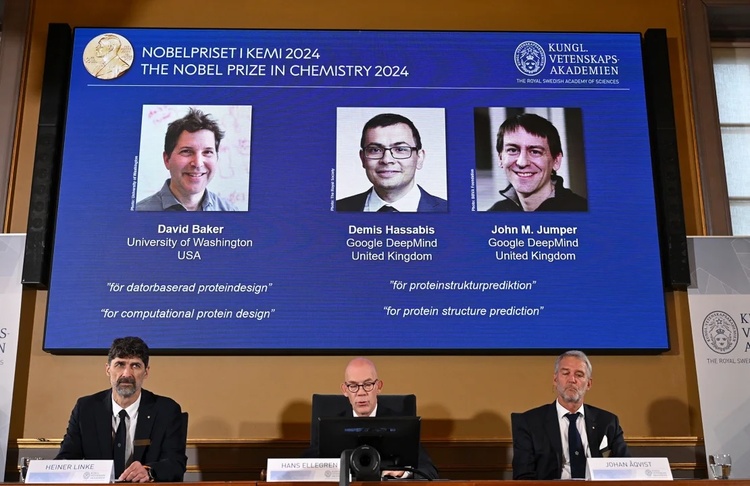
Half of the 2024 Nobel Prize in Chemistry was awarded to David Baker,“for contributions to computational protein design”; the other half was jointly awarded to Demis Hassabis and John M. Jumper, “in recognition of their achievements in protein structure prediction.”
David Baker is the director of the Institute for Protein Design at the University of Washington and is acclaimed as a pioneer in protein design. Starting in 2003, he successfully designed various innovative, entirely new proteins, including Top7, with wide applications in drugs, vaccines, nanomaterials, miniature sensors, and other fields. As early as 1999, he proposed the protein structure prediction algorithm RoseTTA, preceding Deepmind's AlphaFold.
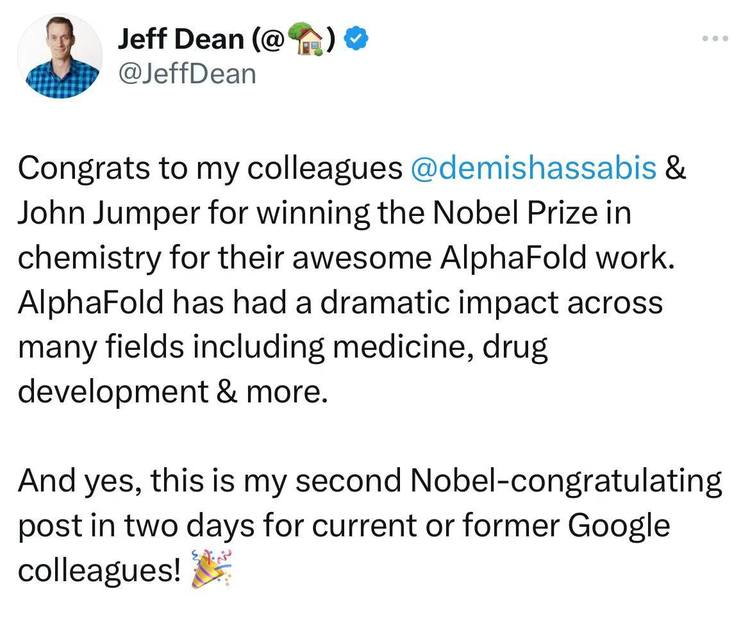
The other two laureates are even more familiar. Demis Hassabis is the co-founder and CEO of Google DeepMind, and John M. Jumper is currently a director at Google DeepMind.By leading the team that developed the AI model AlphaFold 2, the two solved a problem that had troubled the scientific community for 50 years: predicting the complex structures of proteins from their amino acid sequences.
Proteins are life's fundamental chemical tools. They control and drive all biochemical reactions and play key roles as hormones, signaling substances, antibodies, and building blocks of tissues. In proteins, amino acids are linked together in long chains that fold into three-dimensional structures. Since the 70s, researchers have tried to predict protein structures from amino acid sequences, but progress remained slow until DeepMind's astonishing breakthrough four years ago.
In 2020, Demis Hassabis and John Jumper developed AlphaFold 2 based on the original AlphaFold. It can predict the structures of almost all 2 hundred million proteins identified by researchers, has been cited more than 2 ten thousand times to date, and has been used by more than 200 million people from 190 countries, driving major advances in fields including malaria vaccines, cancer treatments, enzyme design, and antibiotic resistance research. In fact, before the Nobel Prize, the two had already received last year's Breakthrough Prize in Life Sciences, known as the “Oscars of science,” and the Lasker Award, regarded as a “Nobel Prize predictor,” in recognition of their outstanding contributions to basic medical research.
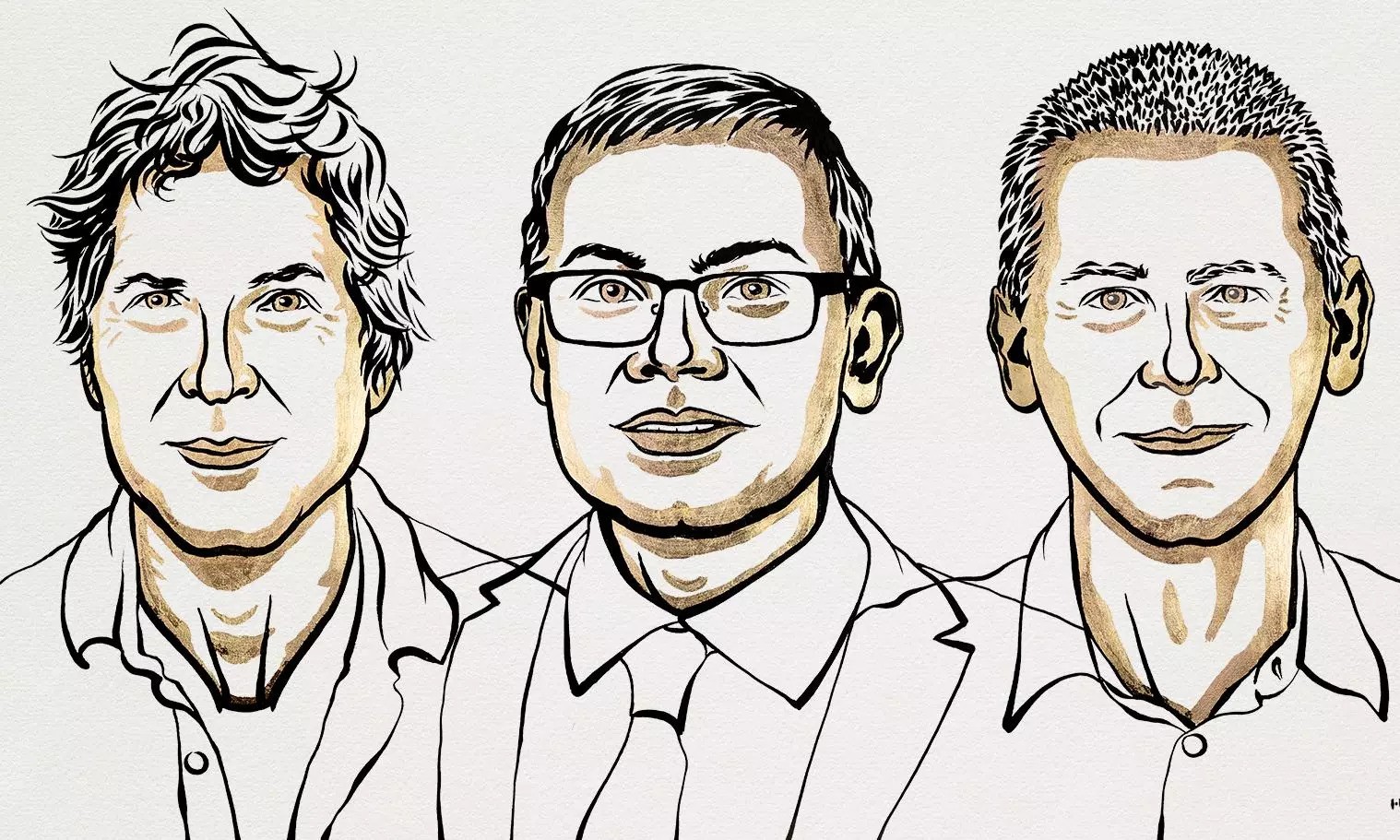
The Royal Swedish Academy of Sciences stated, “Without proteins, life could not exist. Now that we can predict protein structures and design our own proteins, this brings enormous benefits to humanity.”
After learning of the award, Google DeepMind’s official account promptly posted to “share the good news.”
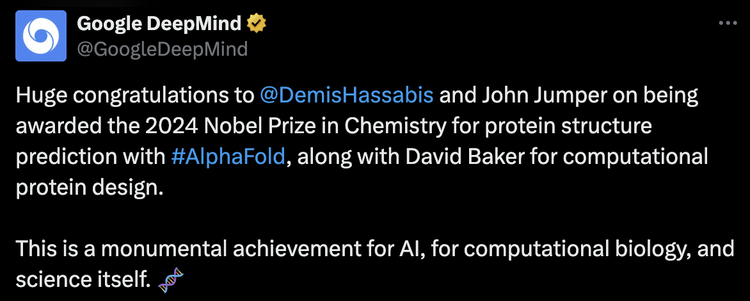
Demis Hassabis also issued a statement saying:
“Receiving the Nobel Prize is the honor of my lifetime. Thank you to the Royal Swedish Academy of Sciences, to John Jumper and the AlphaFold team, to the wider DeepMind and Google teams, and to all the colleagues who contributed to this moment. I have dedicated my career to advancing AI because of its unparalleled potential to improve the lives of billions of people. AlphaFold has already been used by more than 200 ten thousand researchers to advance critical work, from enzyme design to drug discovery. I hope that in the future we will see AlphaFold as the first demonstration of AI's immense potential to accelerate scientific discovery.”
John Jumper then said: “This is an important demonstration that AI can accelerate scientific research and ultimately help us understand diseases and develop treatments. This work is due to the outstanding team at Google DeepMind, and this award also recognizes their exceptional contributions.”
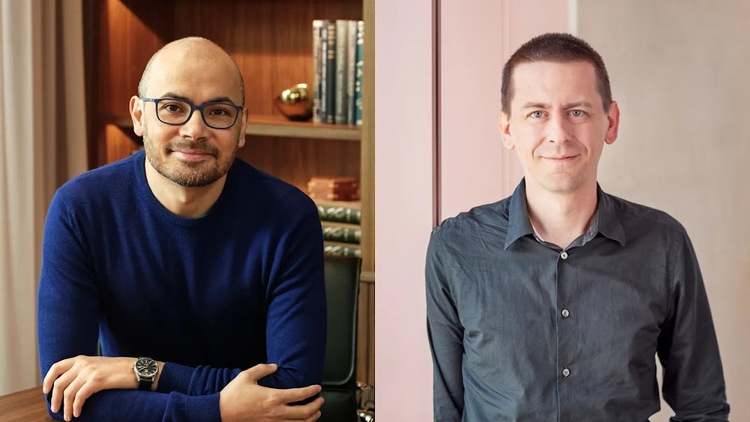
At this point, including Geoffrey E. Hinton, the “godfather of AI” who had already won the physics prize and sparked extensive discussion, the common connection behind this year's most closely watched laureates was clear—Hinton was a central figure in Google Brain, which carried Google's early AI ambitions, while Demis Hassabis is the driving force behind Google DeepMind, which has carried Google's AI research agenda in recent years.
No wonder even the “Nobel party” was held right on Google's campus.
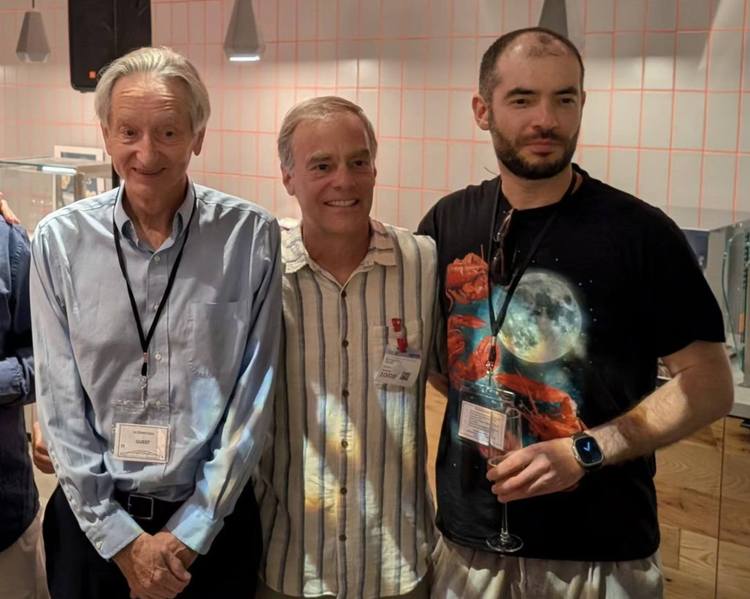
With Nobel Prizes going to AI scientists in succession, Google has also been “winning big.”
Google's Offensive
Looking at the timeline, Google was definitely the earliest major corporate player to enter artificial intelligence.
Although many versions of the story portray the secret auction held at a casino hotel beside Lake Tahoe in the United States in the winter of 2012 as fair competition among the three technology giants Google, Microsoft, and Baidu, along with DeepMind, for DNNResearch—the small company Hinton had just founded, which had no tangible products beyond a few papers—in hindsight, the outcome was already determined. One reason is that the auction itself partly originated in a push from Google 6 months earlier.
In June 2012, Google Brain publicly launched the “Google Cat (The Cat Neurons)” project, using algorithms to identify cats in YouTube videos. The project was led by Andrew Ng, with Jeff Dean participating and strong support from company cofounder Larry Page. The month was 6.
The project built a large neural network with 10 hundred million connections and trained it on 1000 ten-thousand unlabeled videos from YouTube using 16,000 CPUs. Through unsupervised learning, the system successfully taught itself to recognize cat faces with an accuracy of 74.8%, and could also recognize other objects, including human faces.
However, Andrew Ng chose to step back while things were going well in the later stages of the project. Before leaving, he recommended his teacher Hinton to Google as his replacement. Hinton said he would not leave the university and was only willing to “spend a summer” at Google. And so he became the oldest intern in Google's history.
As an authority in deep learning, Hinton quickly recognized the project’s flaws, pointing out that Google Cat “ran the wrong neural network and used the wrong computing power.” So, after his brief “internship” ended, Hinton immediately brought together his students Ilya Sutskever and Alex Krizhevsky to form a team and develop a new neural network architecture, AlexNet. They entered the 2012 ImageNet image recognition competition with results trained using just 4 NVIDIA GPUs, ultimately achieving a groundbreaking victory with an accuracy of 84%.
In month 10 of the same year, Hinton's team formally introduced the winning algorithm, AlexNet, at a computer vision conference in Florence. An academic team had defied the odds to defeat Google despite an enormous disparity in hardware and research resources, causing a sensation throughout academia and industry. The AlexNet paper also became one of the most influential papers in computer science history, with over 120,000 citations.
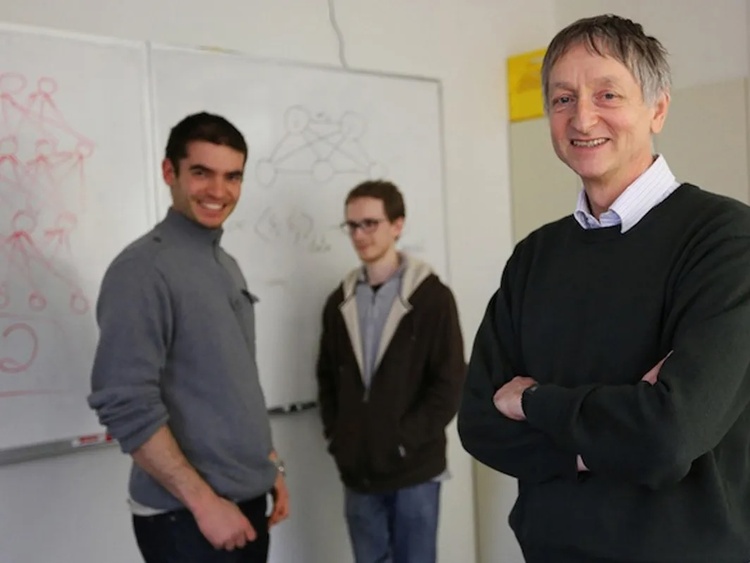
Next, the three registered their company, DNNResearch. The subsequent bidding unfolded even more naturally. When the valuation reached 4400 ten thousand US dollars, Hinton halted the auction and formally joined Google with his two students, serving as Google Brain’s vice president and an engineering fellow.
At the time, Hinton wrote in a statement: “I will continue teaching part-time at the University of Toronto, but at Google, I can see how we handle computing on an enormous scale.”
During his ten years at Google, which lasted until month 5 of 2023, Hinton continued researching large-scale artificial neural networks, making foundational contributions to the underlying technologies of modern AI systems such as Bard and ChatGPT. He also helped develop the open-source machine learning library TensorFlow, advancing AI capabilities in areas such as image recognition and language understanding, and brought deep learning technology into widespread use across Google's products and services.
Google has never slowed its accumulation of talent and technology. Just two years after acquiring DNNResearch, it also acquired DeepMind, founded by Hassabis, which had been one of its rivals in that bidding contest.
Reportedly, Google even chartered a private plane to take Hinton to London to “inspect the goods,” specially modifying a seat to address the back pain that prevented him from flying. Facebook, which Google had edged out at the time, turned to hiring Yann LeCun, one of the “three giants of deep learning,” at a high price after missing out on DeepMind.
The Story of Deepmind
Turning to DeepMind, even before Google acquired it, the company had run into financial difficulties. It kept burning through money without finding a sustainable business model and was even on the verge of bankruptcy.
Google's US$600 million acquisition saved DeepMind, retaining its core technical team while providing powerful computing resources, including cloud computing platforms and data center support. This enabled DeepMind to use greater computing power to train deep neural networks, substantially improving computational speed and model accuracy, particularly during AlphaGo's development. Google also provided specially designed TPUs (Tensor Processing Units), further optimizing the efficiency of training and inference for deep learning models. TensorFlow, a foundational AI tool, was also widely used in DeepMind's research, helping improve AlphaGo's performance.
AlphaGo is an AI Go program developed by the DeepMind team. By analyzing millions of game records and using self-play for reinforcement learning, it mastered complex Go strategies and became capable of surpassing the world's top human Go players. In 2016, AlphaGo defeated world Go champion Lee Sedol by 4 to 1, becoming famous overnight and astonishing the world.
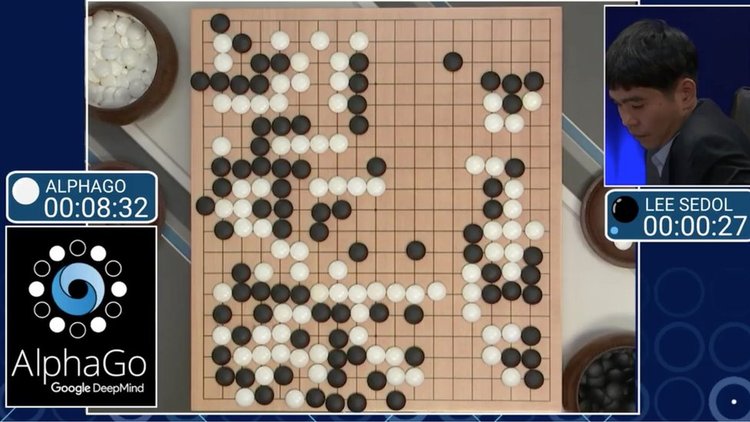
In Hassabis’s eyes, however, using board games to demonstrate AI’s potential to solve complex problems was only the beginning. More important was using it to guide general-purpose learning systems in tackling real-world challenges, thereby truly improving human lives, transforming industries, and advancing science.
Within a few months, DeepMind quickly hired biologists and assembled an interdisciplinary team focused on solving the protein-folding problem, ultimately bringing about the AlphaFold project in 2018. After multiple iterations, AlphaFold has transformed biological research through its groundbreaking ability to predict protein structures, demonstrating AI's tremendous potential for scientific applications.
In 5 this year, Google Deepmind made another official announcement, jointly introducing the next-generation protein prediction model AlphaFold 3 with Isomorphic Labs; the accompanying paper landed in Nature.
Compared with previous versions, AlphaFold 3 has not only advanced protein folding prediction but also, for the first time, achieved highly accurate predictions of the structures and interactions of biological molecules including proteins, DNA, RNA, and ligands. This breakthrough helps scientists understand disease mechanisms and life processes more deeply while substantially reducing research and development time and costs. From developing renewable materials to accelerating drug design and genomics research, AlphaFold 3 has opened up a broader range of applications in the field of biomolecules.
In addition, the team launched a free platform called AlphaFold Server, based on AlphaFold 3, for scientists worldwide to conduct noncommercial research, further broadening access to scientific exploration.
Through DeepMind, Google continues to attract top research talent from around the world and provides long-term funding, allowing researchers to focus on breakthrough research without relying on short-term commercial returns. Google also grants DeepMind a high degree of strategic autonomy, allowing it to freely choose its research directions. This independence and long-term support have laid a solid foundation for DeepMind's forward-looking research.
Beyond gaming and breakthroughs in biology, DeepMind also developed WaveNet, a realistic speech synthesis model used in Google Assistant, improving the voice interaction experience. Its vision-language-action model RT-2 enhanced robots' ability to perform tasks in diverse environments. Its research also addresses complex problems such as weather forecasting and nuclear fusion reactors, and advances computer algorithms through projects such as AlphaCode and AlphaDev.
Google’s reserves remain substantial
In today's AI competition, the rapid rise of high-profile companies such as OpenAI and Anthropic, and the “overwhelming dominance” of ChatGPT and Claude over Gemini, led people for a time to question Google's AI strategy. Particularly in the commercialization of generative AI products and developer tools, the rapid progress of companies like OpenAI stood in sharp contrast to Google's relatively slow pace.
Yet the two Nobel Prizes before us seem to remind us that Google’s deep scientific research foundations and accumulated technical expertise remain advantages that other companies find difficult to replicate.
Before 2006, the state of deep learning could be summed up by that famous remark by Baron Kelvin: “The edifice of deep learning is essentially complete, except for three small dark clouds floating in the sunny sky.”
These three little dark clouds are algorithms, computing power, and data.
And Google has clear advantages in precisely these key areas. First, it commands vast, world-leading data resources. Through platforms such as YouTube, Google Scholar, and Google Search, Google provides rich and diverse training data for AI models in areas such as vision, speech recognition, and natural language processing.
Second, Google has a significant advantage in computing resources. Its internally developed TPU hardware greatly accelerates the training of deep learning models. Google Cloud not only provides powerful computing capabilities for internal research but also offers tools to developers worldwide, helping them quickly build and deploy complex AI applications.
Google is also at the forefront of algorithm research and development. The Transformer architecture, born within the Google Brain team, laid the foundation for modern natural language processing and drove the development of nearly all of today’s frontier AI models. These technologies have not only advanced academic research but are also widely used in Google’s core products.
In 2024, the AI field still faces challenges in algorithms, computing power, and data. Although many companies have made breakthroughs in particular areas, Google still seems, by comparison, to be the one with advantages in all three and the ability to keep combining them effectively.
In competing with companies such as OpenAI and Microsoft, Google still has substantial resources to draw on and has not been defeated in the AI race. Artificial intelligence's potential is far from fully explored, and in this long-distance race, perhaps the depth and breadth of technological innovation will determine the ultimate winner.
