

— Exploring the connection between Henan dialects and Classical Chinese through an everyday expression for being unclothed
In parts of Henan, someone who has no clothes on may be described as “裼吧肚”. It is an everyday spoken expression: familiar as a local voice, yet difficult to write because it contains the uncommon character “裼”.
On 2026-7-25, Dapu.com published a short article on the Puyang dialect recording the expression “裼[xi]吧肚”. An earlier article on the Anyang dialect mentioned “裼肚” and “裼脊梁”, and used “裼肚儿” in an imagined conversation recalling childhood companions. The available material associates the full expression “裼吧肚” with Puyang and several related forms with Anyang. All concern bodily exposure; whether they refer to being entirely unclothed or simply bare-chested depends on local usage.[1][2]
Here, the dictionary pronunciation of “裼” is xī. It is a phonosemantic character, with 衣 indicating clothing and 易 providing the sound component. Shuowen Jiezi explains it with 袒, meaning to bare the body; modern dictionaries define this sense as removing the upper garment and exposing part of the body. The alternative pronunciation of “裼” is tì , it refers to a baby's wrapping cloth. The actual pronunciation of the three syllables in “裼吧肚” in different counties and villages still needs to be established by listening to local speakers.[3]
Looking further back, “Da Shu Yu Tian” in the “Airs of Zheng” section of the Book of Songs already contains the line “襢裼暴虎,献于公所”. Here 襢裼 means to remove one's clothing and bare the body. The line describes a hunter grappling bare-handed with a tiger and presenting his quarry to the lord. The character “裼” also appears in ancient dress etiquette: 裼袭 in the Book of Rites concerns the display and covering of clothing. Its meaning must be read in context.[4][5]
Both the Book of Songs and local speech in Henan offer a clue linking “裼” to bodily exposure. Ancient texts help explain the character's earlier meaning, but earlier local documents or dialect records are still needed to determine when “裼吧肚” became a complete expression.
The last two characters also deserve attention. The middle character 吧 can provisionally be treated as a way of recording the spoken sound. The available sources say little about its local pronunciation or its function within the expression.
There is a more specific clue concerning the final character 肚. The Dapu.com article notes that some Puyang expressions written as 光肚 actually refer to bare buttocks. Dictionaries contain a character with the pronunciation dū : “㞘”, meaning the buttocks. This makes “㞘” a possible candidate for the last character of “裼吧肚”. Whether it corresponds to the local expression still requires checking the tone and actual examples. This article retains “裼吧肚”, the spelling already found in informal records.[1][6]
In everyday conversation, “裼吧肚” describes the state of having no clothes on. The following three sentences are constructed examples based on that meaning, used respectively as a reminder, a description and a childhood recollection.
- “快把衣裳穿上,别裼吧肚地站着。” — “Put your clothes on; don't stand there naked.” A family member urges someone to get dressed.
- “他正换衣裳,裼吧肚地在屋里找干净衣服呢。” — “He's changing, looking around the room for clean clothes with nothing on.” This describes someone being unclothed while changing.
- “俺小时候还裼吧肚地满屋跑哩。” — “When I was little, I used to run all around the house with no clothes on.” The tone is that of a slightly teasing childhood recollection.
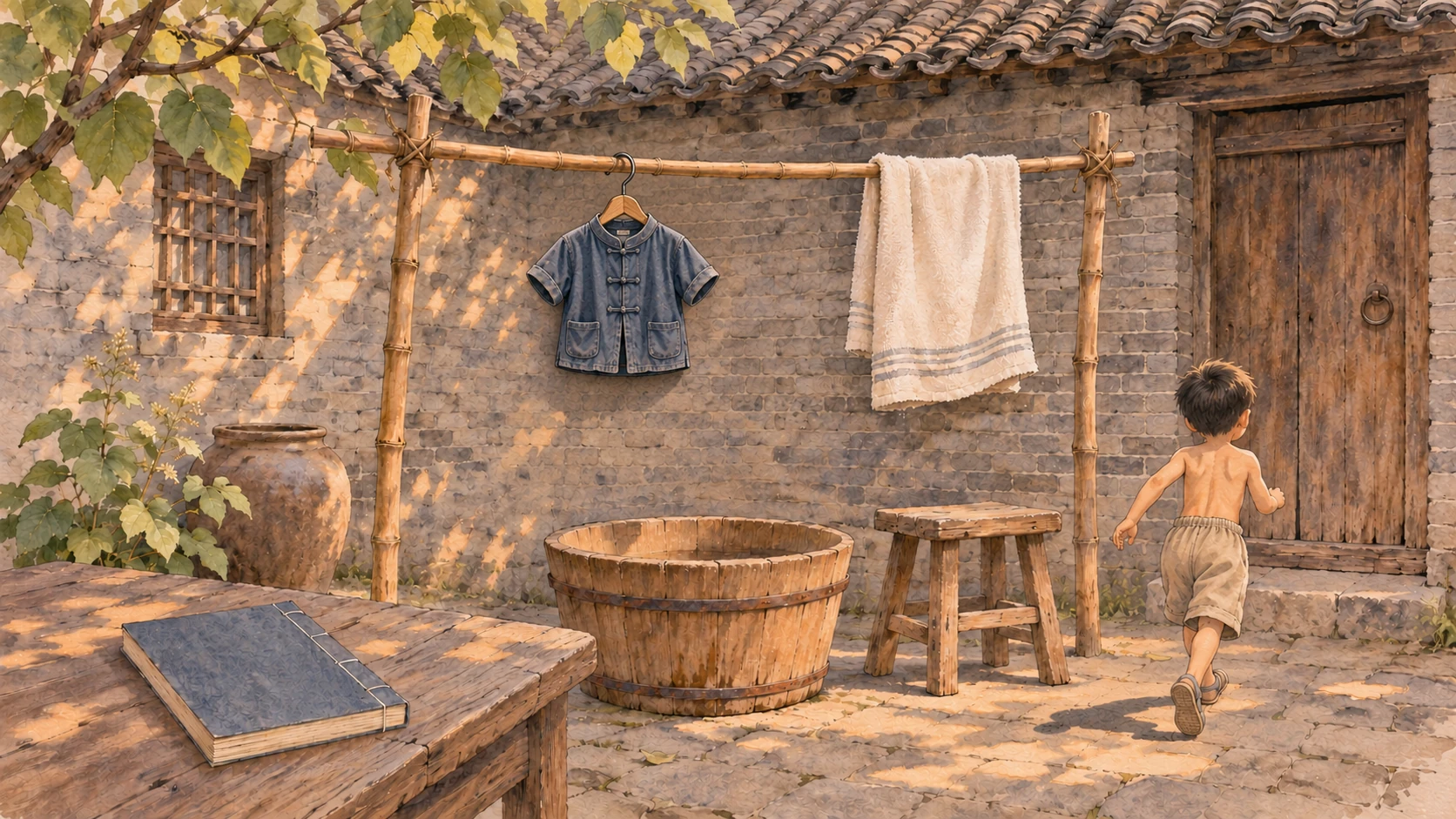
The use of 裼肚儿 in the Anyang article to recall a childhood friend is particularly revealing of the expression's conversational flavor. The speaker is saying that the two have known each other since childhood, casually bringing a childhood scene into the conversation.[2]
A recording of a local speaker, accompanied by the county or village, the speaker's age and a complete sentence, would help establish the tone of the final syllable and clarify what “裼吧肚”, 裼肚儿 and 裼脊梁 each refer to in different places.
References
- Dapu.com, “光肚不是我本意,本意是屁股” (What I Mean by Guangdu Is Bare Buttocks)
- Changshu Travel Notes, “安阳方言中的文化传承” (Cultural Heritage in the Anyang Dialect)
- Hanzi Dictionary (ZDIC), entry for “裼”, including the Shuowen Jiezi definition
- Book of Songs, “Airs of Zheng: Da Shu Yu Tian”, text and annotations
- Peng Lin, “周代裼袭礼辨疑” (Questions Concerning the Zhou Ritual of Tixi)
- Hanzi Dictionary (ZDIC), entry for “㞘”, including a quotation from Jiyun
